
FtFw: Enhancing Job Recommendations via Structured Field-to-Field Matching
Field selection for job categorization and recommendation to social network users
The paper introduces a "Field to Field Weighting" (FtFw) model for job categorization and recommendation within social networks. It leverages the inherent structure of job offers, user profiles (Facebook/LinkedIn), and job categories by calculating cross-field similarities to improve matching accuracy and reduce computational overhead.
TL;DR
Researchers from Centrale Paris and industry leaders (Multiposting/Work4) have developed the Field to Field Weighting (FtFw) model. By shifting from "bag-of-words" matching to a structured "field-to-field" similarity logic, they've boosted job recommendation accuracy on social networks while slashing the computational power required for real-time operations.
The Problem: The Noise in the Machine
In the world of e-recruitment, "Big Data" is often "Big Noise." Standard recommendation engines often aggregate all text from a user's LinkedIn profile and a job posting into two massive vectors and calculate a single cosine similarity.
The issue? A job seeker's "Interests" (like "Skiing") might dilute the importance of their "Professional Experience" when matched against a job's "Technical Requirements." Previous SOTA methods lacked the surgical precision to ignore noisy fields while emphasizing the high-signal ones.
Methodology: The FtFw Insight
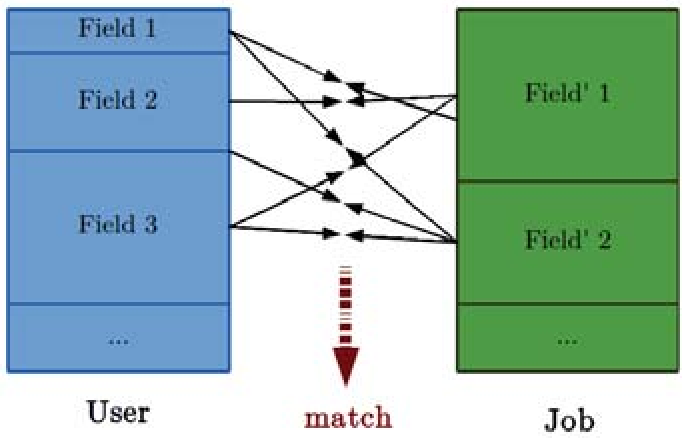
The core innovation lies in treating documents as a collection of vectors—one for each field (Title, Description, Skills, etc.)—rather than a single entity.
1. The Similarity Matrix
Instead of one similarity score, the model generates a Field to Field Similarity Matrix. For a user and a job , it computes: where and are specific fields.
2. Weighted Prediction
The final matching score is a weighted sum of these individual field similarities: By training an SVM on these weights (), the model learns which field pairings actually matter. For instance, it might learn that a user's "Headline" matching a job's "Title" is 10x more important than the "Bio" matching the "Company Description."
Experimental Results: Precision meets Efficiency
The team tested the model on real-world datasets from Facebook and LinkedIn.
SOTA Comparison
As shown in the table below, the FtFw model consistently outperformed Basic Cosine (BC) and standard Field Weighting (Fw) across multiple datasets, particularly in the complex "ALL" dataset where it achieved an AUC of 0.77 compared to the baseline's 0.43.
| Method | Review | Validation | ALL | Categorization |
|---|---|---|---|---|
| Basic Cosine (BC) | 0.63 | 0.66 | 0.43 | 0.80 |
| FtFw + SVM | 0.60* | 0.73 | 0.77 | 0.83 |
| *Note: In some subsets, variance is high, but the overall trend favors structured matching. |
The Power of Feature Selection
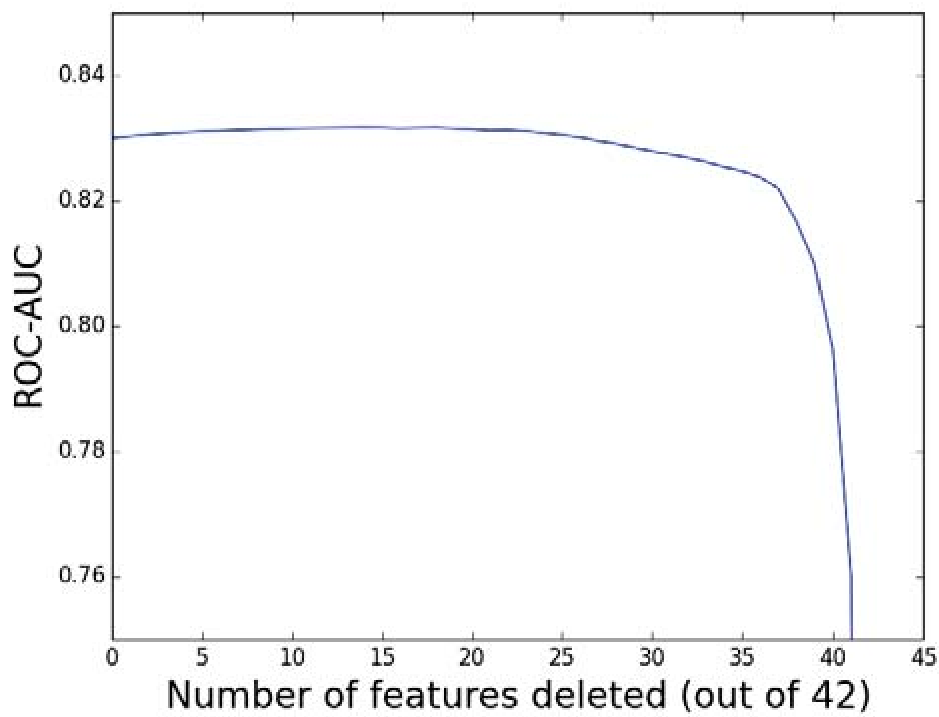
Perhaps the most impressive finding was the "knee" in the performance curve. The authors found that they could eliminate 90% of field pairings and still maintain peak performance. Using only 3 key field-to-field similarities yielded results nearly identical to using 42.
Critical Insight: Why Does This Work?
The authors' 95% confidence interval analysis reveals a fascinating truth about recruitment: Job Titles are everything. In the "Categorization" task, the correlation between the Job Title and the Category Title was the most stable and significant feature. Meanwhile, "Job Descriptions" were often found to be noisy and less reliable for automated matching due to boilerplate text.
Future Outlook & Limitations
The primary hurdle for FtFw is its dependency on structured data. The model excels when fields are clearly defined (as on LinkedIn), but struggles with raw PDF resumes. The authors propose that the next frontier is "Automated Field Detection"—using NLP to pre-segment unstructured text before applying the FtFw logic.
In conclusion, the paper proves that in the race for better AI recommendations, how you structure the data is just as important as the algorithm you use to process it.