
DIVER: Neutralizing Social Engineering via Strategic Link Recommendation
1714_Fighting Opinion Control in Social Networks via Link Recommendation.
The paper introduces DIVER, an NP-hard problem aimed at counteracting malicious opinion control in social networks by strategically recommending links. It utilizes a pseudo-linear-time heuristic based on Markov chain perturbation analysis to drive the network's average opinion back to its original state after an external attack.
TL;DR
Researchers have developed a method called DIVER to fight back against "opinion control" in social networks. Instead of deleting fake news or banning users, it recommends new links to users to shift the network's "gravitational center" of opinion back to a healthy state. By using Markov chain theory, it identifies which links can most effectively dilute malicious influence.
Context: The Gravity of Mass Opinion
In any social network, your opinion is rarely formed in a vacuum; it is an "attractor" process where users' views settle toward a weighted average. This average is dominated by Eigenvector Centrality—the idea that the more influential your neighbors are, the more your opinion carries weight.
Malicious actors (advertisers, state actors) target these central nodes to "hijack" the mass opinion. The challenge for platform operators is: How do you fix this without becoming a "Thought Police"?
The Problem: DIVER and NP-Hardness
The authors define the DIVER problem: given an altered opinion distribution , find a set of edges to add so that the new weighted average opinion matches the original .
This is inherently difficult because:
- Complexity: Searching for the best subset of edges is NP-hard.
- Sensitivity: Adding even one edge changes the centrality of every other node in the network.
Methodology: The "Physics" of a Network Link
To solve this, the authors moved beyond simple "what if" simulations to a formal Perturbation Analysis. They derived a formula representing how the entire eigencentrality vector shifts when a single edge is introduced.
1. The Power of MFPT
The core insight is the Mean First Passage Time (MFPT). While direct weights represent local trust, MFPT represents "global influence"—how fast information flows from node to node across all possible paths.
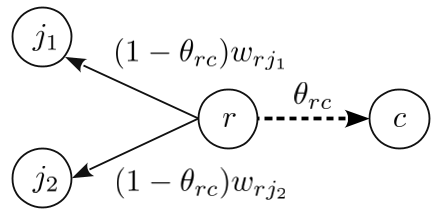 Figure: The structural logic of adding edge (r, c) to rebalance the network's influence distribution.
2. Scalable Heuristics
Calculating MFPT for a billion users is computationally impossible (). DIVER bypasses this with two "shortcuts":
- Focus on the Elite: Only consider edges from top-centrality nodes (sources) as they have the highest leverage.
- Random Walk Estimation: Instead of matrix inversion, they use finite-length random walks to estimate MFPTs, which converge rapidly for high-centrality nodes ( time).
Experimental Evidence
The authors tested DIVER against real-world data (Facebook and Epinions) and synthetic scale-free networks.
 Figure: DIVER (blue) vs. Baselines. Note how DIVER rapidly restores original opinion levels with minimal link additions.
The results show a clear "winner": DIVER restores the status quo much faster than "greedy" baselines that only look at local centrality. In BA (Barabási-Albert) networks, the recovery is almost immediate.
Critical Insight & Future Outlook
The most profound takeaway is that relative centrality matters more than absolute centrality. To counter a "celebrity" influencer, you don't necessarily just make them less popular; you connect them to "grounding" nodes that balance the ideological flow.
Limitations:
- Edge Acceptance: The model assumes users will accept the recommended links. In reality, "Friend Recommendations" have a low click-through rate.
- Dynamic Adversaries: The current model assumes a static attack; in reality, an attacker might respond by changing their strategy as the network evolves.
Conclusion
DIVER provides a mathematically rigorous framework for maintaining "informational hygiene" through structural updates. It moves the conversation from "censorship" to "architecture," suggesting that a well-connected society is its own best defense against opinion control.