
Fighting Organized Crime via Automated Financial Transaction Analysis
8787_Fighting organized crime by automatically detecting money laundering-related financial transactions.
The paper proposes an advanced Anti-Money Laundering (AML) detection model based on uniquely engineered financial features. Utilizing a Random Forest classifier, the system achieves a state-of-the-art accuracy of 95.44% and a recall of 97.22% on synthetic financial datasets.
TL;DR
This research tackles organized crime by introducing a rigorous, feature-based detection model for Money Laundering (ML). By moving beyond simple metadata to mathematically defined temporal and international behavioral features, the authors achieved an impressive 95.44% accuracy using a Random Forest classifier, significantly reducing the operational burden of false positives in banking systems.
Motivation: The Evolution of "Dirty" Money
Money laundering is no longer just a physical act of hiding cash; it has evolved into a digital, multi-stage process involving Placement, Layering, and Integration. As organized crime adapts to the digital era, financial institutions are drowning in millions of transactions daily.
The authors argue that existing Anti-Money Laundering (AML) systems suffer from three critical flaws:
- Lack of Reproducibility: Most studies use proprietary, undisclosed datasets.
- Poor Feature Definition: Features are often heuristic rather than mathematically formalized.
- Operational Inefficiency: High False Positive Rates (FPR) force analysts to waste time on legitimate customers.
Methodology: Formalizing Financial Intuition
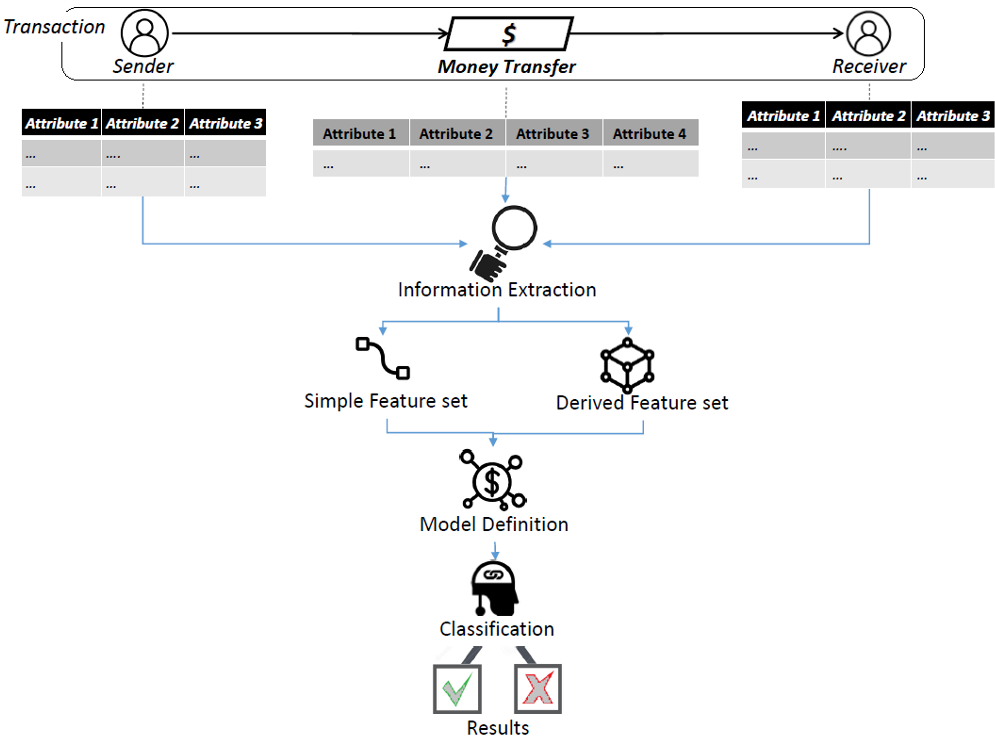
The core contribution is a robust feature-set that treats a transaction not as an isolated event, but as a data point within an entity's history.
The "Entity-Time-Flow" Framework
The authors proposed 9 feature groups (resulting in 27 total features when applied across 30, 60, and 90-day windows).
- Balance Difference (BD): Captures the volatility of an account's funds over time.
- Internationalization: Specifically distinguishes between domestic and foreign flows, crucial for identifying "Layering" stages.
- Temporal Windows: Analyzes counts and amounts across varying time horizons to detect "structuring" (breaking large sums into small transactions).
The methodology utilizes a mathematical notation to ensure consistency. For instance, the BalanceDifference () is formalized as: where .
Experiments and Results
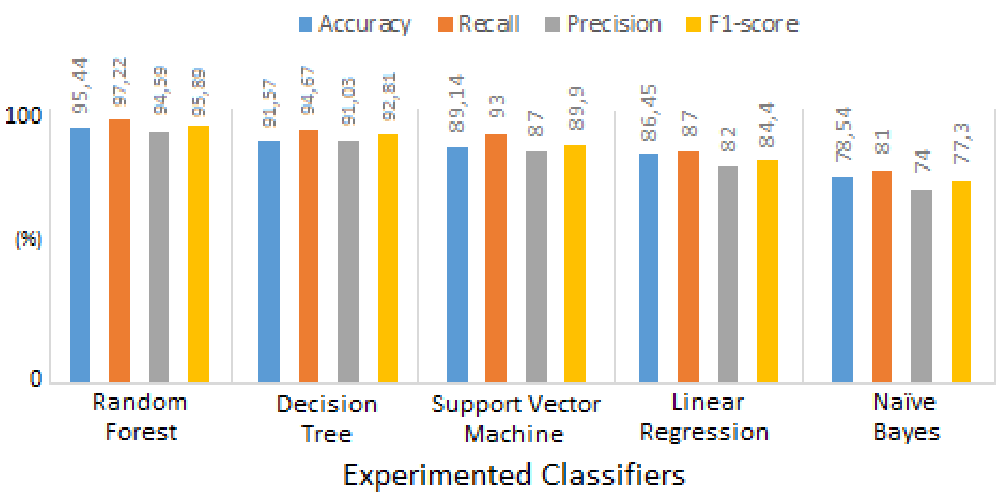
The model was tested using the Kaggle Paysim dataset, a synthetic yet realistic representation of mobile financial services. Five classifiers were compared: Random Forest (RF), Decision Tree (DT), Support Vector Machine (SVM), Linear Regression (LR), and Naïve Bayes (NB).
SOTA Performance Comparison
The results were clear: Random Forest is the champion of AML detection in this framework.
| Metric | Random Forest | Decision Tree |
|---|---|---|
| Accuracy | 95.44% | 91.57% |
| Recall | 97.22% | 94.67% |
| Precision | 94.59% | 91.03% |
| False Positive Rate | ~3% | ~7% |
Feature Importance: Why it Works
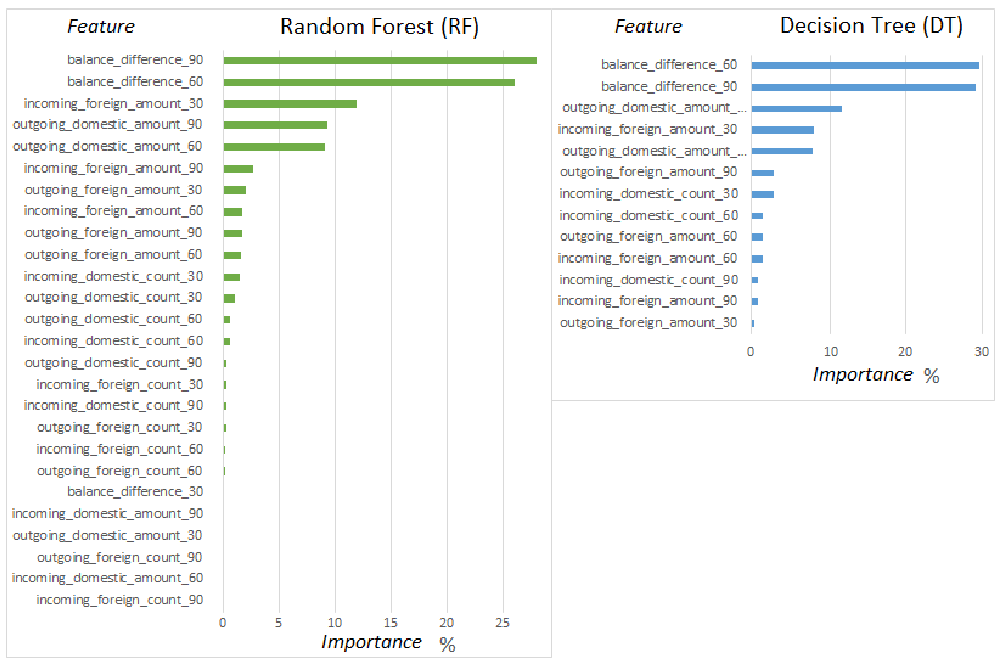
Through entropy-based analysis, the authors discovered that long-term balance changes (90-day and 60-day windows) and incoming foreign amounts are the most significant predictors of suspicious activity. This validates the "Layering" theory—criminals often move funds across borders and maintain high volatility in account balances.
Critical Insight & Conclusion
This work stands out for its interpretability. Unlike "Black Box" Neural Networks, the Random Forest approach allows bank analysts to see which features (like a 90-day balance shift) triggered the alert.
Limitations: The reliance on synthetic data is a double-edged sword. While it enables benchmarking, real-world "adversarial" money laundering (where criminals actively try to spoof these specific features) might require more dynamic, unsupervised learning components.
Future Outlook: The next frontier for this model is the integration of "Privacy-Preserving Computation," allowing banks to share these behavioral insights without exposing raw customer data.