
Fighting Spam on the Social Web: Beyond the Inbox
Fighting Spam on Social Web Sites
This paper provides a comprehensive survey of anti-spam strategies for social Web sites, categorizing countermeasures into detection, demotion, and prevention. It evaluates the impact of "social knowledge" (tag coincidence) and "resource constraints" (tag budgets) on mitigating spam in collaborative tagging environments.
TL;DR
Social Web sites are under siege by a new breed of spam. This paper, authored by experts at Stanford University, dissects the unique vulnerabilities of user-generated content platforms. By moving beyond traditional email filtering, the authors demonstrate that social knowledge (user coincidence) is a more effective weapon than simple resource limiting (budgets), reducing spam prominence by up to 50% in experimental settings.
Background: Why Your Inbox Filter Fails on Flickr
The rise of social platforms like Wikipedia and Flickr introduced a paradigm shift: the "Single Controlling Entity" model. Unlike the decentralized nature of Email (SMTP) or the open Web (HTTP), social sites have well-defined interactions and identity-tied content. However, this creates a "multiple interface" problem. A spammer doesn't just send a message; they attempt to hijack tag clouds, "most popular" lists, and search results simultaneously.
The Three Pillars of Defense
The authors categorize the anti-spam landscape into three strategic buckets:
- Detection (Identification-based): Using manual moderators or pattern-based classifiers (Source/Text/Link analysis) to label and delete malicious content.
- Demotion (Rank-based): Instead of deleting content, the system lowers its prominence. This is crucial for interfaces where "absolute truth" is subjective.
- Prevention (Interface/Limit-based): Implementing "friction" like CAPTCHAs or computational costs (HashCash) to make spamming economically unviable.
 Figure: The core taxonomy of countermeasures: Detection, Demotion, and Prevention.
Methodology: The Power of Social Coincidence
The most striking technical contribution is the Coincidence-based model. The intuition is simple: Reliability is a function of agreement. If User A tags a photo "Sunset" and fifty other people do the same, User A is deemed reliable. If User B tags the same photo "Cheap Mortgages" while no one else does, User B’s reliability score (Coincidence Factor) drops.
The rank of a document for a tag is calculated by normalizing the sum of reliability scores of all users who assigned that tag:
Results: The "Tag Budget" Paradox
The researchers conducted simulations to test two primary hypotheses:
- Does social knowledge help? Yes. Leveraging tag coincidences (Social Knowledge) cut the SpamFactor significantly compared to a simple frequency-based (Occurrence) model.
- Do limits help? It’s a double-edged sword. While a "tag budget" (limiting tags per user) restricts spammers, it disproportionately hurts "power users"—the very people who provide the ground truth for coincidence modeling.
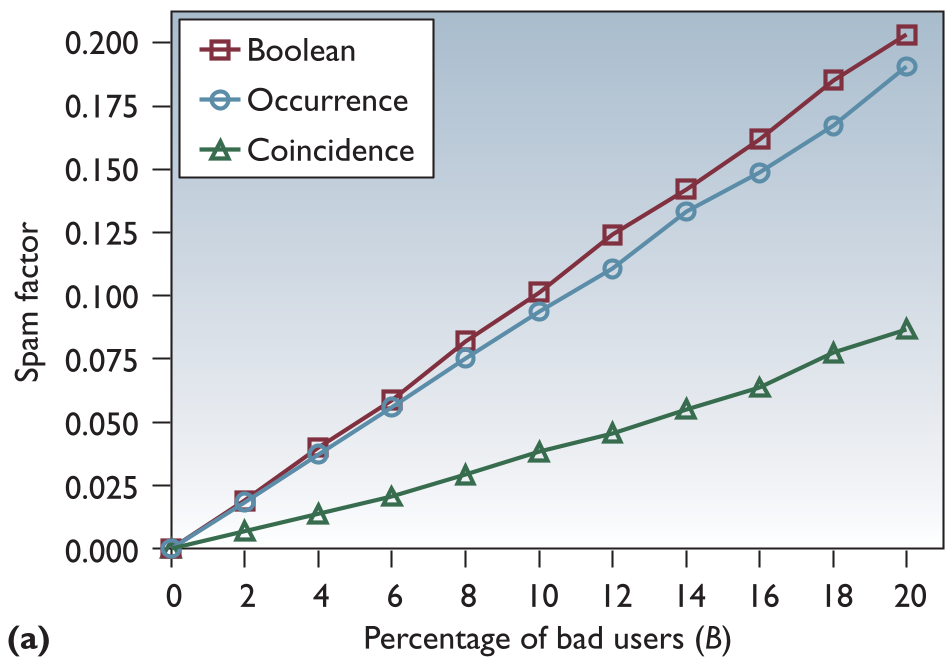 Figure: Performance comparison showing that Coincidence-based ranking (bottom line) maintains lower spam levels even as the population of bad users grows.
Critical Insight: The Unending Conflict
The authors conclude with a sobering reality: spam is a moving target. As we deploy more sophisticated "Rank-based" demotion, spammers will evolve to "Collusive Attacks," where groups of bots agree with each other to artificially inflate their Coincidence Factors.
The takeaway for platform architects is clear: Don't just build a wall (Prevention); build a reputation economy (Demotion). The future of social integrity lies not in stopping every bad actor, but in ensuring that the collective wisdom of the community naturally pushes the garbage to the bottom.
Summary
- Task: Survey and evaluate anti-spam for social tagging systems.
- Core Method: Coincidence-based user reliability ranking.
- Key Finding: Social agreement is a better signal than simple activity counts.
- Future Challenge: Combating sophisticated bot collusion.