
BNN and ANN: Revolutionizing Financial Distress Prediction in Bangladesh’s Banking Sector
Prediction of Financial Distress in Bangladesh’s Banking Sector Using Data Mining and Machine-Learning Technique
2020-01-01
Summary
Problem
Method
Results
Takeaways
The paper develops a Financial Distress Prediction (FDP) framework specifically for Bangladesh’s banking sector using Machine Learning techniques. It compares the performance of Artificial Neural Networks (ANN), Bayesian Neural Networks (BNN), and Support Vector Machines (SVM) against the traditional Altman Z-score benchmark.
## TL;DR
This study addresses the critical challenge of predicting bank failures in Bangladesh by moving beyond traditional formulas. Leveraging three years of financial data, researchers demonstrated that **Bayesian Neural Networks (BNN)** and **Artificial Neural Networks (ANN)** provide far superior predictive accuracy (up to 94%) compared to traditional **Support Vector Machines (SVM)** and the widely used **Altman Z-score**.
## Background & Motivation: Why Does Predicting Bank Failure Matter?
Banks are the circulatory system of a modern economy. In Bangladesh, where the sector comprises 57 institutions categorized into state-owned and private corporate banks, "Financial Distress"—defined as the inability to meet obligations to creditors—can trigger national economic instability.
Historically, analysts used the **Altman Z-score**, a linear discriminant model. However, financial markets are rarely linear. The authors recognized that existing research in Bangladesh was too reliant on manual statistical methods and lacked the sophisticated pattern recognition required to provide "Early Warning" signals.
## Methodology: Beyond the Altman Formula
The researchers extracted 20 financial items from balance sheets and cash flow statements to calculate **seven core features**, including ratios like:
* Current Assets / Total Assets
* Net Income / Total Assets (ROA)
* Cash Flow / Loans
### The Trio of Machine Learning Models
1. **Artificial Neural Networks (ANN)**: Utilizing back-propagation to learn non-linear relationships.
2. **Bayesian Neural Networks (BNN)**: A probabilistic approach that treats weights as distributions, effectively preventing **overfitting**—a common problem when dealing with the limited datasets typical of the Bangladeshi banking sector.
3. **Support Vector Machines (SVM)**: A kernel-trick based classifier used as a baseline for structural risk minimization.
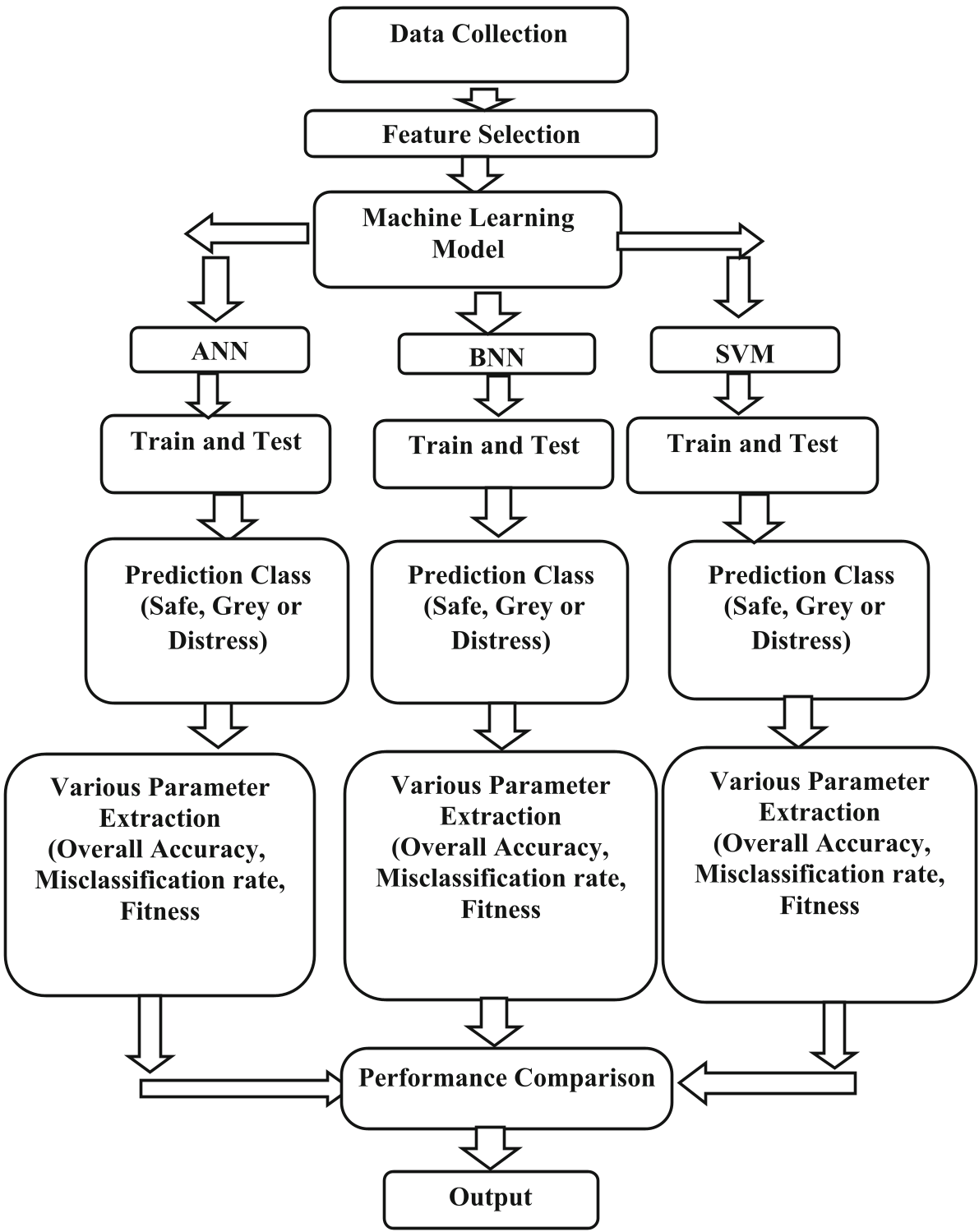
*Figure: The BNN approach provides a link between empirical data (D) and the hypothesis (H) using Bayes’ theorem to handle uncertainty.*
## Experimental Analysis: Financial Pulse of 2015-2017
The study classified 18 selected banks into three zones based on their Z-score: **Safe, Gray, and Distress**.
* **2015**: High stability (14 Safe banks).
* **2016**: A significant downturn, with 5 banks sliding into the Distress zone.
* **2017**: Partial recovery, with 4 banks remaining in distress.
### Performance Comparison
The competition between models was decisive. SVM struggled significantly, whereas the neural models excelled.
| Year | Model | Overall Performance |
| :--- | :--- | :--- |
| 2015 | **BNN** | **94.11%** |
| 2016 | ANN | 72.22% |
| 2017 | **BNN** | **88.88%** |
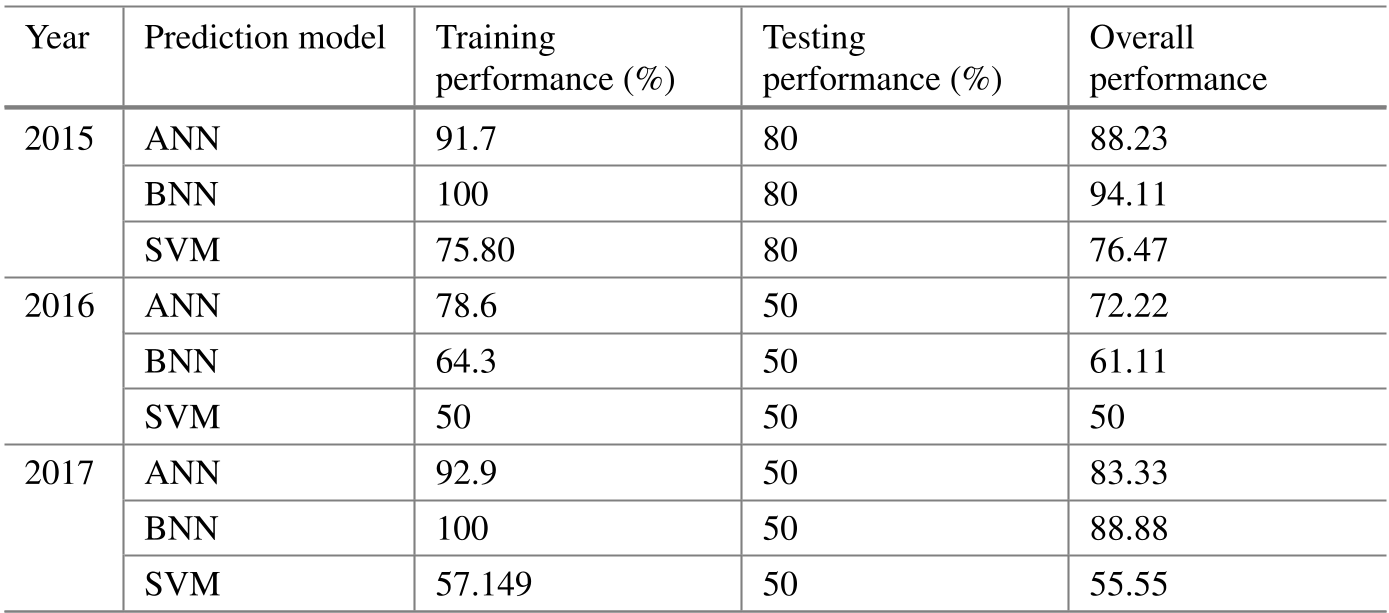
*Table: The superiority of BNN and ANN across different testing cycles.*
## Critical Insight: Why did BNN win?
The success of the **Bayesian Neural Network** is particularly noteworthy. In financial forecasting, data is often "noisy" and "sparse." BNNs excel here because they provide a measure of uncertainty. Unlike standard NNs that provide a point estimate, BNNs calculate errors related to projections, making them more robust against the "Out-of-Sample" biases that caused the SVM to perform poorly (often only hitting 50-55% accuracy).
## Conclusion & Future Outlook
The study concludes that for the Bangladeshi banking sector, **ANN and BNN should become the standard for insolvency prediction**. While the Altman Z-score provides a useful "zone" classification, machine learning models provide the precision needed for modern risk management.
**Limitations & Next Steps**:
* **Feature Expansion**: Future models could include qualitative data, such as corporate governance scores or management quality.
* **Dynamic Data**: Moving from annual reports to quarterly data could provide a more rapid early warning system.
* **Improving SVM**: The authors suggest that specialized kernels may be required to bring SVM performance closer to neural levels.
By integrating these AI models into regulatory frameworks, Bangladesh can build a more resilient financial wall against future economic shocks.