
Selective Socializing: Why Your Local Friend-Finding Strategy Is Probably Suboptimal
On Finding Better Friends in Social Networks
The paper investigates the dynamics of social network formation where nodes locally select friends to maximize personal welfare (sum of incident edge weights). It introduces the "Lookahead-Local Algorithm" and proves that limited local visibility leads to significant global sub-optimality in distributed social graphs.
TL;DR
In the quest for the perfect social circle, we are limited by "Dunbar's Number" (a cap on total friends) and our social reach (we usually meet people through current friends). This paper mathematically proves that no matter how smart your local strategy is, it can be arbitrarily worse than a global social optimum. However, by combining multiple "friend-finding" strategies, you can at least stay competitive with the best single strategy available.
The Problem: The Invisible Horizon of Socializing
Most game-theoretic models of stable matching assume you can see everyone in the market. In reality, social networks are visibility-constrained. If you want a new friend, you look at your friends' friends (a 2-hop lookahead).
The authors identify a critical tension: Should you be greedy (pick the best person you see now) or diverse (pick a variety of people to increase the number of "friends of friends" you might meet later)?
Methodology: The -Local Model
The researchers define a network where every edge has a quality .
- Welfare: The sum of qualities of a node's friends.
- -Lookahead: You can only propose to someone within hops of your current position in the graph.
- Stable State: A configuration where no node can improve its welfare by swapping a current friend for a visible acquaintance.
The "Track" Mechanism
To prove that local algorithms fail, the authors use a construction called a Track.
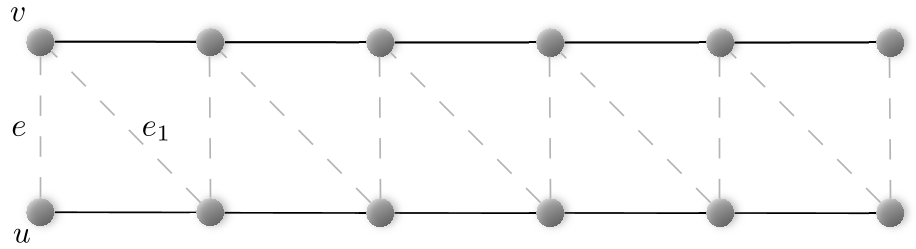 A track represents a path of potential friendships that only "unlocks" if you start at the beginning. If an algorithm ignores the first (low-quality) link, it never sees the high-value cluster at the end of the track.
Key Insights
1. Local vs. Global: The Wide Gap
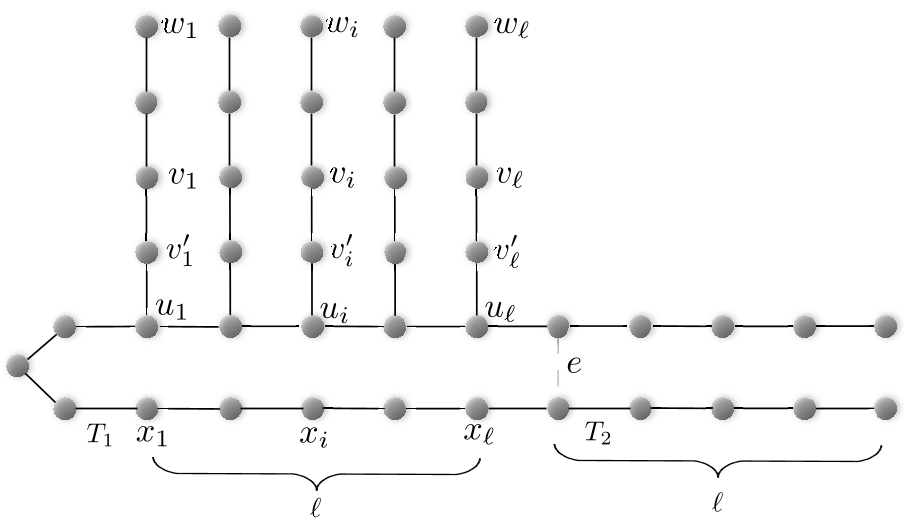
The paper proves that for any local algorithm, there is a graph where the global optimum achieves total welfare , while the local algorithm gets stuck at . Because the bridge between high-value clusters is "initially invisible" or "unattractive," local nodes never cross it.
2. No "Best" Local Algorithm
More surprisingly, the researchers prove there is no "Optimal Local Strategy."
- For every algorithm , there exists a scenario where algorithm outperforms it significantly.
- This is because any choice made to explore one "social track" might prematurely block another more valuable track that was hidden behind a different set of neighbors.
3. Parallelism as a Solution
If you can't find one perfect strategy, use several!
- The authors suggest running multiple local algorithms in parallel.
- At the end, nodes greedily select the best edges from the union of all proposed connections.
- Result: This achieves a 2-approximation compared to the best strategy in your portfolio.
Advanced Valuations: The Chaos of "Friends-of-Friends"
The paper also explores a model where you value a friend based on who their friends are.
- Instability: Unlike the basic model, this can lead to infinite cycling (similar to the Stable Roommate Problem).
- Non-Convergence: You might dump Friend A for Friend B because B has "cool" friends, but once you join B's circle, B's friends might leave, making Friend A attractive again.
Conclusion and Future Outlook
The study concludes that locality is a fundamental barrier to social efficiency. If we only meet people through our current circles, we are destined to live in suboptimal social "bubbles" unless we occasionally take "non-beneficial" risks or follow multiple diverse networking strategies simultaneously.
Future Work: The authors suggest looking into specific graph classes (like Small World networks) to see if the "local-global gap" shrinks in more realistic topologies.