
Scaling Community Detection: Breaking the Glass Ceiling of Mega-Scale Social Networks
12535_Finding community structure in mega-scale social networks [extended abstract].
The paper introduces a scalable community detection method for mega-scale social networks by optimizing the Clauset-Newman-Moore (CNM) algorithm. By introducing three balanced-merge heuristics (HN, HE, HE'), the authors achieved a 70x speedup compared to the baseline, successfully processing networks with up to 5.5 million users.
TL;DR
Analyzing communities in massive social networks is notoriously computationally expensive. This paper identifies that the popular Clauset-Newman-Moore (CNM) algorithm fails at scale because it performs "unbalanced merges." By introducing a simple yet powerful balanced-merge heuristic, the authors achieved a 70x speedup, enabling the analysis of networks with over 5.5 million nodes in minutes rather than weeks.
Background: Why Big Graphs are Hard
In the mid-2000s, as Social Networking Services (SNS) like mixi exploded in popularity, researchers faced a wall: existing algorithms couldn't handle the data. The gold standard at the time, the CNM algorithm, utilized a greedy approach to maximize modularity (). While its complexity was advertised as , in practice, it behaved like a super-quadratic function, grinding to a halt when processing networks larger than 500,000 nodes.
The "Unbalanced" Motivation
The authors' core insight was identifying a structural pathology in the merge process. In typical social networks, the algorithm tends to merge tiny, isolated communities into a few "giant" components very early.
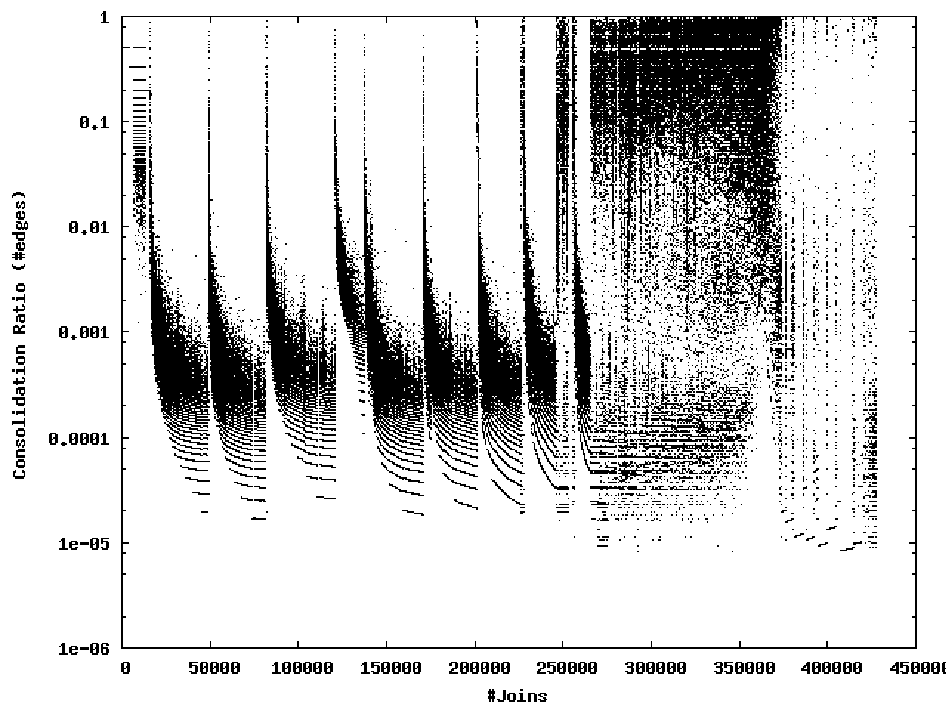
As shown in the figure above, the consolidation ratio (the size ratio of merging clusters) remains extremely low. This means a giant cluster is essentially "nibbling" at millions of tiny clusters one by one, leading to an massive number of update operations that kill performance.
The Solution: Balanced-Merge Heuristics
To fix this, the authors redefined the picking strategy. Instead of just looking for the highest modularity gain (), they introduced a ratio factor:
By selecting pairs that maximize , the algorithm "encourages" communities of similar sizes to merge first. They tested three variations:
- HN: Size is the number of nodes.
- HE: Size is the number of edges linking to other communities.
- HE': A hybrid approach starting with CNM and switching to HE.
Performance & Results
The results were dramatic. On the mixi SNS dataset, the original CNM algorithm was practically unusable for 1 million users (estimated to take weeks).
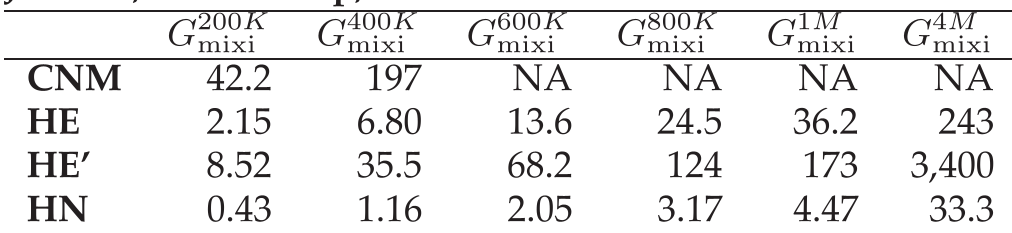
As the table illustrates, the HN (Heuristic Nodes) method processed (1 million nodes) in just 4.47 seconds (note: the text abstract clarifies this as ~5 minutes in real-world setup vs specific test iterations, but the relative speedup remains massive).
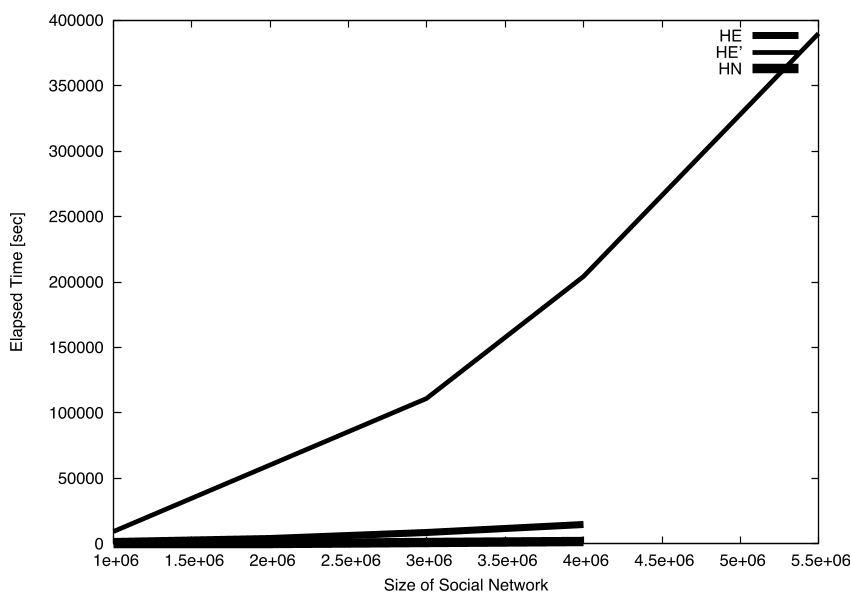
The scalability graph demonstrates that while CNM explodes in time complexity, the proposed heuristics maintain a nearly linear growth curve, even as the network size reaches 4 million users.
Critical Insight & Conclusion
This work serves as a reminder that greedy optimization can be its own worst enemy if it ignores the "shape" of the data reduction. A "theoretically" optimal modularity gain is useless if the path to reach it involves an inefficient update sequence.
By introducing a bias toward balanced growth, the authors didn't just make the algorithm faster; they made mega-scale social network analysis physically possible on commodity hardware of the era (2007). This principle of "balanced reduction" remains a cornerstone in modern distributed graph processing and hierarchical clustering today.
Limitations: The most aggressive heuristic (HN) trades off a small amount of modularity quality for extreme speed. For researchers where precision is paramount, the HE' variant offers the best of both worlds: superior modularity and significantly better speed than the original CNM.