
From Noise to Opportunity: Leveraging Marketing Brochures to Find Buyers on Social Media
Finding Demand for Products in the Social Web
The paper introduces "Noise to Opportunity," a system designed to identify potential sales leads by detecting product demand in social media posts. The core method utilizes a two-stage text categorization pipeline—identifying "demand" first, then classifying the specific "product"—achieving high precision for sales lead generation.
TL;DR
Converting social network "noise" into actionable sales opportunities is notoriously difficult due to the vast differences between formal marketing speak and informal user posts. This paper presents a two-stage classification system that first identifies "demand" (intent) and then "product" (category). By slicing long marketing brochures into small fragments, the authors successfully trained a high-precision lead detection engine without requiring salesmen to manually label thousands of posts.
The "Document Mismatch" Challenge
For a B2B company, the best time to reach a customer is when they are actively seeking recommendations. However, finding these "needles in the haystack" on platforms like LinkedIn is a manual slog.
The researchers identified three core technical hurdles:
- Non-user Perspective: Marketing brochures are written by sellers, while posts are written by seekers.
- Document Mismatch: Length and style vary wildly; brochures are pages long, whereas posts are a few sentences.
- Small Corpus: Most companies only have a handful of brochures per product, leading to data sparsity.
Methodology: The Two-Stage Pipeline
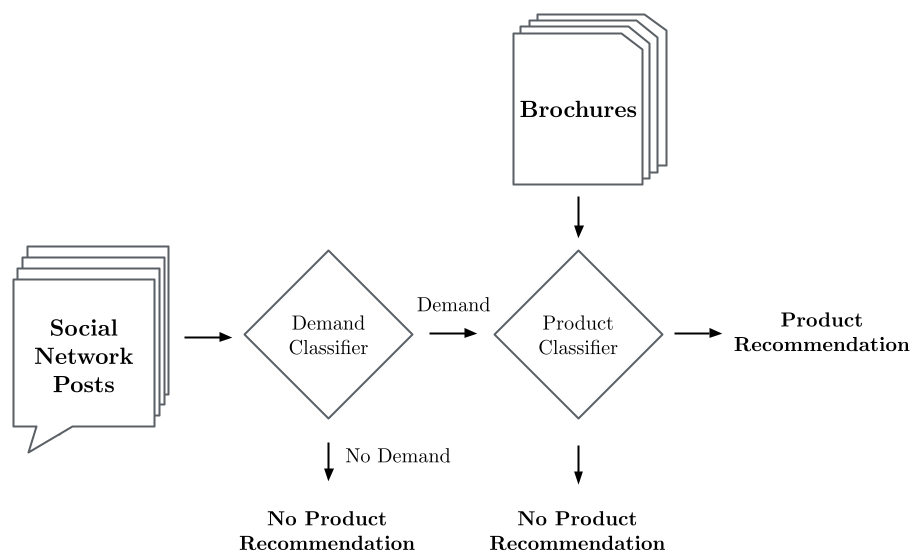
The breakthrough intuition of this work is that Intent and Topic are independent variables. A post might mention a product (Topic) but not want to buy it (Negative Intent).
The system architecture, as shown below, separates these concerns:
Stage 1: Demand Detection
The authors used a Bernoulli Naive Bayes model. Why Bernoulli? Because in short texts with a small vocabulary, the absence of certain words is just as predictive as their presence. They focused on "demand words" like recommend, help, looking for, and anyone.
Stage 2: Product Identification
To handle the "Small Corpus" problem, the authors introduced Document Sampling. They split long brochures into groups of sentences (Grouping Strategy) to mimic the length of a social media post. This artificially expanded the training set and aligned the document lengths between the training (brochures) and testing (posts) domains.
Experimental Results & Critical Insights
The evaluation focused on high-precision outcomes, as salesmen's time is expensive.
- Feature Selection Matters: The study found that picking only the top 10 keywords via TF-IDF yielded the best results. Being "strict" prevents the model from over-fitting on formal marketing jargon that never appears in casual posts.
- The Power of Two Stages: The 12% performance jump when moving from a single classifier to a two-stage model proves that "intent" often confuses "topic" classifiers.
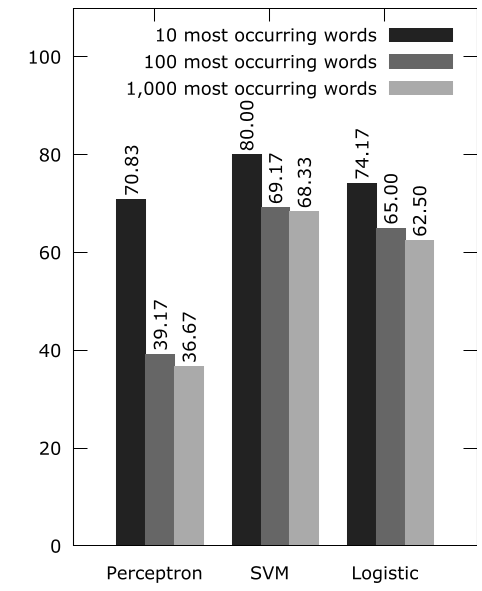 In the chart above, linear models like Logistic Regression and SVM outperformed earlier k-NN baselines significantly when paired with normalization.
Conclusion and Future Outlook
This research provides a pragmatic blueprint for Small-to-Medium Enterprises (SMEs) to build custom lead-gen tools. By using Active Learning to build a small "Gold Standard" and leveraging existing brochures through fragmenting, companies can bypass the need for massive labeled datasets.
Limitations: The reliance on machine translation for cross-lingual support (German brochures to English posts) is a potential bottleneck, though the authors noted it actually improved their results by increasing data diversity. In a modern context, leveraging LLMs for this "translation" or "fragmenting" role would likely push performance even further.
Takeaway: Don't just look for product keywords; look for the shape of a question.