
Scaling Graph Mining: Weighted Strategies for Longitudinal Social Networks
Finding Frequent Subgraphs in Longitudinal Social Network Data Using a Weighted Graph Mining Approach
The paper introduces a weighted approach to Frequent Subgraph Mining (FSM) specifically for longitudinal social network data. It proposes three weighting schemes—AMW, AW, and UBW—integrated into the gSpan algorithm to handle the high computational complexity of massive temporal networks like the UK Cattle Tracking System (CTS).
TL;DR
Analyzing how social networks evolve over time (longitudinal data) is computationally expensive. This paper introduces three weighting schemes—AMW, AW, and UBW—that integrate into the gSpan algorithm. By focusing on the "significance" of nodes and links, these methods allow researchers to mine massive datasets, like the UK Cattle Tracking System, which were previously impossible to process using standard frequent subgraph mining.
The Scalability Wall in Social Network Mining
Social Network Mining (SNM) often seeks "frequent subgraphs"—recurring structures that represent common behaviors. However, when we add the temporal dimension (a sequence of network snapshots), the data volume explodes.
The main bottlenecks are:
- Candidate Generation: An exponential number of potential subgraphs to check.
- Subgraph Isomorphism: Determining if a pattern exists within a larger graph is NP-complete.
- Redundancy: Standard algorithms treat every connection equally, flooding the results with thousands of trivial patterns.
The authors argue that not all nodes and links are equal. By weighting them, we can prune unimportant branches of the search space early.
Methodology: Three Heavily Weighted Ideas
The authors propose moving from standard support counts to weighted support.
1. Average Mutual Information Based Weighting (AMW)
AMW uses an information-theoretic approach. It calculates weights based on the Pointwise Mutual Information (PMI) between nodes. If two nodes often move together relative to their individual movement frequency, they are given higher significance.
- Strategic Advantage: It satisfies the anti-monotone property, meaning if a small graph is infrequent, its larger versions are also guaranteed to be infrequent, allowing for massive pruning.
2. Affinity Weighting (AW)
AW focuses on "node distance" and "weight ratios." It calculates how much of the original graph a subgraph covers. It forces the algorithm to prioritize subgraphs that represent a cohesive "affinity" between members.
- Pruning Condition: Candidates are discarded if they don't meet a minimum weighted support and a specific weighting ratio threshold.
3. Utility-Based Weighting (UBW)
Drawing from "share-based" itemset mining, UBW uses the Jaccard similarity coefficient. It doesn't naturally follow the anti-monotone property, so the authors developed a specific theorem (Theorem 1) to provide a pruning upper bound.
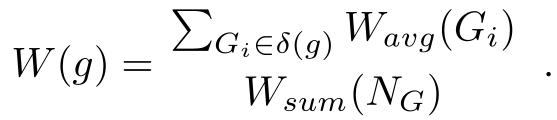 The weighting functions (like the one above for AMW) redefine how 'frequency' is calculated across time steps.
Experiments: The Great Britain Cattle Network
The study used the Cattle Tracking System (CTS) database, tracking every animal movement in GB over a year (52 weekly snapshots).
| Dataset | Max Nodes | Max Links |
|---|---|---|
| Derbyshire | 227 | 179 |
| Lancashire | 396 | 394 |
| Great Britain (Total) | 23,660 | 30,107 |
Key Findings:
- Survival of the Heaviest: The extended non-weighted gSpan (extGspan) crashed on the full GB dataset due to memory errors. The weighted versions (AW, AMW) completed the task successfully.
- Efficiency vs. Discovery: AMW-gSpan was the most "economical," maintaining steady runtimes even as the support threshold dropped. UBW-gSpan was the most "strict," finding the smallest set of high-utility patterns but requiring more computation time.
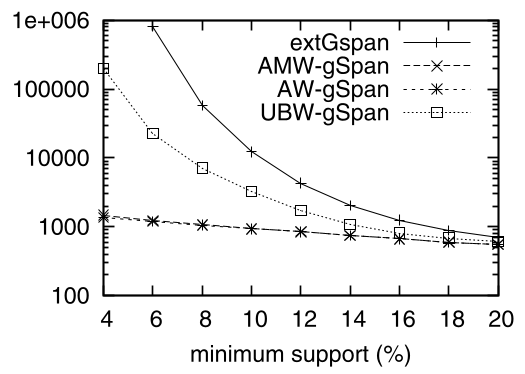 Performance of weighting schemes vs. standard gSpan. Note how standard gSpan's pattern count (extGspan) explodes as support decreases.
Beyond Static Graphs: Tracking Behavior Changes
The real value of these discovered subgraphs is using them as "building blocks" for Sequential Pattern Mining. By representing each time step as a set of frequent weighted subgraphs, the researchers applied the PrefixSpan algorithm to see how entire clusters of cattle movement evolve.
They discovered specific "hub" locations (e.g., location ID 266329912) where movement patterns followed a strict sequence over several weeks, revealing the "pulse" of the agricultural network.
Critical Insight & Conclusion
The transition from quantitative mining (how often?) to qualitative weighted mining (how significant?) is essential for temporal data.
- Contribution: The paper successfully bridges the gap between traditional FSM and heavy-duty longitudinal data.
- Limitation: The choice of weighting parameters ( and ) requires domain expertise; a "bad" weight could potentially prune useful outliers.
- Future Impact: This framework is highly applicable beyond cattle tracking—think of anti-money laundering (AML) where specific transaction "shapes" between accounts are more important than just volume, or tracking disease spread in epidemiology.
Summary Takeaway
If you're drowning in redundant graph patterns or your mining algorithm is crashing on large datasets, weighted pruning isn't just an optimization—it’s a necessity for extracting meaningful "behavioral signatures" from longitudinal data.