
Finding Your Social Space: The Evolutionary Journey of Online Socializing
Finding Your Social Space: Empirical Study of Social Exploration in Multiplayer Online Games
This paper introduces a data-driven framework to study "social exploration" in MMORPGs, specifically identifying four distinct social behavior types: Lone Wolf, Small Pack Wolf, Large Pack Wolf, and Social Butterfly. Using unsupervised clustering on Sony Everquest II logs, the authors demonstrate that players undergo a "social settling in" process, migrating from large, weak-tied groups to smaller, more stable, and cohesive social units.
TL;DR
In the vast digital landscapes of MMORPGs, players don't just "play"—they explore social identities. This paper analyzes years of activity from Sony Everquest II to reveal a natural lifecycle of online friendship. The core finding? Most players start as "Social Butterflies" with many weak ties but inevitably "settle in" to become "Lone Wolves" or members of "Small Packs" with deep, stable connections. This "social settling" is a fundamental human process of discovering one's social aspirations.
The Social Discovery Gap: Why Do We Explore?
Most research into online games treats social groups as static entities. We talk about guilds as if they are permanent fixtures. However, this paper argues that there is a critical preceding step: Social Exploration.
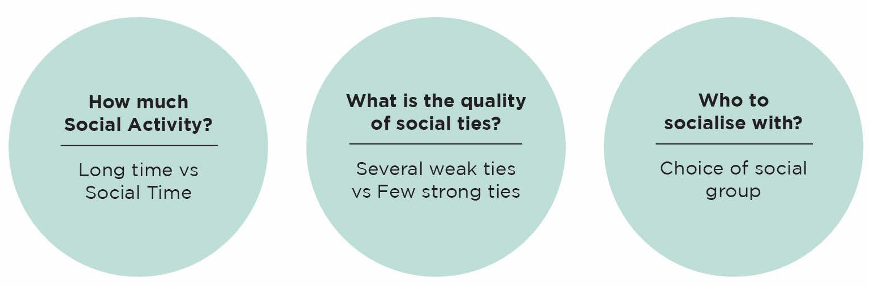
Before a player commits to a group, they must answer three internal questions:
- Personal vs. Social Balance: How much "me time" do I need?
- Breadth vs. Depth: Do I want 100 acquaintances or 3 best friends?
- Group Fit: Which specific community aligns with my playstyle?
The authors argue that existing literature missed the transient nature of these phases, failing to observe how players move between different "social spaces" over time.
Methodology: Mapping the Social DNA
The research team extracted logs from four weeks of gameplay, clustering players based on three primary metrics:
- Number of Neighbors: How many unique people did you play with?
- Fraction of Group Sessions: What percentage of your time was social?
- Average Tie Strength: The ratio of group sessions to total neighbors (High = deep bonds; Low = superficial interactions).
Using the "Elbow Method" on k-means clustering, they identified four distinct archetypes:
The Four Social Archetypes
- Lone Wolf (LW): Few neighbors, but very high tie strength. They have "settled" into a tiny, elite circle.
- Small Pack Wolf (PWS): Moderate socialization with stronger-than-average bonds.
- Large Pack Wolf (PWL): High socialization but lower tie strength; likely part of a massive, loosely-knit guild.
- Social Butterfly (SB): The extreme of social breadth. Hundreds of neighbors but almost zero tie strength.
Results: The "Settling In" Phenomenon
By tracking Player Behavior Paths (Bpaths) over 4 weeks, the study uncovered a fascinating longitudinal trend.
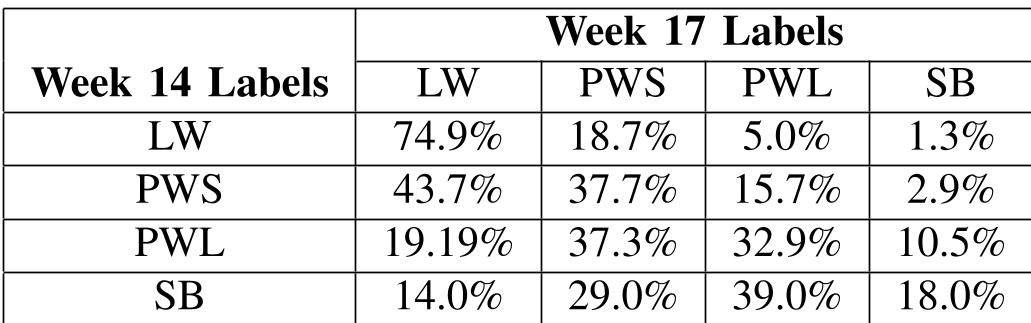
- The Stability of Loneliness: 74.9% of Lone Wolves remained Lone Wolves. Once a player finds their rhythm or their small tight group, they rarely change.
- The Transience of Butterflies: Only 18% of Social Butterflies stayed that way. The "Butterfly" state is commercially and socially taxing—it’s an exploration phase, not a destination.
- The Progression: The data showed a one-way street. Players frequently move from high-breadth (SB/PWL) to low-breadth (PWS/LW), but they rarely move backward. This is "Social Settling."
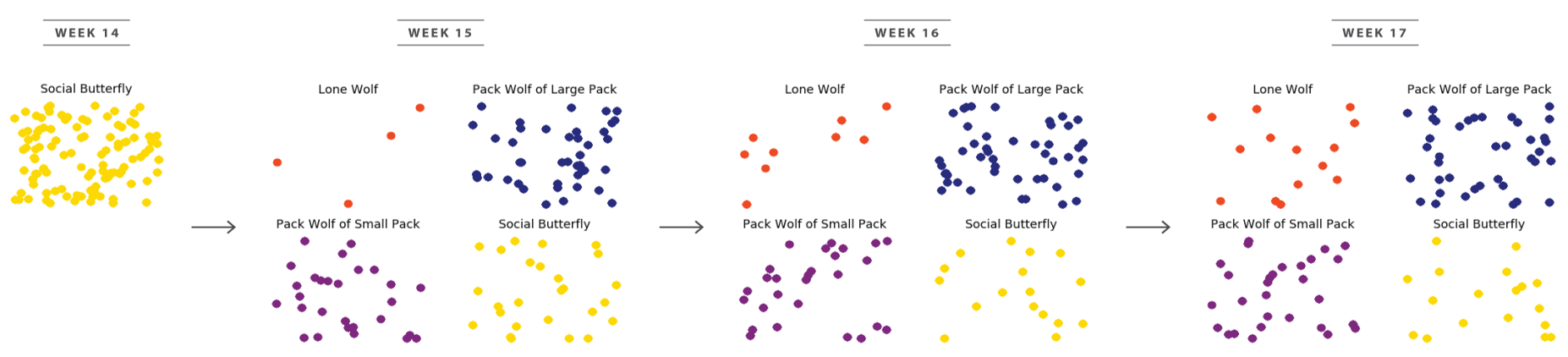 (Above: The thinning density of Social Butterfly states over time as they transition into more stable behaviors)
Critical Insight & Conclusion
The "Social Butterfly" isn’t just a personality type—it’s often a functional state. Players enter this high-activity mode to learn game strategies, find better loot groups, or search for a new "pack" after their old one churns.
The Takeaway for Game Designers: Don't try to force extroversion forever. High-breadth social tools (like massive chat channels or public matchmaking) are essential for exploration, but long-term retention depends on facilitating the transition into Small Packs. If a player can't find their "social space" to settle into, they aren't just a Lone Wolf—they are a churn risk.
Limitations
While the study provides a robust look at behavior, the 4-week window is relatively short. Future research could investigate if these "settled" players eventually re-enter an exploration phase after reaching "end-game" content or experiencing social conflict.
Blog based on "Finding your social space: empirical study of social exploration in multiplayer online games" (ASONAM '19).