
Identifying Trendsetters: Moving Beyond the "Million Follower Fallacy" on Yelp
Finding Trendsetters on Yelp Dataset
This paper introduces a Big Data analytics approach to identify "Trendsetters" within the Yelp social network by combining temporal diffusion patterns with graph topology. Using a specialized Trendsetter (TS) algorithm, the researchers successfully pinpointed users who act as both early adopters and influential information multipliers, outperforming traditional PageRank and Centrality measures in predicting peer influence.
TL;DR
In the world of social media, being popular isn't the same as being influential. This paper explores how to find Trendsetters on Yelp—the rare breed of users who discover "the next big thing" before it peaks and successfully drive their friends to follow suit. By employing a specialized Trendsetter ranking algorithm that blends temporal data with graph theory, the authors prove that traditional metrics like PageRank are often blindsided by "passive popularity" and fail to capture real-world influence.
The Core Challenge: Why Popularity is Deceptive
Most social media strategies focus on In-degree (how many followers someone has). However, research points to a phenomenon called the "Million Follower Fallacy": a user might have a massive following but zero ability to actually trigger action.
The authors argue that to find a true Trendsetter, we must look for two things:
- Innovation: The tendency to pick up on a business before it becomes a mainstream hit.
- Propagation: The ability to spread that choice through a social network effectively.
Methodology: Mapping Modern Influence
The research team utilized the Yelp Challenge dataset, focusing on businesses that exhibited "trending" behavior.
1. Defining Popularity via "Tips"
The authors discovered that "Tips" (short, quick updates) are a better proxy for real-time popularity than "Reviews" (long-form content). Tips showed a 0.85 Pearson Correlation with actual business Check-ins.
2. The Trendsetter (TS) Algorithm
Unlike static algorithms, the TS algorithm uses a recursive formula to calculate a node's value based on its social influence over time:
 The formula balances a probability distribution with the weighted influence of incoming edges, iterating until the values stabilize.
Experiments and Visual Evidence
The team compared four algorithms: In-degree, Eigenvector Centrality, PageRank, and the Trendsetter (TS) algorithm.
Quantitative: Who arrives first?
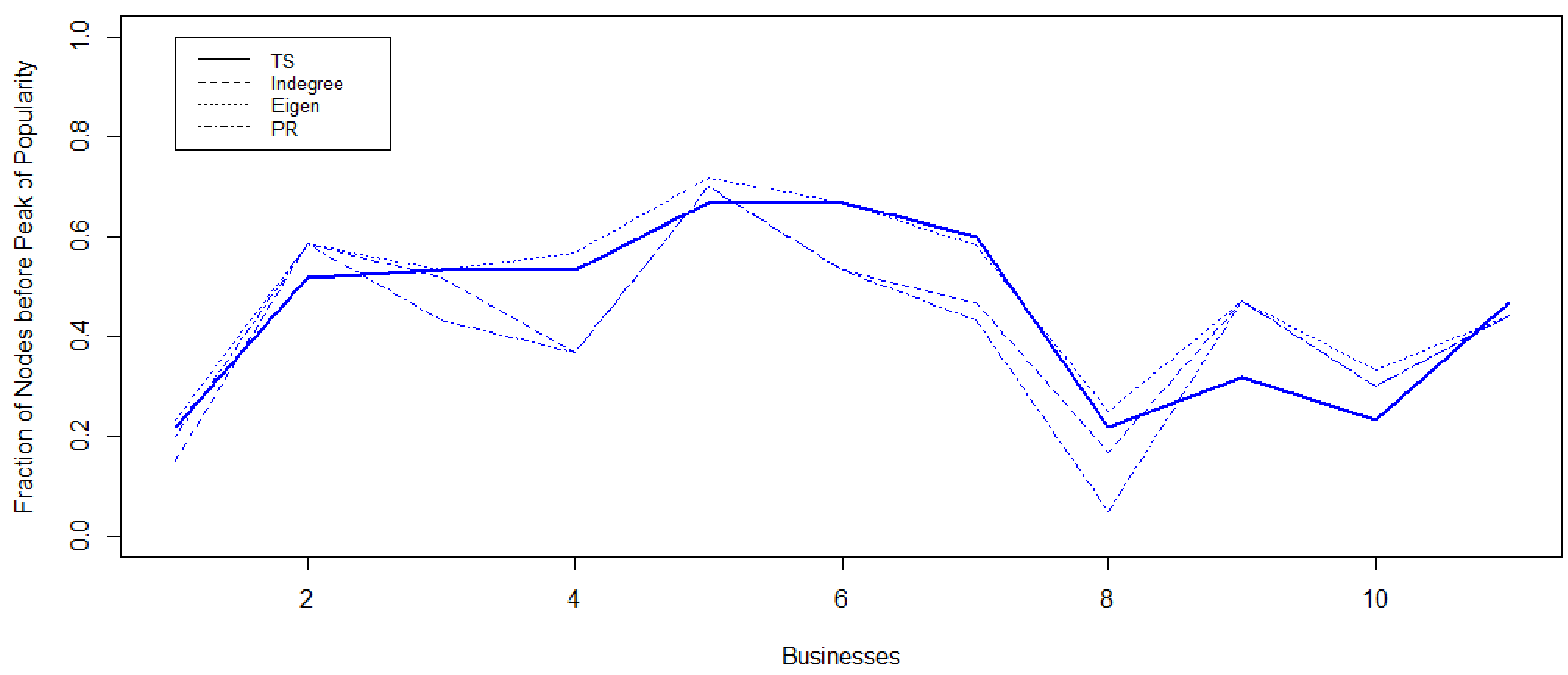
As shown in the charts below, the TS algorithm and Eigenvector centrality were neck-and-neck in identifying users who interacted with a business before it reached its popularity peak.
Qualitative: Who actually influences friends?
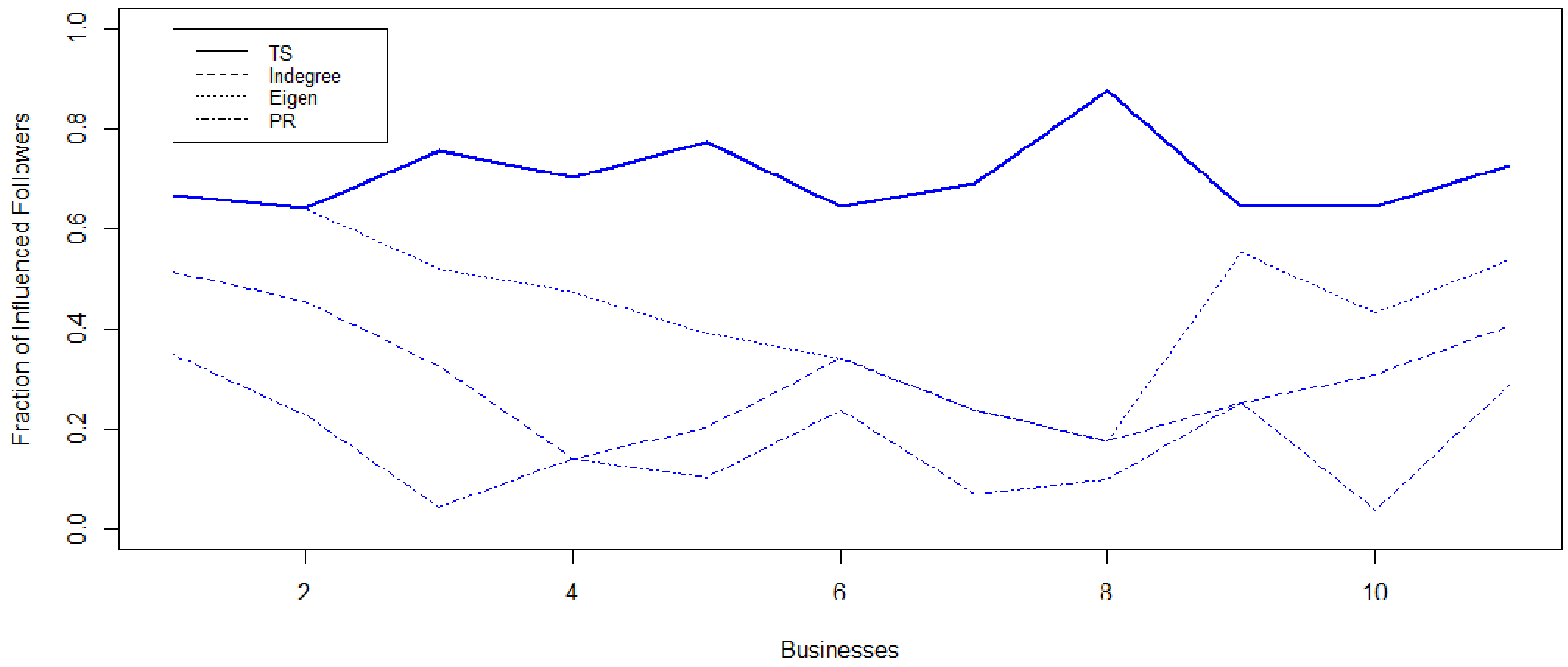
This is where the TS algorithm truly shined. It consistently identified users whose friends were most likely to visit a business after the user's tip. Predictably, PageRank—designed for web page authority rather than human social dynamics—performed the worst in this social propagation metric.
Critical Insight & Future Outlook
The biggest takeaway is that time causality is the missing link in most social analytics. A user who reviews a restaurant after 1,000 other people is just a participant; a user who reviews it when it only has 5 tips—and then sees 20 of their friends show up—is a Trendsetter.
Limitations: The study notes that Yelp's dataset can sometimes be segmented and skewed. Future research could further improve accuracy by integrating the exact timestamps of "Check-ins," which provide a more granular view of physical foot traffic than a text-based Tip or Review might provide.
Conclusion: For businesses looking to maximize marketing ROI, the message is clear: stop chasing the accounts with the most followers. Start chasing the innovators who have the "social grip" to pull their network into a new trend.