
NCL: Revolutionizing Medical Concept Linking with Composite Attentional Neural Networks
Fine-grained Concept Linking using Neural Networks in Healthcare
The paper introduces Neural Concept Linking (NCL), a novel framework for mapping healthcare text snippets to canonical medical concepts. It utilizes a custom COMposite AttentIonal encode-Decode (COM-AID) neural network to overcome word discrepancies and semantic overlaps, achieving SOTA accuracy on real-world medical datasets.
Executive Summary
TL;DR: Linking noisy clinician notes (e.g., "ckd 5") to precise medical codes (ICD-10: N18.5) is a bottleneck in healthcare analytics. This paper presents Neural Concept Linking (NCL), an end-to-end framework featuring the COM-AID architecture. By treating concept linking as a semantic translation task and integrating hierarchical ontology data via a dual-attention mechanism, NCL achieves a paradigm shift in accuracy over traditional dictionary-based tools.
This work marks the first significant application of deep neural "encode-decode" processes to fine-grained medical concept mapping, moving beyond simple keyword matching to deep semantic understanding.
The Problem: The "Translation" Gap in Healthcare
In modern hospitals, data is abundant but messy. A clinician might write "abdomen pain," while the formal ICD code description is "unspecified abdominal pain." This creates two massive hurdles:
- Word Discrepancy: Diverse writing styles, abbreviations ("ckd" for chronic kidney disease), and typos make string matching unreliable.
- Semantic Overlap: Fine-grained concepts (e.g., different types of anemia) are so similar that standard machine learning models struggle to distinguish them without more context.
Existing tools like MetaMap or NOBLECoder rely on static dictionaries. If the word isn't in the book, the system fails.
Methodology: The COM-AID Architecture
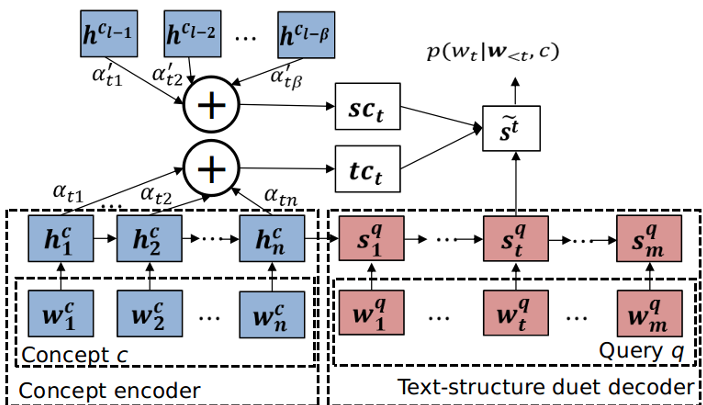
The authors propose COM-AID (COMposite AttentIonal encode-Decode), which views the concept-to-query relationship as a translation problem.
1. Concept Encoder
The encoder takes a canonical concept description from a Knowledge Base (KB) and converts it into a high-dimensional vector (hidden state ).
2. Text-Structure Duet Decoder
This is where the magic happens. Unlike a standard translator, the decoder uses two "eyes" (attentions):
- Textual Attention: It focuses on the most relevant words in the formal description to match the query.
- Structural Attention: It looks "up" the ontology tree. If a concept is a sub-type of "Anemia," the model incorporates information from the parent concepts to ensure the context is correct.
3. Concept-Aware Pre-training
Traditional word embeddings (like Word2Vec) might group different nutrients (Iron vs. Folate) too closely because they appear in similar sentences. NCL fixes this by injecting unique concept IDs into the training text, forcing the model to learn that "Iron" and "Folate" lead to distinct medical outcomes.
Experimental Results: Dominating the Baselines
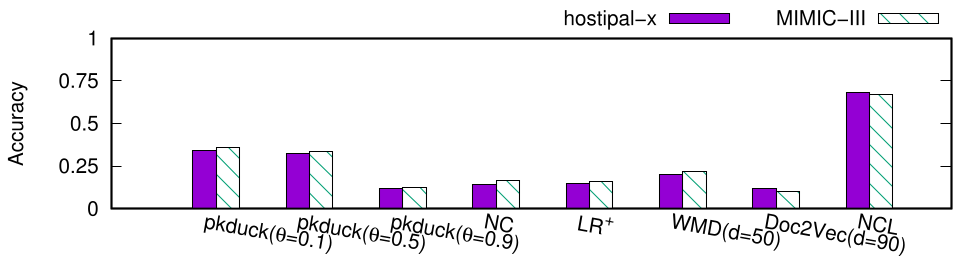
The researchers tested NCL on two massive datasets: hospital-x (Singapore) and MIMIC-III (USA).
- Accuracy Boost: NCL consistently outperformed dictionary-based (NOBLECoder) and standard ML (Logistic Regression) by wide margins.
- Ablation Success: Removing the "Structural Attention" (structural context) led to an immediate 8% drop in accuracy, proving that medical hierarchies are vital for disambiguation.
Deep Insights & Conclusion
The core takeaway of this paper is that structure matters. By mathematically formalizing the "ancestral" relationship of medical codes and feeding that into a neural decoder, the authors solved the "minor meaning difference" problem that has plagued the industry for decades.
Limitations: While powerful, the model still struggles with extremely rare words (out-of-vocabulary) that appear neither in the KB nor the clinical training set. Future work likely involves utilizing Large Language Models (LLMs) to provide even broader linguistic common sense to the NCL framework.
Final Verdict: NCL is a masterclass in combining domain-specific structural knowledge (Ontologies) with modern NLP (Sequence-to-Sequence attention), setting a new standard for medical data integration.