
FBI: Precision Engineering for Social Influence Evaluation
Fine-Grained Feature-Based Social Influence Evaluation in Online Social Networks
The paper introduces FBI (Feature-Based Influence), a fine-grained model for evaluating user influence in Online Social Networks (OSNs). It integrates multi-dimensional features (topics, profiles), tie strengths, and local network topology using an iterative adjustment algorithm inspired by PageRank.
TL;DR
Quantifying "influence" in a social network has long suffered from the "Resolution Problem"—where thousands of users end up with the same score. The FBI (Feature-Based Influence) model solves this by decomposing influence into fine-grained features, tie strengths, and the structural "bridge" effect of common neighbors. By applying a PageRank-style iterative adjustment, the authors reduced score duplication from 80% down to 7% while identifying higher-quality "seed" influencers.
The Resolution Crisis in Social Networks
In a typical power-law distributed network (like Twitter or LinkedIn), most users have very few connections. Standard metrics like Degree Centrality or User-Attractor models treat all neighbors as equal nodes. This leads to a massive mathematical "collision" where thousands of users are assigned identical influence values.
The authors argue that true influence is not just about how many people you know, but the depth of your relationship (Tie Strength), the similarity of your interests (Feature Strength), and whether your influence is reinforced by mutual friends (Common Neighbors).
Methodology: The Anatomy of the FBI Model
The FBI model operates through a sophisticated three-step pipeline:
1. Direct & Indirect Affinity
Instead of a binary link, FBI calculates Direct Affinity () as a product of tie strength and feature similarity. However, the real innovation lies in Indirect Affinity ().
Borrowing from social intuition—"A friend of a friend's idea may influence us"—the model uses common neighbors as professional or social bridges.
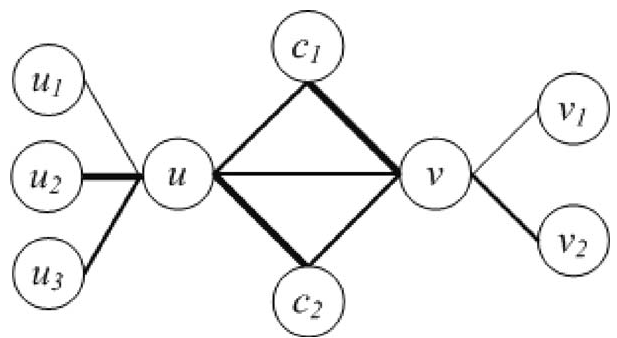 Fig 1: The role of common neighbors (c1, c2) in mediating influence between users u and v.
2. Importance Estimation
The model acknowledges that some users are inherently influential due to their status (e.g., H-index for scientists, job titles for employees). This "Personal Importance" () is integrated with social impact to form the Initial FBI.
3. Iterative Adjustment (The PageRank Twist)
Influence is dynamic. Your influence affects your friends, which in turn reflects back on you. FBI uses a transition matrix where each edge is weighted by the proportion of contribution.
This turns an undirected social graph into a directed influence network.
 Fig 2: Evolution from an undirected social graph (a) to a directed, weighted influence network (b).
Experimental Proof: Better Resolution, Better Seeds
The authors tested FBI against UDI (Degree-based) and UAI (Attractor-based) on large datasets like DBLP and HEPTH.
- Anti-Duplication: In the HEPTH dataset, UDI showed over 90% duplication. FBI, by incorporating fine-grained features, slashed this to under 7%.
- Influence Spread: Using the Independent Cascade (IC) model, FBI's top-k users consistently reached a larger audience than those selected by other models.
- Quality Check: In a case study on academic co-authors, FBI correctly identified a user with an H-index of 46 as the top influencer, whereas degree-centric models favored a user with higher volume but lower impact (H-index of 12).
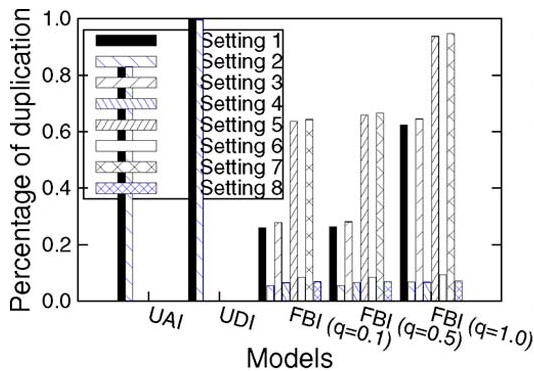 Fig 3: Convergence and variation of FBI across iterations, showing rapid stability.
Critical Insight & Conclusion
The FBI model proves that local topology matters more than global connectivity when precision is required. By allowing the "Impact" and "Importance" factors to be weighted ( and parameters), the model is highly adaptable to different OSN types—be it a professional network like LinkedIn or a casual one like Instagram.
Future Outlook: The next frontier for this work is the bidirectional relationship between Influence and Trust. High influence doesn't always equal high trust; integrating these two metrics could create "reputation systems" that are resilient to manipulation and viral misinformation.