
Balancing the Scales of Trust: Fine-grained Identification with Real-time Fairness in MSNs
Fine-Grained Identification with Real-Time Fairness in Mobile Social Networks
This paper introduces a novel fine-grained identification protocol for Mobile Social Networks (MSNs) that ensures real-time fairness and privacy without an online Trusted Third Party (TTP). It utilizes an iterative "gradual exchange" mechanism where users progressively reveal identity information through policy trees.
TL;DR
Mobile Social Networks (MSNs) often require users to identify themselves to build trust, but revealing too much information too early creates an "unfair" advantage for malicious actors. This paper proposes a Fine-grained Identification Protocol that acts like a calibrated digital handshake: users reveal bits of their identity iteratively. Using policy trees and bilinear pairings, it ensures that if you learn a bit about me, I learn exactly as much about you, eliminating the need for a Trusted Third Party (TTP).
The "Fairness" Dilemma in Mobile Social Networks
In an unattended MSN, users with similar interests (attributes) want to find each other. However, directly sharing attributes is risky. A malicious user could act "passively," collecting the attributes of others while revealing nothing about themselves.
Existing solutions are flawed:
- Online TTPs: Create a single point of failure and a communication bottleneck.
- Offline TTPs: Resolve disputes after the fact, but in the fast-moving world of MSNs, "justice delayed is justice denied."
- Anonymity Sets: Protect identity but don't prevent one-sided information theft.
Methodology: The Art of the Gradual Handshake
The core innovation is the Fine-grained Identification Scheme. Instead of a binary "I am A" or "I am not A," the authors use Policy Trees to reveal identity in layers of uncertainty.
1. The Strategy of Iterative Disclosure
Imagine a game where you want to prove you are a "Surgeon."
- Step 1: You prove you are "1 of 16" medical professionals.
- Step 2: If the other party proves they are also in medicine, you narrow it down to "1 of 4."
- Step 3: Finally, you reveal the exact attribute.
If the other party stops talking at Step 2, you have only lost a small fraction of your privacy, and you have gained a reciprocal amount of information about them.
2. Technical Backbone: Bilinear Pairings
The protocol uses complex mathematical structures (bilinear maps ) to verify that a user’s attribute set satisfies a policy tree without revealing the attributes themselves until the final stages.
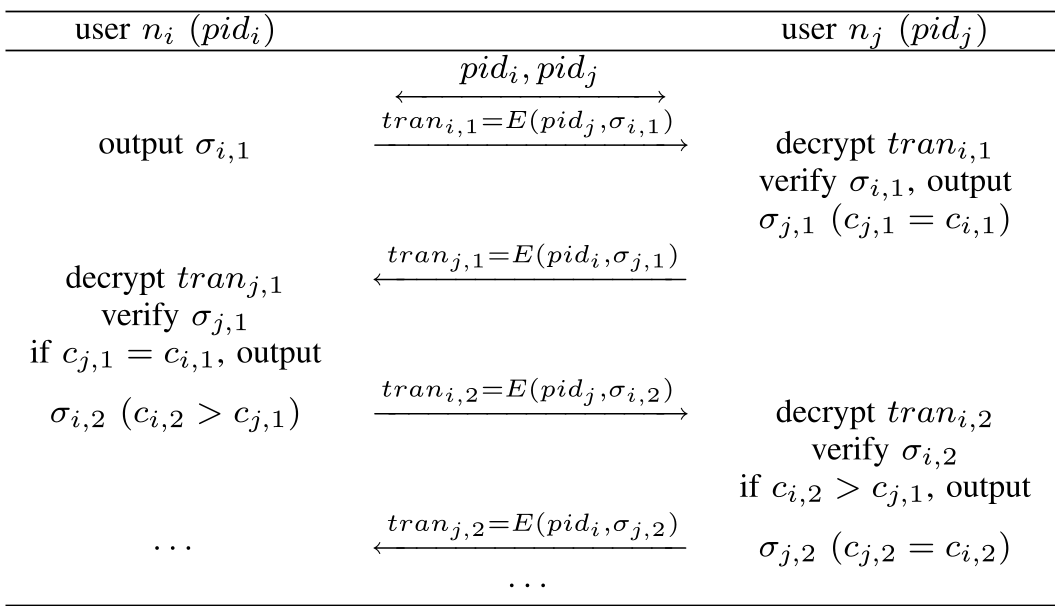 Table 1: The step-by-step exchange of encrypted transactions () between two nodes () and ().
Experimental Proof: Measuring "Uncertainty"
The authors use an information-theoretic metric (Entropy) to measure fairness. Fairness loss is defined as the gap between the amount of information User A has about User B versus what User B has about User A.
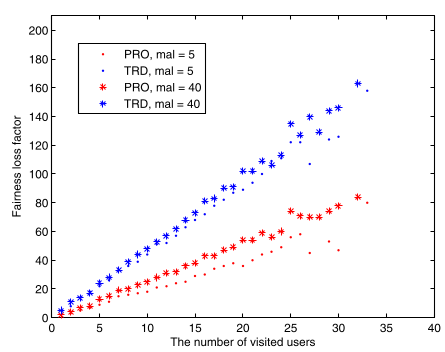 Figure: The Proposed Protocol (PRO) shows significantly lower fairness loss compared to the Traditional (TRD) single-step identification.
Key Findings:
- Resilience to Malicious Nodes: Even when the number of malicious users increases from 5 to 40, the cumulative fairness loss remains controlled because the protocol terminates early when reciprocity fails.
- Granularity Matters: The "Set 1" (1 of 16, 8, 4, 1) performed better than "Set 2" (1 of 4, 2, 1) because the finer increments allowed for safer "testing" of the other party's honesty.
Critical Insight & Practical Value
The brilliance of this work lies in treating Privacy as a tradable commodity. By quantifying privacy via entropy, the authors transform a security problem into a balanced economic exchange.
Limitations: The primary drawback is the computational overhead of multiple iterations and bilinear pairings on mobile devices. In 2026, while mobile hardware is stronger, the latency of multiple handshakes in a fast-moving physical environment (like two people passing each other on a train) remains a challenge.
Future Outlook: This logic is perfectly suited for Web3 and Decentralized Identifiers (DIDs). As we move away from central authorities like Google or Facebook for login, iterative proof systems will be essential for "Safety-First" social discovery.
Conclusion
This paper provides a robust framework for real-time fairness in MSNs. By moving away from "All-or-Nothing" identification and adopting a "Tit-for-Tat" information exchange, it builds a foundation for trust in truly decentralized mobile environments.