
Beyond the News Feed: Rescuing Relevant Content from Weak Social Ties
A fine-grained social network recommender system
The paper introduces a fine-grained social network recommender system designed to identify and surface media content (music and movies) shared by friends that aligns with a user's specific sub-category interests. By leveraging "Interest Profiles" and sentiment analysis, the system bypasses traditional social-tie-based filtering to reveal overlooked content, achieving over 80% user-rated accuracy.
TL;DR
Social networks are failing to show you the music and movies you actually like because they are obsessed with who you talk to rather than what you are interested in. This paper proposes a fine-grained recommender that builds deep interest profiles to find "hidden gems" shared by your distant acquaintances. In real-world tests, it found 41% more relevant content than Facebook's own algorithm.
Background: The "Social Tie" Trap
We've all been there: scrolling through a News Feed filled with life updates from close friends, while a high-quality music recommendation from a "weak tie" (an old high school classmate or a distant colleague) remains buried. Standard algorithms use interaction frequency as a proxy for relevance. However, your best friend might have terrible taste in movies, while a person you rarely speak to might share your exact passion for 1970s Italian horror films. This paper argues that the current social-graph-driven approach creates massive noise and siloes of missed opportunities.
Methodology: Engineering Fine-Grained Interest
The core innovation of this system lies in its ability to look past the "friend" and look into the "genre."
1. Interest Profiling & Bootstrapping
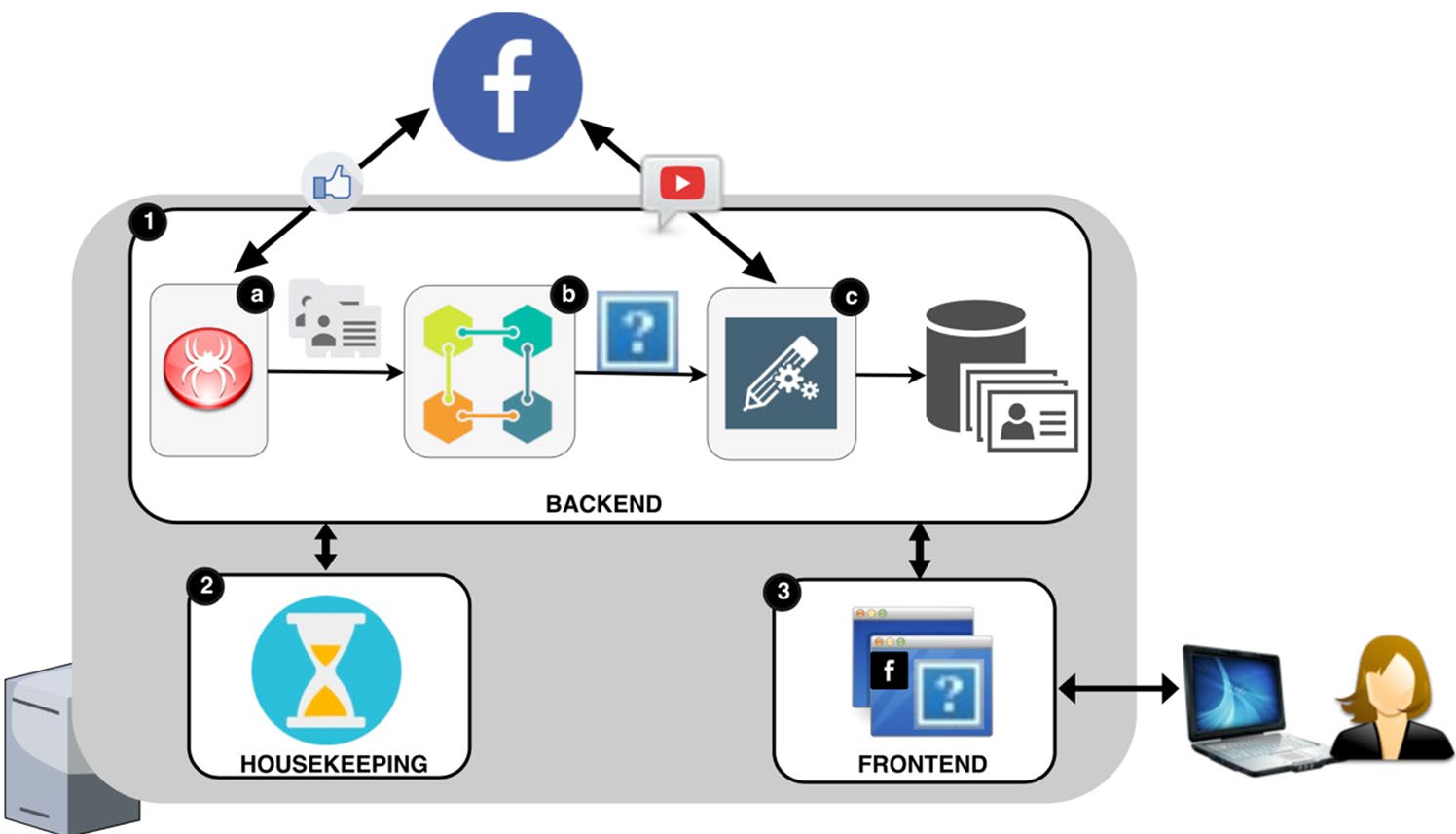
The system doesn't just look at a "Like" for a band; it decomposes that band into a set of sub-genres. If you like "The Rolling Stones," the system registers scores for Rock, Rhythm and Blues, and Country. This creates a high-dimensional vector of your tastes.
2. The Sentiment Filter
To prevent recommending a movie that a friend posted just to complain about, the authors implemented a modified SO-CAL (Semantic Orientation CALculator). By using POS (Part-of-Speech) tagging and valence shifters (e.g., "really" as an intensifier), the system calculates the emotional polarity of the text accompanying a link. Only posts with a score above 0.7 (clearly positive) make the cut.
3. Quantifying Similarity
The system uses a Friend Similarity Score (FSS), which is a weighted combination of:
- Genre Similarity (GSS): Do you like the same types of things?
- Like Similarity (LSS): Do you like the exact same entities?
The authors found that giving Genre overlap double the weight of individual Likes significantly boosted accuracy. This is the "physics" of the paper: categories are more stable indicators of future interest than specific items.
Experimental Results: Beating the Giant
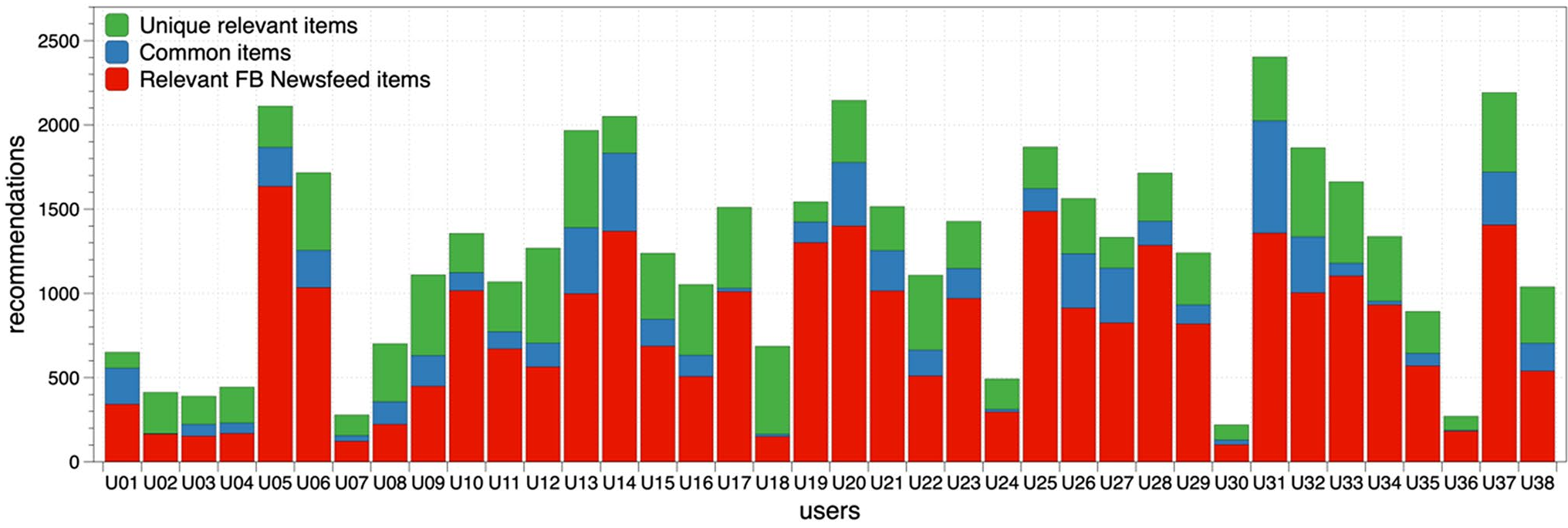
The authors tested their prototype against the actual Facebook News Feeds of 38 participants.
Key Findings:
- Invisible Content Revealed: The system identified 12,096 posts that were relevant to users but were never shown by Facebook’s default algorithm.
- High Precision: In a pilot study, users rated the accuracy of these hidden recommendations at 82-84%.
- User Feedback: Unlike generic "Popular" lists, participants found the recommendations to be "richer and more diverse," specifically because they tapped into niche sub-groups of their social circle.
Critical Insight: The Future of Niche Discovery
The researchers highlight a vital truth for the AI era: as social networks grow, the "noise" of interaction frequency becomes a barrier to discovery. By shifting the focus from Social Ties to Fine-Grained Semantic Overlap, we can transform social networks from "life-update feeds" into powerful, personalized discovery engines.
Limitations: The current system relies heavily on YouTube links for entity extraction. Future iterations will need to handle "naked" text status updates (e.g., "Just saw the new Batman, it was okay") which requires much more complex Named Entity Recognition (NER) in the presence of slang and typos.
Conclusion
This paper is a wakeup call for platform designers. By building a "separate lane" for media recommendations based on sub-genre profiles rather than social proximity, we can significantly improve user satisfaction and surface the high-value content that the current "popularity-biased" algorithms choose to ignore.