
Finish Them on the Fly: Engineering Real-Time Incentives for the Gig Economy
Finish Them on the Fly: An Incentive Mechanism for Real-Time Spatial Crowdsourcing
The paper introduces the Real-time Monetary Incentive for Tasks (MIT) problem, a budget-constrained optimization framework for spatial crowdsourcing (SC). It proposes the Dynamic Threshold Algorithm, an online mechanism that maximizes task completion rates in fluctuating markets using competitive analysis.
TL;DR
Determining how much to "extra" to pay a driver to accept a ride request is a high-stakes, millisecond-level decision for platforms like Uber and Didi. This paper moves beyond static, offline models to propose a Real-time Monetary Incentive for Tasks (MIT) framework. By deploying a Dynamic Threshold Algorithm, the authors achieve near-optimal task completion rates while slashing computation-heavy response times by two orders of magnitude.
Problem & Motivation: The Chaos of the Real World
Most academic pricing models assume a "God's eye view" of the market—knowing exactly when every driver will log on and where every passenger will stand. In reality, a sudden rainstorm in Chengdu or a traffic jam in New York creates localized "supply deserts" that static models cannot predict.
The authors identify a critical gap: Prior work is too slow. Offline algorithms (like Multi-Choice Knapsack solvers) take significant time to compute global optima, whereas spatial crowdsourcing requires instant responses before a worker moves to a different grid or a different app.
Methodology: Bridging Logic and Uncertainty
The paper categorizes the SC market into three scenarios based on "knowledge of the future":
- Omniscient (Static/Offline): Full knowledge of future worker arrivals.
- Predictable: Arrival distributions are known (e.g., Non-Homogeneous Poisson Process).
- Oblivious (True Online): No knowledge of the future; we only know a worker has arrived when they appear.
1. The Dynamic Threshold Algorithm (The Core Insight)
For the "Oblivious" case, the authors utilize a threshold function . As the budget is consumed, the "bar" for providing a monetary incentive rises.
- The Intuition: If you have plenty of budget left, you pay incentives for tasks with lower utility density. As your budget runs dry, you become "choosy," only incentivizing tasks that offer the highest probability of completion per dollar.
2. k-Step Watch Ahead Heuristic
Recognizing that we usually have some clue about the next 5-10 minutes, the authors proposed a hybrid approach. It uses ARMA (Auto-Regressive Moving Average) to predict the immediate future, runs a localized Dynamic Programming (DP) step, and filters the result through the dynamic threshold to ensure long-term budget safety.
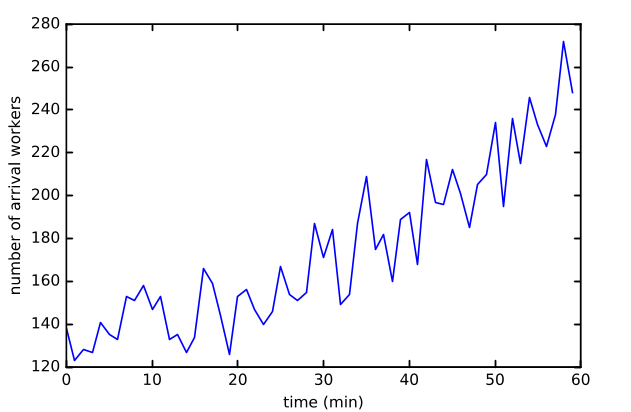 Figure 1: Illustration of worker arrival heterogeneity—showing why static models fail in high-variance rush hours.
Experiments & Results: Speed Matters
The researchers tested their theories using a massive dataset from Didi Chuxing (Chengdu city, Nov 2016).
Key Performance Indicators:
- Efficiency: The "Online" algorithm returned results almost instantaneously, whereas the standard DP-based optimal solution's response time scaled linearly with the budget and task count, making it unusable for real-time dispatch.
- Utility: Despite having no knowledge of the future, the Dynamic-Threshold Algorithm maintained a competitive ratio of , capturing nearly as much utility as the offline optimal.
- Response Time: The proposed method decreased response latency by 100x, a critical metric for worker retention.
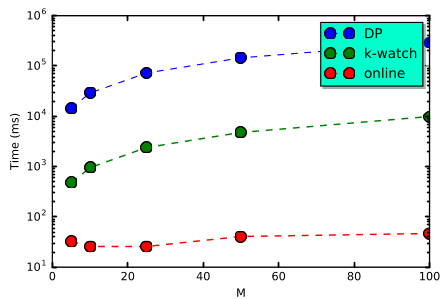 Figure 2: Comparison of Expected Utility and Response Time. Observe that while DP offers slightly higher utility, its time cost is prohibitive compared to the 'Online' and 'k-watch' methods.
Critical Analysis & Conclusion
Takeaway
The genius of this work lies in its Competitive Analysis. By proving a logarithmic bound on the loss of utility, the authors provide mathematical "peace of mind" to platform operators: you don't need a perfect crystal ball to manage a budget effectively; you just need a smart, dynamic threshold.
Limitations
- Independence Assumption: The model assumes workers make decisions independently. In the real world, "herd behavior" or social communication among drivers might influence acceptance ratios.
- Parameter Sensitivity: The algorithm relies on and (upper and lower bounds of utility density). Estimating these accurately from historical data is a prerequisite for the competitive ratio to hold.
Future Outlook
As SC platforms evolve, we expect to see these "threshold-based" mechanisms integrated with Deep Reinforcement Learning (DRL) to fine-tune the function in real-time, potentially closing the small utility gap that remains between online heuristics and offline optima.