
[arXiv 2025] FIPO: Breaking the Reasoning Ceiling with Future-KL Dense Supervision
FIPO: Eliciting Deep Reasoning with Future-KL Influenced Policy Optimization
The paper introduces Future-KL Influenced Policy Optimization (FIPO), a reinforcement learning algorithm that elicits deep reasoning in LLMs by replacing coarse outcome-based rewards with dense, token-level supervision. Applied to Qwen2.5-32B, it achieves a peak Pass@1 of 58.0% on AIME 2024, outperforming o1-mini and DeepSeek-R1-Zero-32B.
TL;DR
The Qwen Pilot Team has released FIPO (Future-KL Influenced Policy Optimization), an RL algorithm that finally solves the "uniform credit assignment" problem in GRPO-style training. By re-weighting tokens based on their downstream impact (Future-KL), they enabled Qwen2.5-32B to scale its internal "thinking" from 4k to 10k+ tokens, surpassing o1-mini and DeepSeek-R1-Zero on AIME 2024 benchmarks.
The Problem: The "Flat Reward" Trap
In standard RLVR (Reinforcement Learning with Verifiable Rewards), we often use GRPO. It’s efficient because it doesn't need a Critic/Value model. However, it has a fatal flaw: it treats every token in a correct trajectory as equally "good."
Whether a token is a brilliant logical leap or a simple "the," it receives the same advantage score. This results in:
- Length Stagnation: Models stop exploring deeper reasoning paths.
- Coarse Credit Assignment: The model can't identify which specific step led to the correct answer.
Methodology: The Intuition of Future-KL
FIPO's core insight is that the value of a token is defined by the trajectory it initiates.
1. Probability Shift ()
The authors track the difference between the current policy and the old policy. A positive shift means the model is leaning into a specific token.
2. Future-KL Formulation
Instead of just looking at the current token, FIPO calculates the Future-KL: the cumulative, discounted sum of future probability shifts.
This acts as a high-fidelity signal: if a token leads to a future sequence that the model is increasingly confident in, that token gets a massive boost.
 Figure: Performance of FIPO vs Baselines on AIME2024.
3. Stability via Masking and Clipping
To prevent the exponential nature of KL from exploding, FIPO introduces:
- Extreme Value Filtering: Masking tokens that exceed safety thresholds.
- Soft Decay Window: A "half-life" parameter () that ensures the model focuses on the local logical chain rather than the distant, noisy future.
The Scaling Effect: Length is a Proxy for Depth
One of the most striking results is the correlation between CoT length and performance. FIPO doesn't just make the model "wordy"; it elicits Self-Reflection.
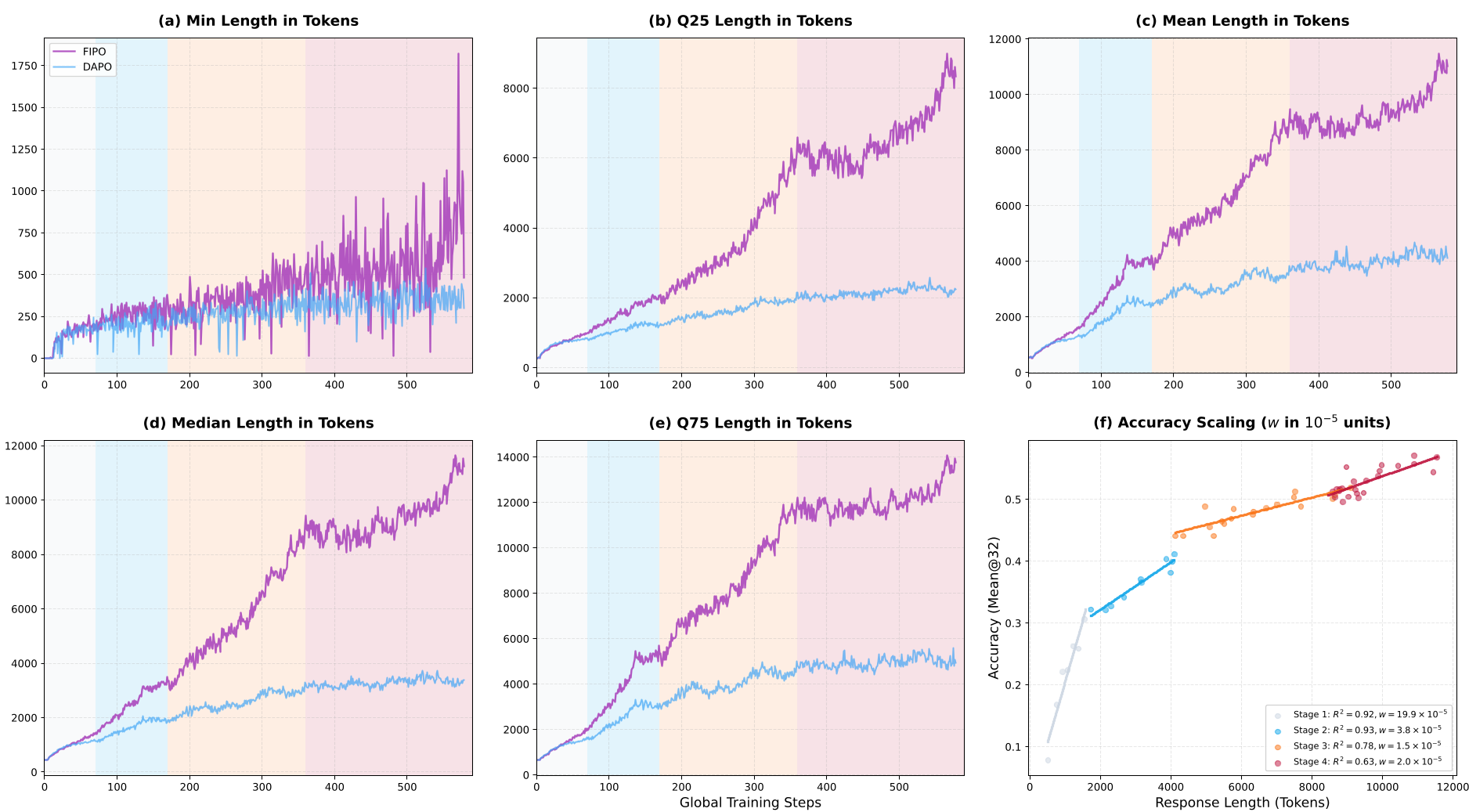 Figure: As training progresses, FIPO pushes the entire distribution of response lengths upward, which directly correlates with higher AIME accuracy.
The paper identifies four stages of reasoning evolution:
- Stage 1: Superficial Planning (Brief, hallucinated conclusions).
- Stage 2: Linear Execution (Standard CoT, single-pass logic).
- Stage 3: Emergent Self-Reflection (Proactive verification of intermediate steps).
- Stage 4: Systematic Deep Reasoning (Multi-pass auditing and granular arithmetic verification).
Experimental Results
FIPO was tested on the Qwen2.5-32B-Base model with remarkable results:
- AIME 2024 Pass@1: 56.0% (Peak 58.0%), compared to DAPO's 50.0%.
- CoT Length: Scaled from 4,000 to over 10,000 tokens.
- Comparison: Outperforms o1-mini (~56.0%) and DeepSeek-R1-Zero-Math-32B (~47.0%).
Critical Analysis & Conclusion
FIPO proves that dense supervision is possible without the overhead of PPO's Critic models. By mathematically formulating the "downstream influence" of a token, we can bridge the gap between pure outcome-based rewards and step-by-step reasoning.
Limitations:
- Inference Cost: 10,000+ tokens per query is computationally expensive.
- Domain Specificity: The current success is primarily in Mathematics, where rewards are strictly verifiable.
Future Outlook: FIPO provides a blueprint for "System 2" thinking in models. The next frontier will be distilling these 10k-token "deep thoughts" back into efficient, shorter responses without losing the underlying logical rigor.