
Fire Regime: The Genealogy and Evolution of a Fundamental Ecological Pillar
Fire regime: history and definition of a key concept in disturbance ecology
This paper provides a comprehensive historical and conceptual reconstruction of the "fire regime" concept, tracing its evolution from 19th-century French hydrology and African colonial botany to its 1960s adoption in the U.S. and modern SOTA ecological frameworks. It identifies the paradigm shift from viewing fire as a destructive external force to a natural, essential disturbance.
TL;DR
While most ecologists assume the concept of "fire regime" is a byproduct of modern American conservation, its roots actually lie in the colonial laboratories of 19th-century French Africa. This paper deconstructs the historical journey of the term, charting a paradigm shift from fire as a "dictatorship" to fire as an "essential management tool," and concludes by offering a robust, modular framework for defining fire regimes in the 21st century.
Background: Beyond the Leopold Report
In the scientific consciousness, the 1963 Leopold Report is often cited as the "Big Bang" for fire ecology. However, this study reveals that the concept was a "multipurpose foreignism" imported from French. Long before it reached the U.S. National Park Service, French botanists like Perrier de la Bâthie were using «régime des feux» to describe the recurring burning patterns in Madagascar and Senegal.
The Paradigm Shift: From "Dictatorship" to "Disturbance"
The evolution of the concept mirrors the decline of Clementsian successional theory, which viewed ecosystems as organisms moving toward a stable "climax." In this older view, fire was an external enemy—a regressive force that "subjugated" the landscape.
The turning point arrived in the 1960s, fueled by:
- Ecological Evidence: Disastrous wildfires (like the 1955 Grant Grove fire) proved that total suppression was a failure.
- Scientific Maturation: The rise of Chaos Theory and a better understanding of disturbance-adapted species.
- Cross-Linguistic Influence: The pivotal 1962 World Conference on National Parks, chaired by French expert François Bourlière, which bridged the gap between European colonial experience and American wildlife management.
Methodology: Mapping the Terminological Explosion
The authors performed a deep-dive into digital archives (JSTOR/ScienceDirect), quantifying the linguistic shift from "burning regime" or "fire chronology" to the standardized "fire regime."
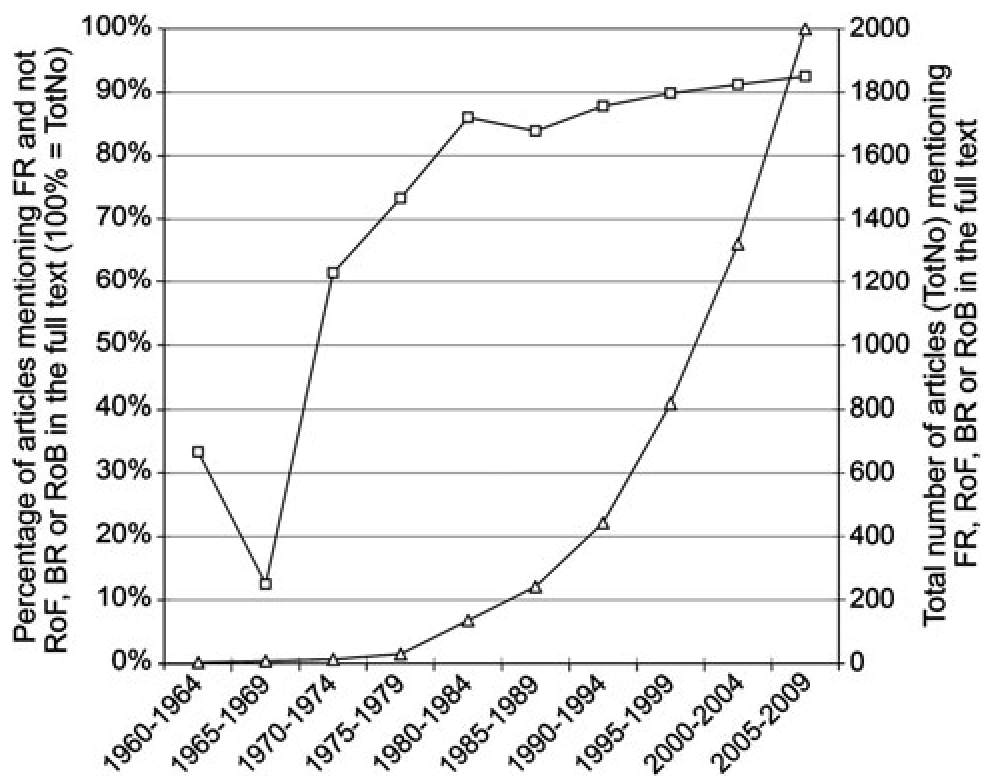 The data indicates a clear terminological specification process since the 1980s, where "Fire Regime" became the dominant keyword in wildfire literature.
A Unified Framework for Fire Regime (Sensu Lato)
One of the paper's core contributions is a structural proposal for parameterizing fire regimes. Rather than a static list, they suggest a modular approach:
- Tier A (Sensu Stricto): The "Who, When, Where"—Frequency, Seasonality, Size, Type, and Intensity.
- Tier B (Sensu Lato - Conditions): The "Why"—Ignition sources (natural/anthropogenic), fuel characteristics, and fire weather.
- Tier C (Sensu Lato - Effects): The "Impact"—Severity, mortality of trees, and socio-ecological damage.
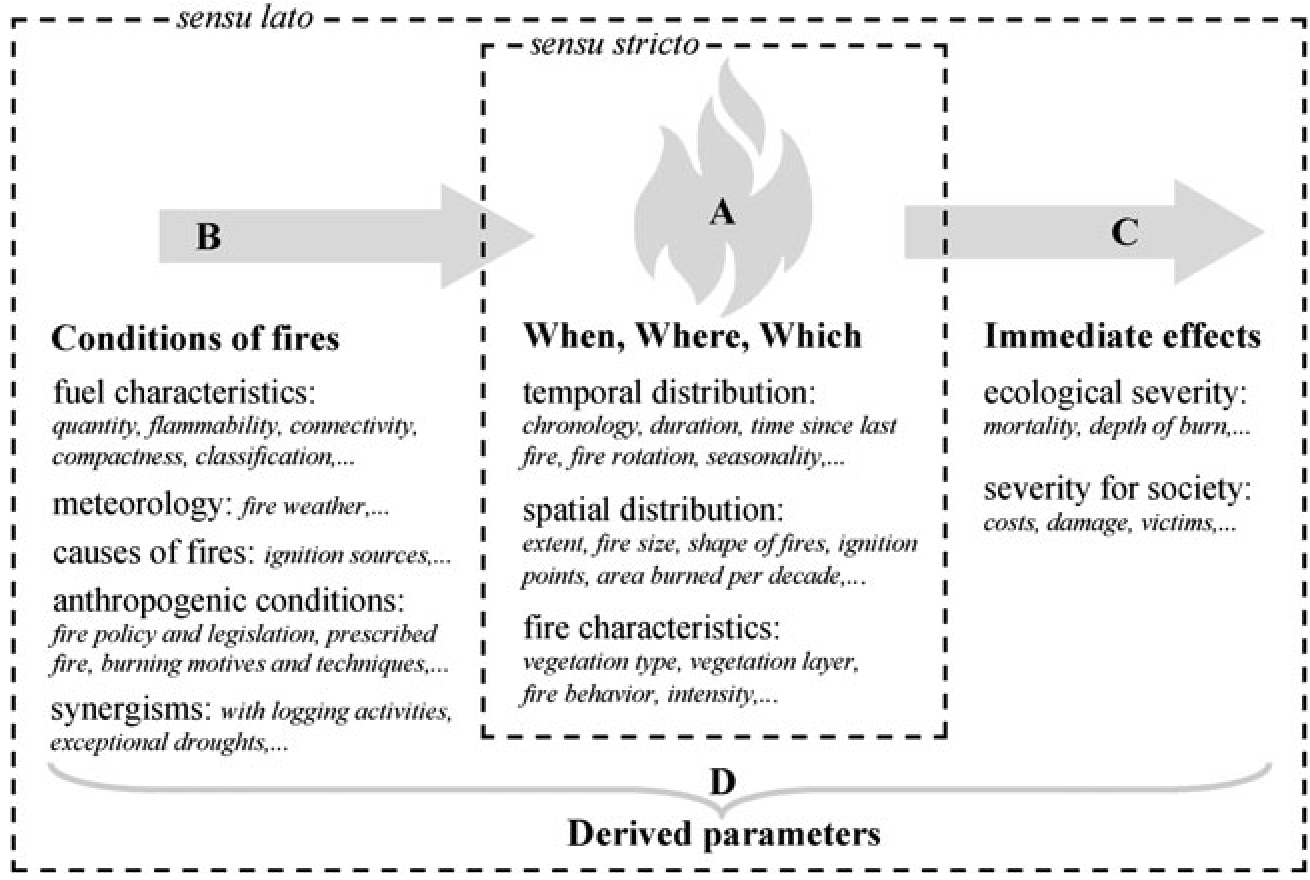 This modular structure allows researchers to scale the complexity of their definition based on data availability, from binary paleo-fire records to high-resolution modern modeling.
Critical Insight: The Fire Paradox
The paper emphasizes the Fire Paradox: the more efficiently we fight fire, the more intense and uncontrollable the eventual "breakout" fires become. This realization moved the concept of fire regime from a negative value (something to be suppressed) to a neutral, quantifiable pattern of variability.
Conclusion & Future Outlook
The "fire regime" concept has evolved from a tool of colonial resource protection to a cornerstone of non-equilibrium ecosystem management. By recognizing the "natural range of variability," ecologists have moved from seeking a "balance of nature" to understanding the "flux of nature."
Takeaway for Practitioners: A fire regime is not merely a set of statistics; it is a historical narrative. To define it effectively, one must account for the feedback loop between physical fire behavior and the socio-ecological context of the landscape.
Disclaimer: This analysis is based on Krebs et al. (2010), "Fire regime: history and definition of a key concept in disturbance ecology."