
Connected Under Fire: How Social Networks Drive Firefighter Coordination and Adaptability
Social Networks Perspective of Firefighters' Adaptive Behaviour and Coordination among Them
This study employs Social Network Analysis (SNA) to investigate the impact of tie strength on coordination and adaptive behavior among firefighters during bushfire emergencies. By analyzing 579 survey responses from Australian and New Zealand emergency services, the researchers identified significant positive correlations between network relational structures and disaster response effectiveness.
TL;DR
In the chaos of a bushfire, formal protocols only go so far. This study reveals that the "Tie Strength" between individuals and teams is a critical predictor of how well they coordinate and adapt. By analyzing a massive dataset of 579 emergency responders, the researchers prove that social connectivity directly enhances the quality of preparedness and resource accessibility, enabling firefighters to pivot strategies when disaster conditions shift.
The Logic of the Crisis: Plan vs. Feedback
Emergency response is traditionally viewed through the lens of Coordination by Plan—standardized programs and pre-established schedules. However, bushfires are "wicked" problems: dynamic, unpredictable, and prone to sudden escalation.
The authors argue that in these high-uncertainty environments, organizations must shift toward Coordination by Feedback. This relies on the transmission of new information and mutual adjustment. The vital engine for this feedback loop isn't just a radio frequency; it is the Social Network of the responders.
Methodology: Mapping the Invisible
To quantify these human elements, the researchers utilized Social Network Analysis (SNA). They looked at two primary dimensions:
- Tie Strength: The intensity and quality of relationships within and between teams (Internal vs. External ties).
- Adaptive Behavior: The ability of teams to recover quickly, reallocate roles, and adjust strategies in real-time.
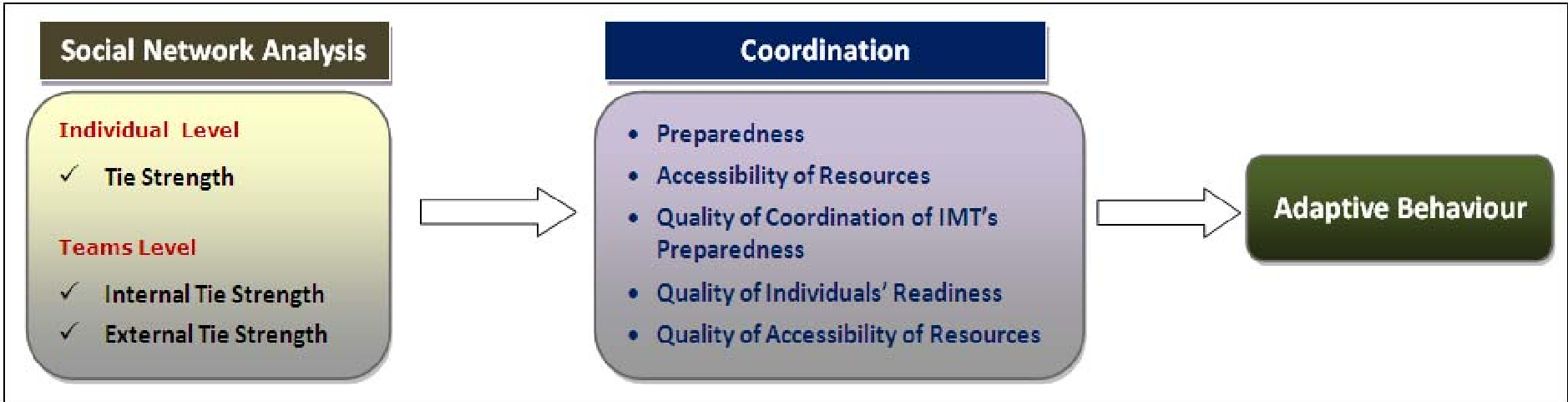 Figure 1: The proposed model linking human ties to coordination and adaptive outcomes.
Key Insights from the Data
The study’s empirical analysis (Statistical significance p < 0.001) yields several profound insights for disaster management:
- Tie Strength is the Foundation: There is a high positive correlation between individual/team tie strength and coordination. If people trust each other and have history, they share resources more effectively.
- The Quality of Preparedness: The strongest link to Adaptive Behavior was the "Quality of Coordinators' Preparedness" (Rho = 0.689). This suggests that when the Incident Management Team (IMT) is well-connected and prepared, the ground crews feel empowered to adapt.
- Resource Accessibility: Knowing where the tools are is coordination; having the social relationship to access them in a pinch is what saves lives.
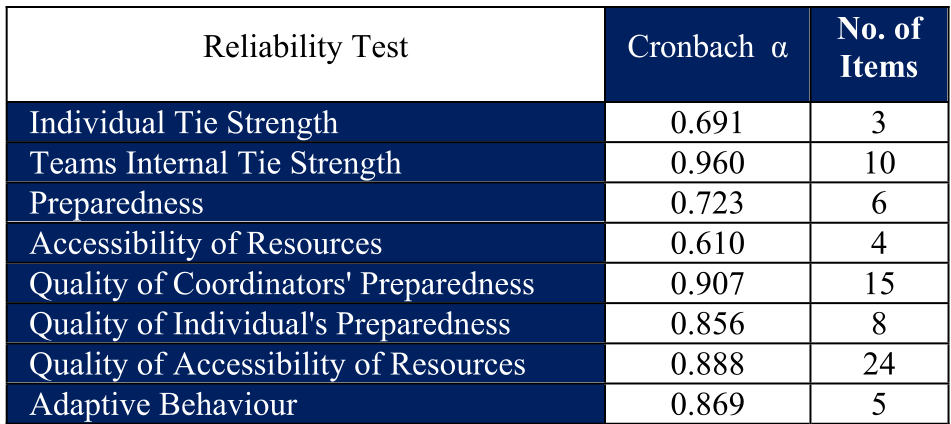 Table 1: Reliability testing for the constructs used in the study, showcasing the robustness of the adaptive behavior and coordination scales.
Why This Matters (Takeaway)
The most critical takeaway is that human relations are technical assets. In the context of the Australasian Inter-service Incident Management System (AIIMS), the study suggests that training shouldn't just be about drills; it should be about building relational capital.
Limitations and Future Work
The study admits a minor limitation in the reliability score of "Accessibility of Resources" (α=0.610), indicating that how we measure resource flow in a crisis might need more granular refinement. Future research could explore how Weak Ties (acquaintances from other agencies) versus Strong Ties (immediate team members) provide different types of value during the multi-agency response phase.
Conclusion
Effective disaster management is not just a flowchart; it is a living network. By prioritizing tie strength, emergency agencies can ensure that when the next bushfire strikes, their personnel are not just following a plan—they are adapting as one.