
ELBFC: Advancing TCSC Firing Angle Control via Emotional Learning
Firing angle control of TCSC using Emotional Learning Based Fuzzy Controller
This paper introduces an Emotional Learning Based Fuzzy Controller (ELBFC) designed for tuning the firing angle of a Thyristor Controlled Series Capacitor (TCSC). By mimicking biological emotional responses (stress vs. satisfaction), the controller effectively damps low-frequency oscillations and enhances the transient stability of power systems under various load conditions.
TL;DR
The stability of modern power systems relies on Thyristor Controlled Series Capacitors (TCSC) to manage power flow and damp oscillations. This paper presents the Emotional Learning Based Fuzzy Controller (ELBFC), a bio-inspired approach that uses a "Critic" to minimize system stress. Compared to traditional fuzzy PD controllers, ELBFC demonstrates superior robustness and faster damping across varied operating conditions, from heavy to light loads.
Background: The Nonlinear Challenge of TCSC
TCSC units are critical for improving transient stability and mitigating subsynchronous resonance (SSR). By adjusting the firing angle (), the reactor's reactance changes, allowing for continuous compensation. However, the power grid is a highly nonlinear entity. Prior work relying on linearized models often fails when the system deviates from the nominal operating point (e.g., during line outages or sudden load spikes).
Methodology: Simulating "Stress" for Grid Stability
The core innovation lies in the ELBFC architecture, which moves beyond traditional Reinforcement Learning (RL). While RL often relies on binary success/failure signals, ELBFC utilizes a continuous Emotional Signal (Stress).
1. The Neurofuzzy Component
The system utilizes a 4-layer Sugeno-type neurofuzzy structure. It processes inputs through Gaussian membership functions and calculates the control output using the Takagi-Sugeno relationship: Here, are the parameters that the "Emotional" part of the system will tune.
2. The Critic (The Emotional Engine)
The "Critic" functions like a specialized fuzzy PD controller. It monitors the error () and the rate of change of error (). If the system is unstable, the Critic generates "Stress." The controller's weight updates are driven by the objective of minimizing this stress signal through a gradient descent approach.
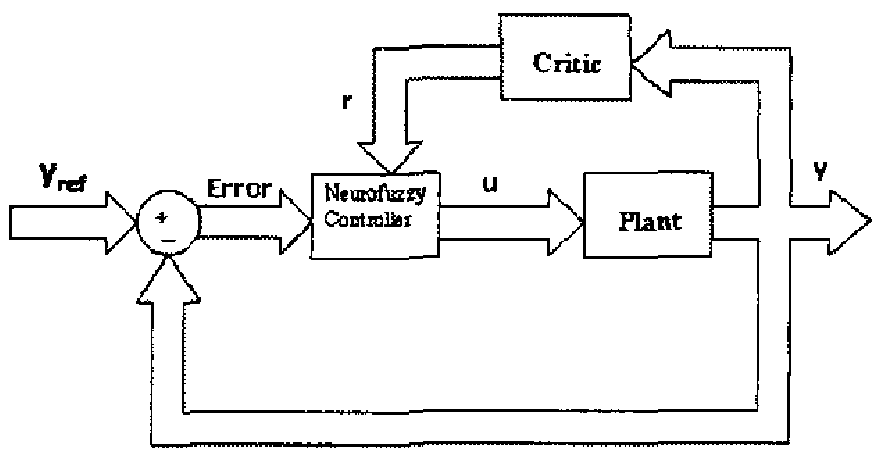 Figure 1: The closed-loop architecture showing the plant, the neurofuzzy controller, and the stress-providing Critic.
Experiments and Results
The authors tested the ELBFC on a Single-Machine Infinite Bus (SMIB) system across six distinct cases involving varying loads and disturbances (three-phase faults and torque changes).
Performance Comparison
In every scenario, ELBFC outperformed the standard Fuzzy PD controller. Specifically:
- Damping Effect: The rotor angle oscillations were damped much faster with ELBFC.
- Robustness: While the Fuzzy PD controller showed increased overshoot under light load conditions, ELBFC remained consistent, adapting its firing angle control logic to the current state of the grid.
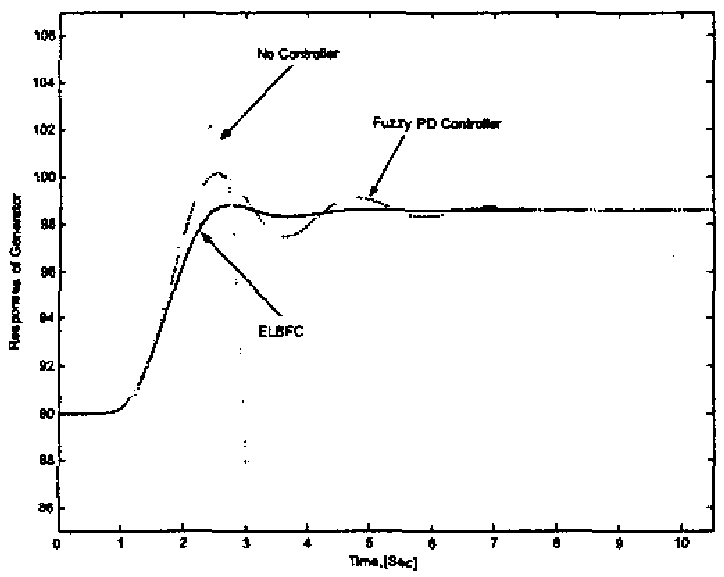 Figure 2: Generator response under heavy load during a mechanical torque change. Note the faster settling time of the proposed method.
Critical Insight & Conclusion
The beauty of the ELBFC is its ability to learn "on-the-fly." Traditional controllers are often "blind" until a total failure occurs or are rigid in their mathematical constraints. By introducing a continuous emotional signal, the system begins correcting its trajectory as soon as "discomfort" (deviation from reference) is detected.
Takeaways for the Future
- Adaptive Nature: This method shows that fuzzy systems coupled with emotional learning models (like BELBIC) are highly suitable for high-stakes, nonlinear industries like power electronics.
- Limitations: The study focuses on a single-machine system. Future research should address the complexity of multi-machine systems where inter-area oscillations might create conflicting emotional signals for decentralized controllers.
In conclusion, ELBFC represents a significant step toward a "cognitive" power grid, where components don't just react—they learn to stay calm under pressure.