
Decoding Information Propagation: The Power of First-Use Analysis in Social Networks
First-Use Analysis of Communication in a Social Network
This paper introduces a novel analytical framework for social networks called "First-Use Analysis," which identifies information propagation patterns based on content and message timing. By applying this method to the Enron email corpus, the authors demonstrate how to classify users into "Primary" or "m-ary" classes based on whether they initiate or respond to specific content.
TL;DR
Researchers have developed a "First-Use" framework to track how information originates and spreads within a network by analyzing e-mail timestamps and content keywords. Applying this to the Enron dataset, they discovered that business discussions trigger deep chains of responses, whereas legal disclaimers and external news reports are mostly characterized by spontaneous, isolated "first-use" events.
Background & Positioning
In the landscape of Social Network Analysis (SNA), we often focus on who talks to whom. However, the why and when are equally critical. Most prior work, such as the studies by Kossinets and Kleinberg, focuses on the "fastest paths" for information flow. This paper carves out a niche by introducing content-dependency. It isn't just about the pipe; it’s about the water flowing through it.
The Problem: The Content Gap in Temporal Networks
Existing models often treat all messages equally. However, in a corporate environment, an email containing a legal disclaimer (template) propagates differently than an urgent business strategist's report. The difficulty lies in distinguishing between:
- Spontaneous Activity: A user starting a conversation.
- Propagated Activity: A user passing on information they just received.
Without this distinction, we cannot identify who the true "thought leaders" or "primary sources" are versus the "relays."
Methodology: First-Use Paths and User Classes
The core of the methodology is the recursive definition of user classes based on the First-Use event.
- First-Use: Defined as the first time a user sends a specific content (X) within an observation window, provided they haven't received it first.
- Primary (1-ary) Sender: The "Zero Patient" of a specific topic. They send before they receive.
- m-ary Sender (m > 1): Someone who receives information from an (m-1)-ary sender and then sends it themselves for the first time.
The Analytical Framework
The authors represent this via a Time-Content Graph. Unlike standard graphs, the edges here are strictly constrained by temporal order and message content.
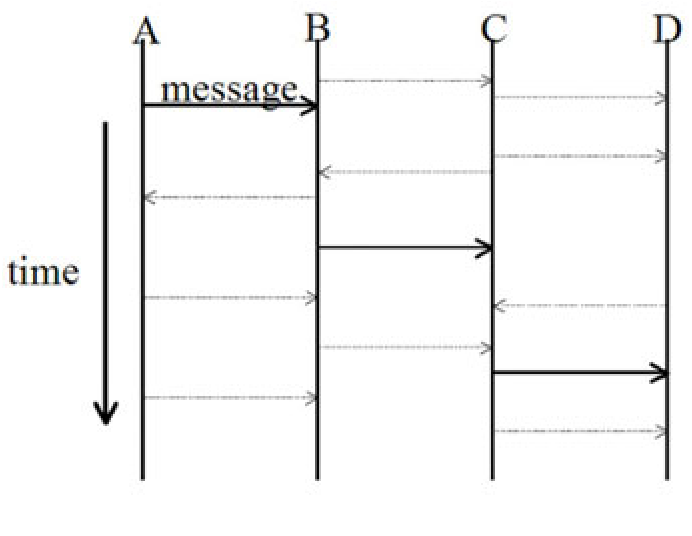 Figure 1: (a) Shows a unique first path from A to D. (b) Shows how nodes B and D are classified as secondary or tertiary based on their reception from primary nodes.
Experiments: Insights from the Enron Corpus
The researchers used TF-IDF to extract "popular yet localized" keywords from the Enron emails. They compared business terms like 'esp' (Energy Service Provider) with legal terms ('estoppel') and external events ('terrorist').
Key Visual Findings
The network visualization (Figure 2) shows that certain nodes (like Node 73) act as massive primary broadcasters to the outside world, while others occupy the center of complex, multi-layered response chains.
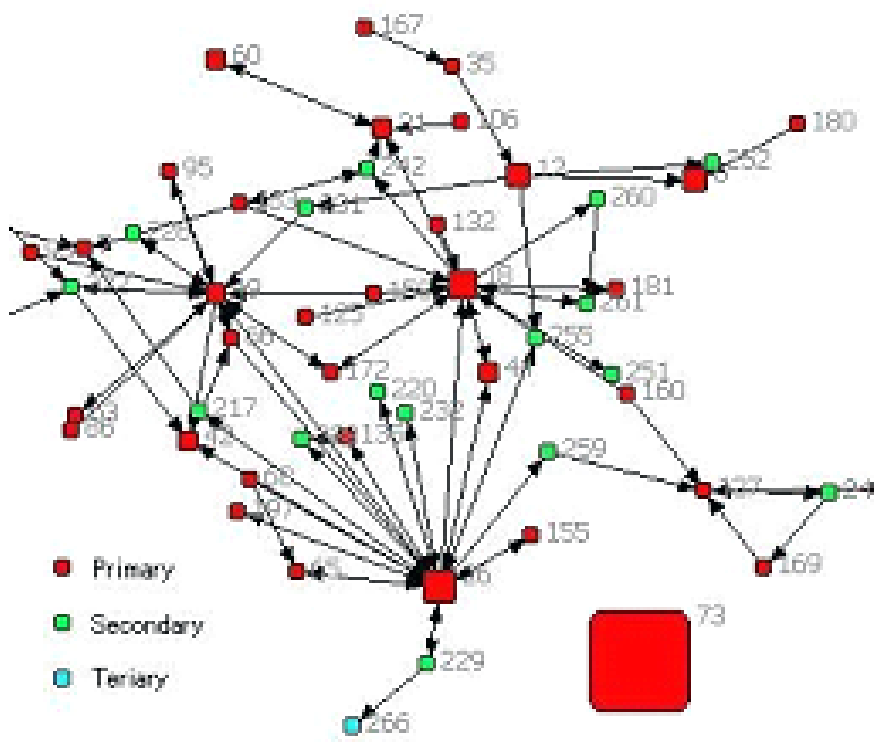 Figure 2: Visualization of the 'estoppel' network. Node size indicates volume, while icons represent First-Use classes.
The "Non-Primary" Ratio
One of the most profound metrics introduced is the Ratio of Non-Primary Emails.
- High Ratio (e.g., 'esp'): Indicates a "conversation" or "viral spread." People are talking because they were talked to.
- Low Ratio (e.g., 'estoppel', 'terrorist'): Indicates "broadcast" or "independent origin." People are either using a template or reacting to external news (TV/Radio) rather than internal emails.
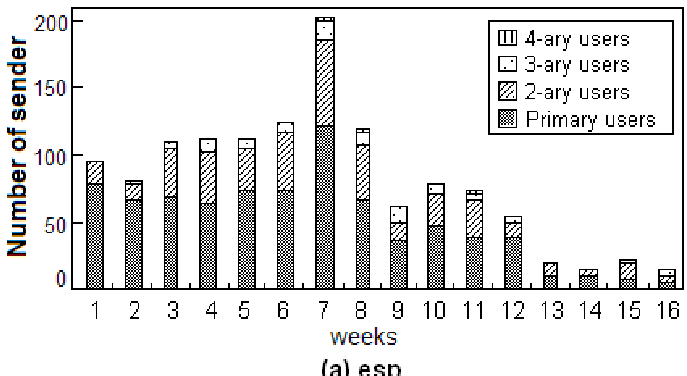 Figure 3: Correlation between keyword type and user response behavior.
Critical Analysis & Conclusion
Takeaway: This research proves that "content is king" even in structural network analysis. By looking at first-use, we can filter out the noise of routine signatures and focus on the actual mechanics of organizational influence.
Limitations:
- Keyword Simplicity: The study relies on exact keyword matching. Modern LLMs could significantly improve this by using "Concept Tracking" instead of "Word Tracking."
- The "External" Problem: As seen with the 'terrorist' keyword, the model struggles when the "Primary Source" is outside the observed network (e.g., the news).
Future Outlook: This framework is a precursor to modern viral marketing and misinformation "tracing" algorithms. By identifying 1-ary users, organizations can pinpoint high-potential communicators—essential for internal change management or external brand advocacy.