
Fitcolab: Engineering a High-Fidelity Sandbox for Social Network Analysis
Fitcolab Experimental Online Social Networking System
This paper introduces Fitcolab, an experimental Online Social Networking (OSN) system designed specifically for research into network structures and social phenomena. Developed using the Elgg open-source platform, it successfully collected rich interaction data from a controlled population of 209 active university students over a 131-day period.
TL;DR
Fitcolab is a custom-engineered Online Social Network (OSN) designed to bridge the gap between superficial friendship graphs and deep, multi-layered social structural research. By deploying a modified version of the Elgg platform to a specific university student base, the project captured 131 days of granular data, emphasizing strict "Network Boundary Specification" to ensure the scientific validity of its findings.
Background & Positioning
In the landscape of social computing, researchers often struggle with "data shadows"—partial snapshots of interaction provided by API-limited platforms like Facebook or Twitter. Fitcolab changes the paradigm by acting as a Research-First OSN. It isn't just a site; it’s a controlled experimental environment designed to observe how "friendship," "collaboration," and "communication" intersect in real-time within a defined demographic.
Motivation: The Context Gap
The author identifies a critical flaw in current OSN research: the study of relations in isolation. Analyzing a friendship network without the context of private messages, blog comments, or wiki edits results in a fragmented understanding of social structure. Fitcolab was built to enable a multi-angle study where the "wider setting" (e.g., educational background and distance learning status) is known, providing the necessary metadata to ground structural findings.
Methodology: The Architecture of Interaction
The system was built on the Elgg open-source framework, selected for its educational pedigree and dedicated social networking features. The architecture includes:
- Directed Friendships: Moving beyond binary connections to reflect the reality of social followership.
- Multi-Modal Interaction: Integrated modules for Blogs, Wikis, Files, Forums (vBulletin), and a "News Feed" equivalent named Neretva.
- Notification Loops: Automated email and private message systems to drive user retention and simulate a modern "sticky" UI.
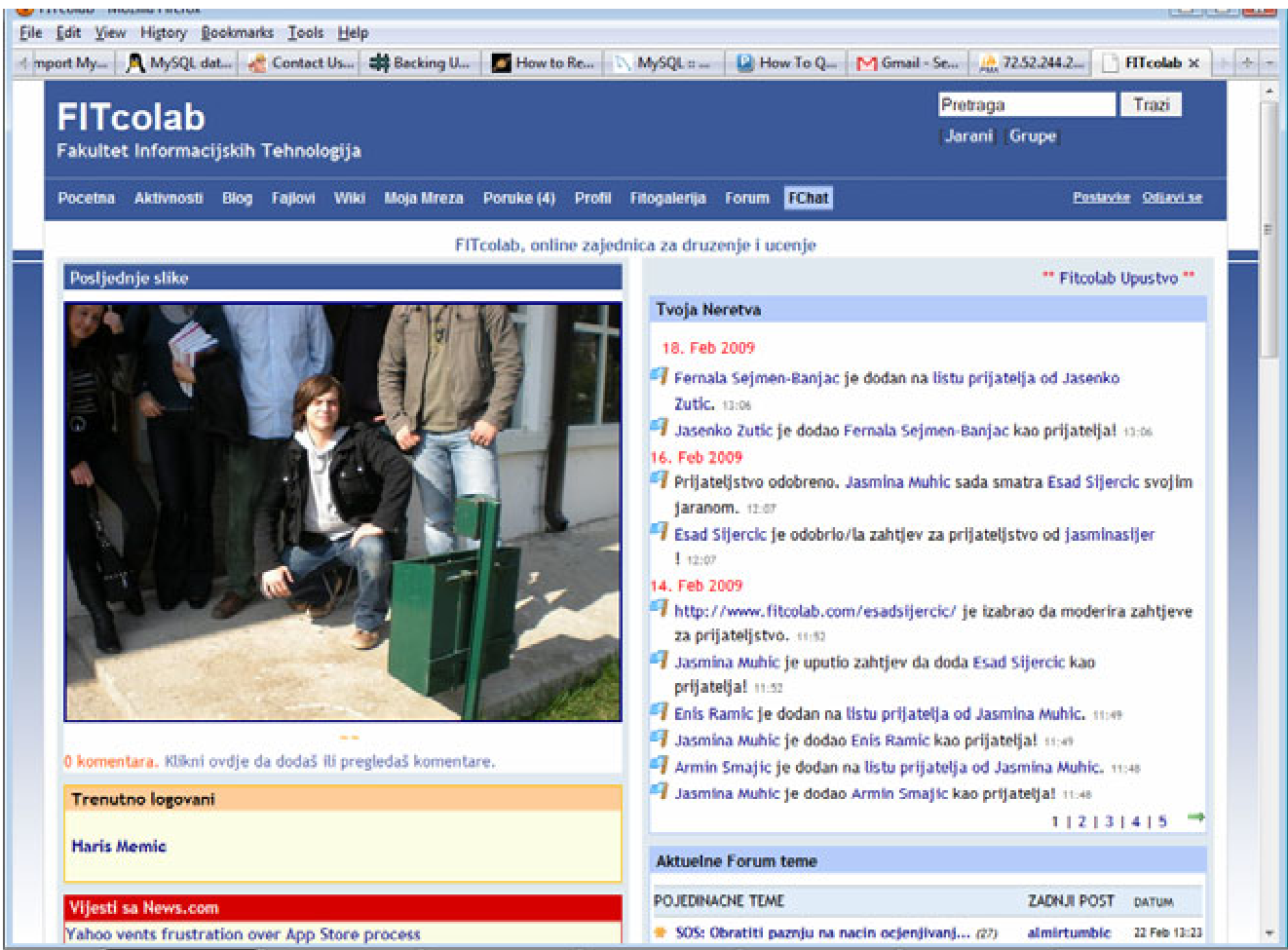 The system dashboard integrates real-time activity feeds, forum topics, and media galleries to stimulate diverse social signals.
Defining the "Network Boundary"
A standout feature of this research is the rigorous approach to Network Boundary Specification. To avoid skewed data from "passive" accounts, the author applied two primary filters:
- Positional Boundary: Focusing on the 2008/09 freshman cohort. This group was "unburdened" by prior usage, allowing researchers to observe a network's birth from a clean slate.
- Event-Based Boundary: Eliminating users who failed to meet a 10-minute total activity threshold or a 7-day minimum span between first and last login.
Key Experimental Findings
The data collection period (14.10.2008 – 22.02.2009) yielded a high-quality dataset of 209 active members.
- In-Group Homogeneity: Freshmen showed a powerful "segregation" effect. While they represented only 20.6% of the total registered user base, 76% of their friendships were formed within their own cohort.
- Lurker Inclusion: Unlike early research that disregarded passive users, Fitcolab treats "lurkers" as vital nodes, provided they meet the minimum login/span requirements, recognizing their presence as part of the community fabric.
(Note: This conceptual placeholder represents the data collection timeline and filtering process described in Section 5 & 6.)
Critical Insight & Future Outlook
The value of Fitcolab lies in its documentation of the environment. By releasing anonymized data alongside a comprehensive description of the system's "boundary specification," the author provides a blueprint for how technical infrastructures shape social outcomes.
Future Directions: The true test of the Fitcolab dataset will be in modeling the growth of these connections. How does a blog comment today lead to a friendship link tomorrow? Because Fitcolab recorded every click and timestamp, it remains one of the few datasets capable of answering these temporal, cross-functional questions.
Summary of the "209" Population:
- Total Links: 884 intra-group links.
- Social Homogeneity: Highly significant p-value relative to random chance (76% actual vs 21% expected).
- Data Integrity: Redundant logs (Database + Apache + Text Logs) ensure no interactions were lost.