
The Flaky Accretions of Infrastructure: Why "Smart Cities" Happen Before Functional Ones
The Flaky Accretions of Infrastructure: Sociotechnical Systems, Citizenship, and the Water Supply
This paper presents an ethnographic study on "hydraulic citizenship" in Pune, India, examining how residents interact with an intermittent and unreliable water supply. It introduces the concept of "infrastructured citizenship," demonstrating how citizens co-create functional systems through ad hoc practices (jugaads) that precede official "smart city" implementations.
TL;DR
In the race to build "Smart Cities," we often assume the underlying infrastructure—pipes, power, and roads—actually works. This ethnographic study from Pune, India, reveals a different reality: a world of "flaky accretions" where residents use a mix of "Tanker Mafias," illegal borewells, and chemical hacks to survive. The paper argues that citizenship isn't just a legal status, but a daily performance of "infrastructuring" to make a broken system livable.
Background: The Myth of the Invisible Infrastructure
In Western HCI (Human-Computer Interaction) theory, we often say infrastructure is "invisible" until it breaks. You don't think about the power grid until the lights go out. But in Pune, the water infrastructure is always broken. It is a "live bomb" of intermittent supply, political drama, and technical gaps.
The authors argue that in these contexts, the "Urban User" (a hybrid of user and citizen) doesn't want a "smart" system that imposes a rigid "ground truth." Instead, they rely on Jugaad—creative, ad hoc workarounds—that give them agency over their own survival.
Methodology: Deep-Diving into Hydraulic Citizenship
The research team spent months in Pune, conducting interviews with residents (from elderly couples to migrant "bachelors") and municipal engineers. They combined this with autoethnography—the lead author experiencing the frustration of scheduled water cuts firsthand—and an analysis of the "Tanker Mafia" landscape.
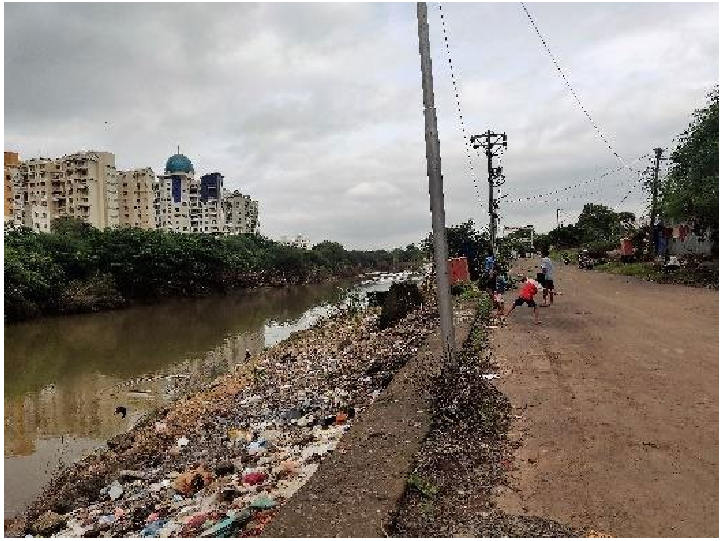 Fig 1: The reality of Pune's infrastructure: temporary tanks and ad hoc pipes sitting alongside modern buildings.
Key Insight: The Politics of the "Smart Meter"
The paper highlights a fascinating clash: The Pune Municipal Corporation is pushing for Automatic Meter Reading (AMR) to establish a data-driven "ground truth."
- The Engineer’s View: "I can point-blank show them their consumption and prove their complaints are wrong."
- The Resident’s View: Hundreds of residents physically removed these meters. Why? Because a meter that records "zero flow" during a municipal failure still charges them a flat tax, and a meter that records "high flow" prevents them from hacking the system to get extra water for their families.
In Pune, technology is seen not as a tool for empowerment, but as a "black-boxed hegemon" that threatens the hard-won agency of the Jugaad.
Lived Experiences: From "Human Pumps" to Chemical Hacks
The study documents the physical and social labor required to be a "Hydraulic Citizen":
- The Human Pump: Sucking water out of pipes manually to create pressure.
- The Acid Hack: Using toilet cleaner (Harpic) to dissolve the salt deposits left by low-quality groundwater in washing machines.
- Social Exclusion: "Bachelors" and renters being barred from society WhatsApp groups where water timings are discussed, creating a "second-grade" citizenship.
 Fig 2: The complex geography of Pune, where rapid outward growth has outpaced pipe networks.
Critical Analysis: "Infrastructured Citizenship"
The core contribution of this work is the concept of Infrastructured Citizenship. The authors argue that we should decouple "citizenship" from "government." If the government can't provide water, the person who coordinates a water tanker for their neighbors is performing an act of citizenship.
Limitations: While the study provides rich qualitative depth, it focuses on the "urban middle class." The experience of those in slums (slum-dwellers) who have zero piped access is even more precarious and requires its own separate "human infrastructure" analysis.
Future Outlook: Designing for the "Fissures"
For the Global South, "Smart" shouldn't mean "Monolithic." The authors suggest that instead of trying to eliminate "leakage" and "hacks," future social computing systems should:
- Support citizen self-reporting that isn't just about "complaints" but about "co-creation."
- Accept heterogeneous data: Acknowledge that a resident’s bucket-count is as much a "ground truth" as a digital meter.
- Recognize Jugaads as legitimate design entries, not "system errors" to be patched.
In an era of climate change and crumbling global systems, Pune’s "flaky accretions" might not be an outlier—they might be a preview of the future for us all.