
The Flexibility Trap: Why Restricting dLLMs Unlocks Superior Reasoning
The Flexibility Trap: Rethinking the Value of Arbitrary Order in Diffusion Language Models
The paper introduces JustGRPO, a minimalist RL framework for Diffusion Large Language Models (dLLMs) that achieves SOTA reasoning performance (e.g., 89.1% on GSM8K) by intentionally restricting generation to an Autoregressive (AR) order during training. This approach bypasses the complexity of arbitrary-order denoising while fully retaining the dLLM's native parallel decoding efficiency at inference.
TL;DR
Diffusion Large Language Models (dLLMs) are celebrated for their "arbitrary-order" generation, yet this very flexibility might be their Achilles' heel in complex reasoning. A new study from Tsinghua University reveals that dLLMs use this freedom to dodge difficult logical decisions, leading to poor exploration. By forcing the model back into a "boring" left-to-right order during RL training—a method called JustGRPO—the researchers achieved state-of-the-art results on math and coding benchmarks while keeping the speed of parallel decoding.
The "Flexibility Trap": Logic is Not a Puzzle
In image generation, you can paint the eyes or the background in any order. In reasoning, however, the sequence is the logic. Standard dLLMs allow the model to pick "easy" tokens first. The authors observed a devastating side effect: Entropy Degradation.
When a model can choose its own order, it avoids "Logical Forks"—connectives like Therefore or Since—which have high entropy because they represent branching paths of thought. By filling in the "easy" future tokens first, the model prunes these branches prematurely. By the time it returns to fill the connective, the logic is already "locked in," destroying the diversity needed for Reinforcement Learning (RL) to find better solutions.
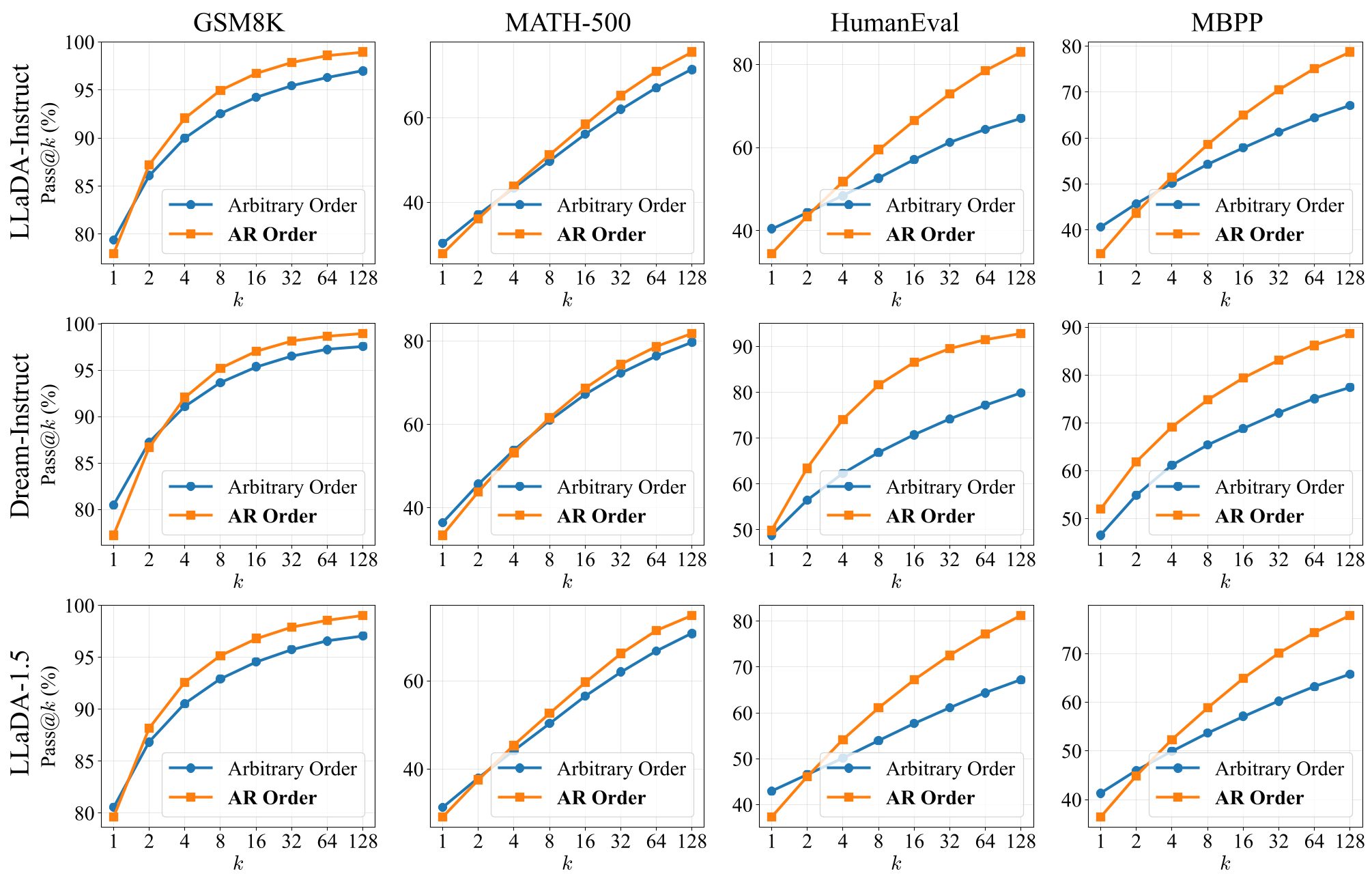 Figure: The AR order (left-to-right) consistently shows a higher Pass@k, meaning it explores a much larger and more useful solution space than the flexible Arbitrary Order.
Methodology: JustGRPO
Current RL methods for diffusion models are notoriously complex. They try to account for all possible unmasking permutations ( trajectories), leading to messy approximations and high computational "taxes."
JustGRPO cuts through this complexity with a radical insight: Use AR as a scaffold.
- Training Phase: The dLLM is treated as a standard Autoregressive policy. For every step, it only "sees" the past and must predict the next token.
- Optimization: Because the order is fixed, we can use the standard Group Relative Policy Optimization (GRPO) objective. No fancy diffusion-specific math is required.
- Inference Phase: Once trained, the "AR scaffold" is removed. The model returns to being a dLLM, capable of bidirectional attention and parallel decoding.
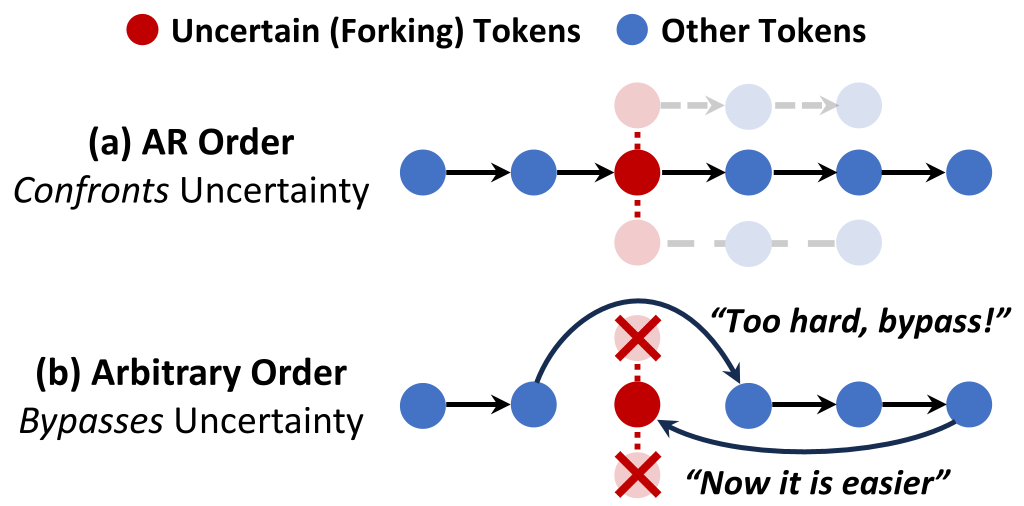 Figure: AR order forces the model to confront uncertainty at logical forks, whereas arbitrary order bypasses it, leading to a collapse in reasoning diversity.
Experimental Results: The Best of Both Worlds
The results are striking. JustGRPO doesn't just simplify training; it crushes the competition.
- GSM8K: 89.1% (surpassing specific diffusion RL methods like d1 and ESPO).
- MATH-500: 45.1%.
- Parallel Efficiency: Surprisingly, an AR-trained model is more robust during parallel decoding. At 5 tokens per step, the accuracy gap between JustGRPO and the base model expands significantly (+25.5% on MBPP), suggesting the model has learned a more stable internal representation of logic.
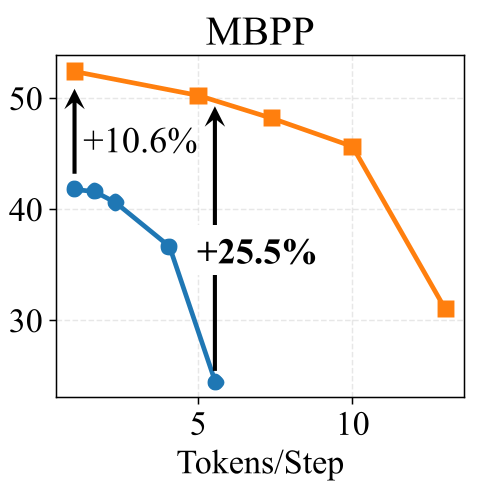 Figure: JustGRPO retains parallel decoding compatibility, proving that sequential training doesn't kill diffusion speed.
Critical Insight: The Value of Constraints
The most profound takeaway from this work is that Inductive Bias matters. While "arbitrary order" is a beautiful mathematical property of diffusion, the "left-to-right" causality of Human language and logic is a powerful prior. By enforcing this constraint during the high-stakes exploration phase of RL, we prevent the model from "cheating" and force it to become a better reasoner.
Limitations & Future Work
While JustGRPO is highly effective for reasoning, the authors note that for non-sequential tasks (like image editing or infilling), the arbitrary order remains essential. Future research could explore "hybrid" schedules that decide when to be rigid and when to be flexible.
Conclusion: If you want your Diffusion LLM to think better, tell it to follow the line.