
Harmonizing Knowledge and Nature: Boosting Shop Floor Efficiency with Knowledge-Mining Fish Swarms
The Research of Flexible Scheduling of Workshop Based on Artificial Fish Swarm Algorithm and Knowledge Mining
This paper introduces a Knowledge-Driven Artificial Fish Swarm Algorithm (K-AFSA) for solving the Flexible Job Shop Scheduling Problem (FJSSP). By integrating ontology-based knowledge representation with CART decision tree mining, the authors extract empirical scheduling rules to optimize the algorithm's initialization, achieving state-of-the-art performance in workshop efficiency and resource utilization.
TL;DR
Production scheduling is the heartbeat of manufacturing, yet it remains computationally "hard." This research introduces a breakthrough by combining Ontology-based knowledge representation and Data Mining (CART) with the Artificial Fish Swarm Algorithm (AFSA). By extracting "intelligence" from historical data to guide the "fish" (solutions), the authors achieved significant gains in scheduling speed, stability (variance -75%), and equipment utilization.
Background: Why Randomness Kills Efficiency
In the Job Shop Scheduling Problem (JSSP), we deal with a puzzle: workpieces, machines, and a web of constraints. Most meta-heuristic algorithms (like GA, PSO, or AFSA) start with a random population.
- The Problem: Starting from scratch every time is inefficient. It ignores the wealth of "latent knowledge" hidden in previous successful schedules.
- The Insight: If we can teach the algorithm established rules (e.g., "prioritize jobs with high critical ratios"), we can prune the search space before the first iteration even begins.
Methodology: The Three Pillars of Intelligence
1. Semantic Architecture (Ontology)
The authors don't just feed raw numbers into a model. They use a six-tuple ontology: This defines the relationships between tasks, resources, and constraints, ensuring the system understands the "logic" of the workshop rather than just treating it as a mathematical matrix.
2. Knowledge Mining via CART
To turn data into rules, the Classification and Regression Tree (CART) algorithm is employed. By calculating the Gini Impurity Index, the system identifies which attributes (like Remaining Process Time - RPT or Delivery Time - DT) are the best predictors of a "good" schedule.
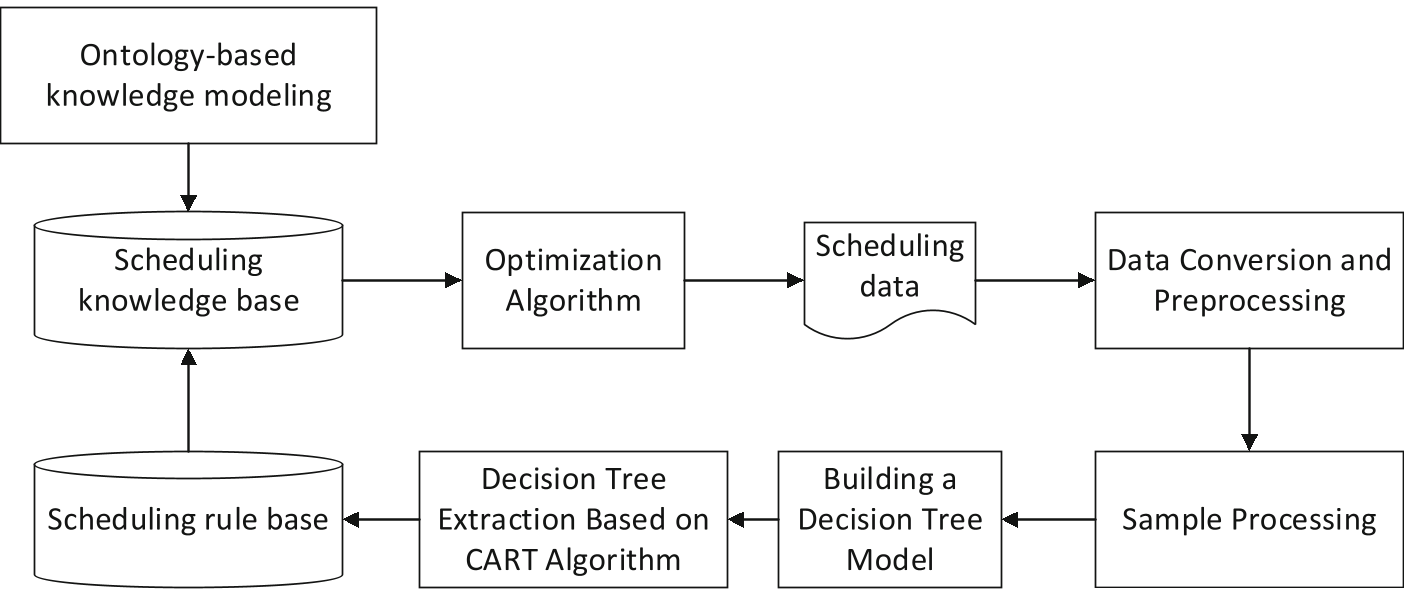 Figure 1: The Decision Tree structure extracted to form IF-THEN scheduling rules.
3. Guided Fish Swarm (K-AFSA)
The Artificial Fish Swarm Algorithm mimics the social behavior of fish (praying, swarming, following). In this paper, instead of dropping "fish" randomly into the "ocean" of possible schedules, the extracted CART rules are used to initialize the population. This "Knowledge-Driven" approach ensures the fish start in nutrient-rich waters.
Experimental Battleground: 6x6 and 8x8 Scenarios
The authors validated their approach against Traditional AFSA, Genetic Algorithms (GA), and Ant Colony Optimization.
| Method | Makespan (6x6) | Variance | Efficiency Gain |
|---|---|---|---|
| Traditional AFSA | 1660 | 1.53 | Baseline |
| Improved K-AFSA | 1560 | 0.38 | Highly Stable |
| Genetic Algorithm | 1690 | 1.46 | Lower Accuracy |
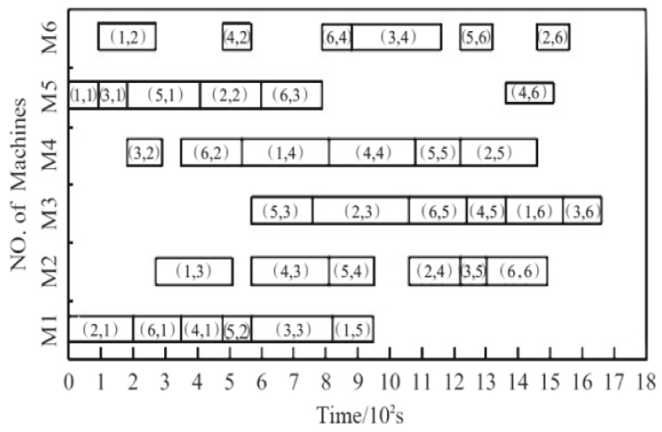 Figure 2: Gantt Chart comparison showing significantly higher machine utilization in the knowledge-driven version (bottom) vs the traditional version (top).
Deep Insights & Critical Analysis
The true value of this work lies in stability. Meta-heuristics are notoriously stochastic; however, by tethering the AFSA to an Ontology-based rule set, the authors reduced the variance from 1.53 to 0.38. This makes the algorithm reliable for real-world industrial deployment where "predictable performance" is as valuable as "peak performance."
Limitations:
- The rule extraction is currently based on static historical data.
- In a highly dynamic "Lights-Out" factory, these rules might need frequent automated retraining to account for machine wear or unexpected breakdowns.
Conclusion
This paper serves as a bridge between Symbolic AI (Ontology) and Connectionist/Heuristic AI (Swarm Intelligence). It proves that we don't need "more compute" to solve hard problems—we need "smarter starts." For technical leads in manufacturing, the takeaway is clear: stop treating scheduling as a pure optimization problem and start treating it as a knowledge management problem.
Academic References
- Ontology modeling based on the 6-tuple:
- Knowledge extraction via Gini Index:
- Core algorithm: Improved Artificial Fish Swarm (K-AFSA)