
Fusing Tags and Social Ties: A Generative Approach to Flickr Group Recommendation
Flickr Group Recommendation Based on User-Generated Tags and Social Relations via Topic Model
This paper introduces a topic-based group recommendation model for Flickr that integrates user-generated tags and asymmetric social relations. By leveraging an Author-Topic (AT) generative framework, the system captures latent semantic interests and fuses them with contact-based preferences to suggest relevant social groups.
TL;DR
In the vast ecosystem of Flickr, users often struggle to find groups that align with their niche interests. This paper proposes a hybrid recommendation framework that uses an Author-Topic (AT) model to extract latent interests from user-generated tags while simultaneously incorporating the influence of a user's social contacts. By balancing personal tag history and social circle preferences, the model delivers state-of-the-art group suggestions.
Context & Motivation
Flickr is more than a photo repository; it is a complex "folksonomy" where users, tags, and groups interact. The authors identify two primary drivers of user behavior:
- Semantic Interest: What a user tags (e.g., "vintage," "Leica," "portrait") directly reflects their topical preference.
- Social Influence: Users are likely to explore groups joined by their contacts, as social ties often imply shared aesthetics or hobbies.
While previous work used Collaborative Filtering (CF) or Matrix Factorization, these methods frequently suffer from cold-start problems and data sparsity. This paper argues that a probabilistic generative model can bridge these gaps by discovering the latent topics that connect tags, users, and groups in a unified space.
Methodology: The Author-Topic Framework
The core of the approach rests on the Author-Topic (AT) Model, which extends Latent Dirichlet Allocation (LDA). In this context:
- Users are treated as "authors."
- Groups are "documents."
- Tags are "words" within those documents.
1. Latent Topic Extraction
The model assumes that every user has a distribution over topics, and every topic is a distribution over tags. Using Gibbs Sampling, the model estimates two critical distributions:
- (Topic-Tag): The probability of a tag belonging to a specific topic.
- (User-Topic): The probability of a user being interested in a specific topic.
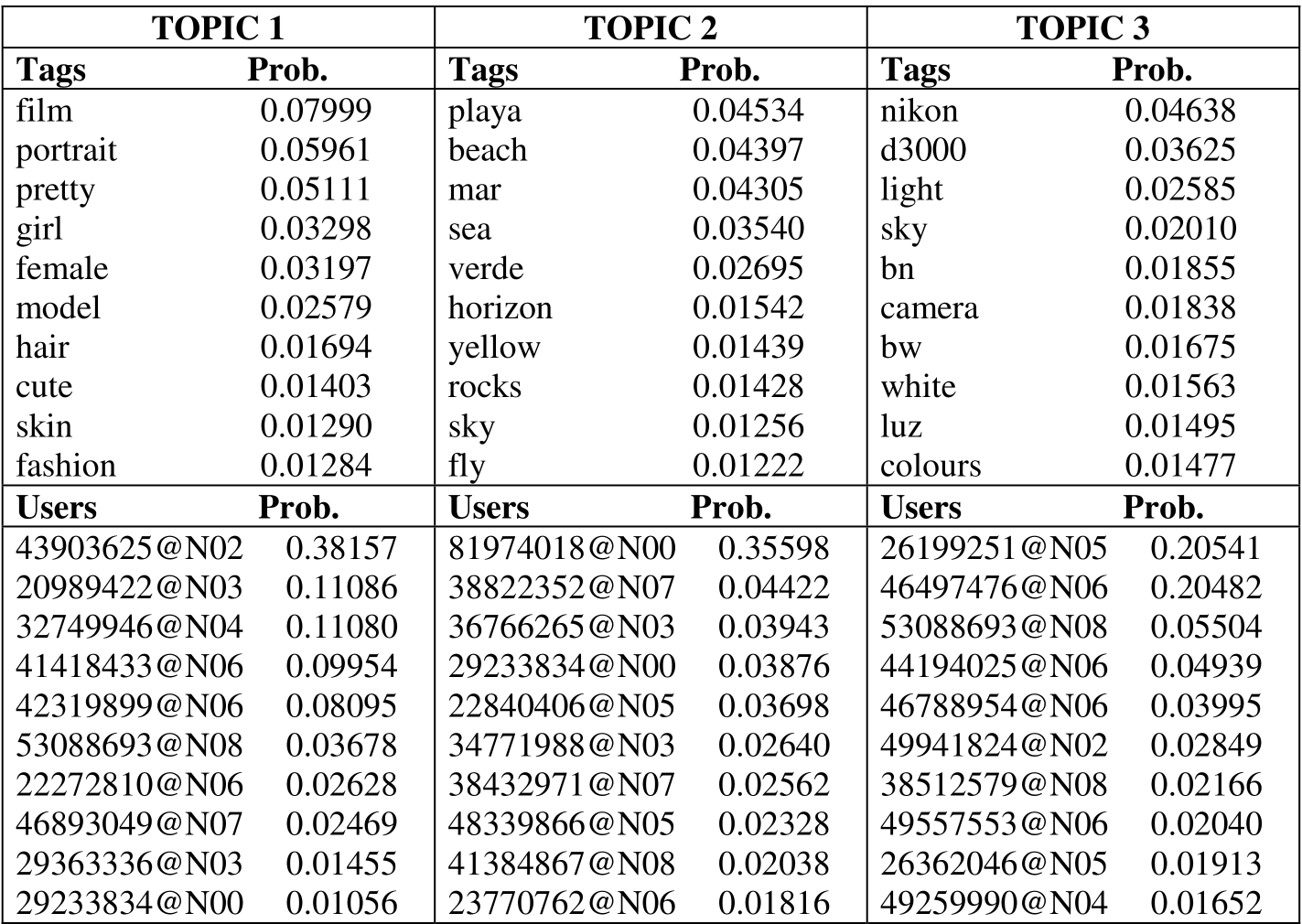 Table 1: Examples of discovered topics (Portrait, Seascape, Equipment) and their associated high-probability users.
2. The Hybrid Recommendation Logic
The recommendation score is a weighted sum (linear interpolation) of two perspectives:
- Personal Preference (): Calculated by matching the user's topic distribution directly with the group's topic footprint.
- Social Preference (): Calculated by averaging the topic distributions of the user's contacts, assuming "friends of friends" share interests.
The final decision is governed by the parameter :
Experimental Validation
The authors crawled 193 users and over 150k triples. The evaluation focused on Top-k Recommendation Accuracy, comparing the proposed model against standard Collaborative Filtering (UB) and Non-negative Matrix Factorization (NMF).
Key Findings:
- Optimal Balance: The best results were achieved at . This suggests that while social contacts are influential, a user's personal tag history remains the strongest predictor of their group-joining behavior.
- Sparsity Resilience: Unlike standard User-based CF, which performed poorly due to the sparse nature of the user-group matrix, the topic-based approach maintained high precision by operating in the "latent topic" space rather than the "raw interaction" space.
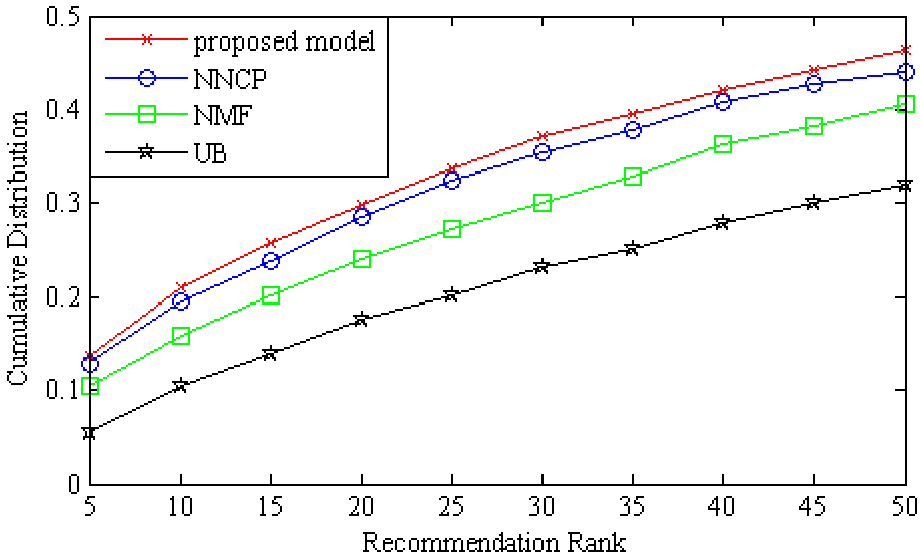 Figure 1: Comparison of the proposed topic model against CF, NMF, and NNCP. The proposed model (at the top) shows superior recall across all @N positions.
Critical Analysis & Conclusion
The strength of this work lies in its interpretability. Unlike black-box factorization methods, the AT model allows us to see why a group was recommended (e.g., because it belongs to the "Film Photography" topic, which both the user and their friends favor).
Limitations:
- Dataset Scale: The study used a relatively small sample (193 users). Scaling Gibbs sampling to millions of users presents computational challenges.
- Implicit Social Weighting: The model treats all contacts equally, whereas in reality, some friends are more "influential" than others.
Future Outlook: The next logical step is integrating Temporal Dynamics (how interests change over time) and potentially using Graph Embeddings to more deeply model the multi-hop relationships in the social network.