
Decoding Social DNA: How the Flickr Network Actually Grows
Growth of the flickr social network
This paper presents a longitudinal study on the growth dynamics of the Flickr social network, tracking over 950,000 users and 9.7 million new links over three months. The researchers identify three primary drivers of link formation: reciprocation, preferential attachment, and a significant proximity bias that favors "friend-of-a-friend" connections.
TL;DR
While many believe social networks expand simply because "the famous get more famous," this landmark study on Flickr reveals a more intimate reality. By analyzing nearly 10 million new links, researchers found that growth is driven less by global popularity and more by reciprocity and local proximity (connecting to friends-of-friends).
The Gap Between Theory and Reality
Before this study, our understanding of social networks was largely "static." We knew they looked like "small worlds" with power-law distributions, but we didn't know how they got there. Theoretical models like the Barabási-Albert (BA) model suggested a global "Preferential Attachment" mechanism—where new links are handed out based on a user's total popularity.
However, the authors hypothesized that users don't have a "god's eye view" of the network. Instead, they navigate their immediate surroundings. The challenge was proving this with massive, real-world data.
Methodology: The Daily Crawl
The team monitored Flickr's growth over 104 days, capturing a 58% increase in the user population.
| Metric | Value |
|---|---|
| Observed New Users | 950,143 |
| Observed New Links | 9,792,634 |
| Growth in Links | 63% |
By revisiting every discovered user daily, they could pinpoint exactly when a link appeared and who it connected.
Core Insights: The Three Pillars of Growth
1. The Courtesy of Reciprocation
Flickr is a directed network. Interestingly, 62% of links are symmetric. The data shows that social "etiquette" is a major driver: 83% of reciprocal links are formed within 48 hours. When someone follows you, you likely follow them back almost immediately.
2. Preferential Attachment: Creation vs. Reception
The study split preferential attachment into two distinct behaviors:
- Preferential Creation: Users with more existing friends are more active in seeking new ones.
- Preferential Reception: Popular users are more likely to be found by others.
Both showed a linear correlation (Rich-Get-Richer), but this was only part of the story.
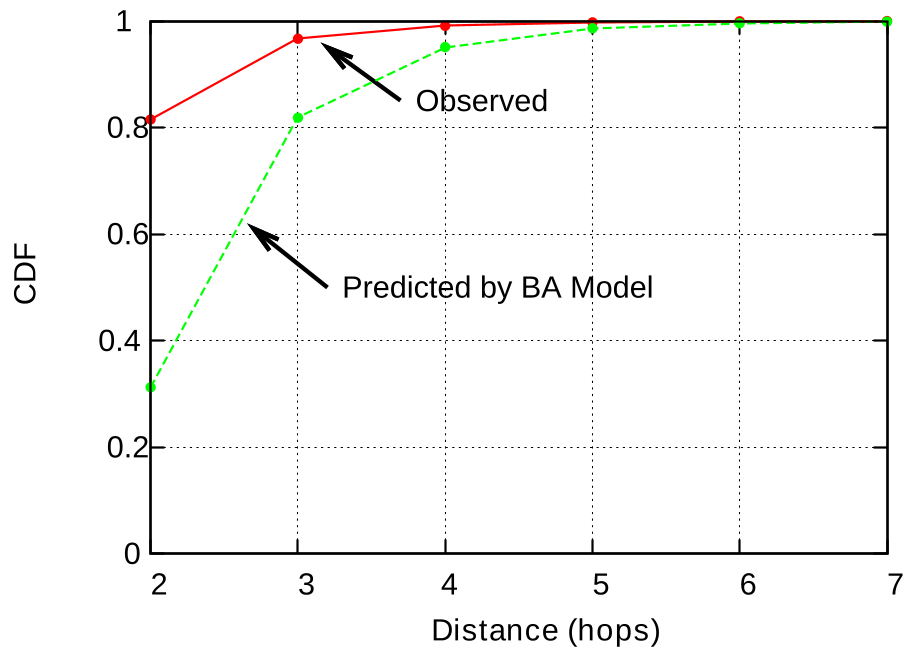 Figure: The linear relationship between indegree and the number of new followers received daily.
3. The Proximity Bias (The "Aha!" Moment)
This is where the BA model fails. If growth were purely about global popularity, the distance between two new friends would be relatively random. Instead, the researchers found that 80% of new links were between people who were already "friends-of-friends" (2 hops away).
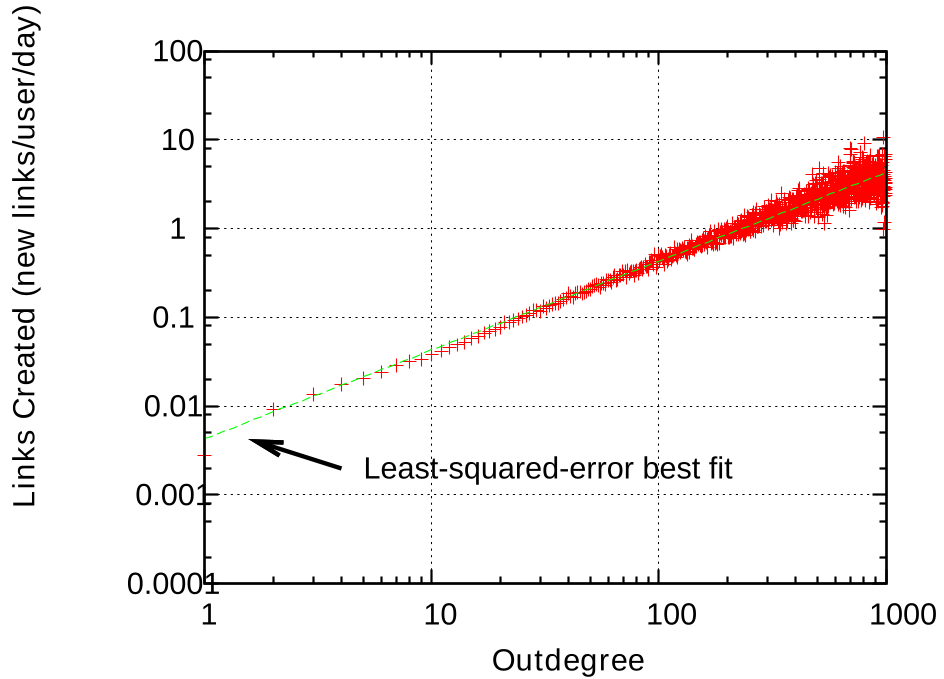 Figure: The empirical data (solid line) shows a much higher concentration of 2-hop links compared to the BA model (dashed line).
Why This Matters
The findings suggest that the Discovery Mechanism of a platform dictates its growth. Because Flickr (at the time) encouraged "walking the graph" (clicking through friends' profiles), the network grew locally.
Implications for Today:
- Algorithm Design: Recommendation engines ("People You May Know") are essentially digitizing this natural proximity bias.
- Network Robustness: Local growth leads to high clustering, making the network more resilient but also more prone to echo chambers.
- Marketing: If you want a product to go viral, targeting a "hub" isn't enough; you need to target the hub's immediate social neighborhood.
Critical Analysis
While the paper is a masterclass in empirical measurement, it acknowledges a limitation: it couldn't see why users made links (e.g., off-site communication). However, its conclusion remains solid: social networks are not just math; they are a reflection of local human interaction.
Takeaway: The next time you follow a friend's friend, you aren't just being social—you are participating in a fundamental law of network evolution that is 3x more powerful than global fame.