
Social Media & Synchronous Learning: Reimagining the Flipped Classroom through Learning Styles
Flipped Classrooms Using Social Networks: An Investigation on Learning Styles
This paper investigates the integration of the Felder-Silvermann Learning Styles Model (FSLSM) within a Flipped Classroom framework facilitated by Facebook. By delivering micro-lectures on social media to 45 higher-education students, the study demonstrates that aligning content with dominant learning styles—specifically "Visual"—significantly enhances learner satisfaction.
TL;DR
This study explores how a "Flipped Classroom" powered by Facebook and tailored to individual learning styles (FSLSM dimensions) can boost student satisfaction. By breaking lectures into 10-minute micro-segments, researchers found that students—particularly those with a "Visual" preference—found social media platforms far more engaging than traditional Learning Management Systems (LMS) like Moodle.
Contextual Positioning
In the landscape of ICT in education, this work moves beyond the "what" of technology (using videos) to the "how" of student psychology (learning styles). It sits at the intersection of Social Learning and Personalized Pedagogy, addressing the persistent issue of student disengagement in hybrid settings.
Problem & Motivation: The "One Size Fits All" Trap
The "Flip" in a Flipped Classroom—moving content delivery out of the lecture hall—is often treated as a logistical change. However, as the authors note, simply recording a lecture doesn't guarantee motivation. Existing methods often ignore that some students are Global (need the big picture first), while others are Sequential (need step-by-step logic). Without addressing these "Inductive Biases" in human learning, the flipped content can feel like a burden.
Methodology: Engineering the Socialized Flip
The researchers conducted a pilot with 45 students using the Felder-Silvermann Learning Styles Model (FSLSM). The core of their intervention involved:
- Micro-Lectures: Lessons were scripted and capped at 10 minutes to maintain cognitive load limits.
- Social Media Integration: Facebook was chosen over Moodle because it encouraged "ubiquitous" participation—students liked and commented more naturally in a social environment.
- Non-Linear Navigation: Content was structured so students could "jump" between sections, catering to both Global and Sequential learners.
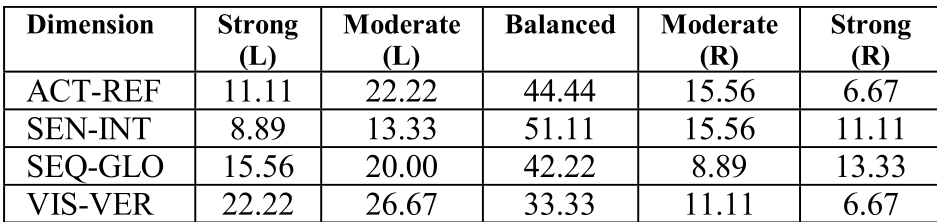 The table above illustrates the distribution of learning styles among the student cohort, highlighting the "Balanced" to "Visual" skew.
Key Results: Content-Style Alignment
The data suggests a clear win for social-platform-based learning:
- Style Dominance: 22.22% of students showed a "Strong" preference for Visual learning, directly correlating with the high satisfaction scores for video-based delivery.
- LMS vs. Social Media: 53% of participants explicitly preferred Facebook over Moodle for content consumption.
- Interaction: The "like" and "comment" culture of social networks provided a more seamless feedback loop than the sterile environment of a traditional LMS.
However, the study also uncovered a "Pre-class Burden"—students felt the time required to prepare before the actual lecture was high, suggesting that while the quality of engagement is higher, the cost of student time must be carefully managed.
Critical Analysis & Conclusion
Takeaway
The paper proves that the Medium is the Message. Social networks aren't just distraction engines; when used for Flipped Classrooms, they act as a "Complementing Platform" that bridges the gap between formal education and the students' daily digital habits.
Limitations & Future Work
The primary challenge remains Capturing Learning Styles accurately at scale. Filling out a 44-question ILS survey is a friction point. Future systems might aim to infer learning styles based on how students interact with content (e.g., do they skip to the end? do they re-watch diagrams?).
Additionally, while visual learners thrive with video, Verbal learners still require robust text support. The authors' addition of narration scripts is a step in the right direction to ensure "Universal Design for Learning" (UDL).