
F-Loc: Deciphering Vertical Space through Crowdsourced Elevator Patterns
F-Loc: Floor Localization via Crowdsourcing
F-Loc is a crowdsourcing-based floor localization system that identifies a user's floor level in multi-story buildings using Wi-Fi signals and smartphone accelerometers. It eliminates the need for labor-intensive "war-driving" or prior building infrastructure knowledge, achieving 98% accuracy in real-world 10-floor environments.
TL;DR
F-Loc is a zero-infrastructure floor localization system that bypasses the tedious "war-driving" process. By detecting elevator usage via smartphone accelerometers and clustering the associated Wi-Fi fingerprints, it automatically maps the vertical topology of any building. It reaches over 98% floor accuracy in real-world trials, even in buildings with sparse Wi-Fi coverage.
Background & Motivation: The Vertical Challenge
While GPS dominates outdoor navigation, indoor vertical positioning remains a "last mile" problem. Traditional Wi-Fi fingerprinting (like RADAR) requires manual surveys of every square meter, while sensor-based methods (barometers) are notoriously affected by weather and air conditioning.
The authors of F-Loc noticed a crucial human-building interaction: people in high-rise buildings almost always use elevators. These elevators provide a distinct "physical signature" on accelerometers that can be used as a natural separator for floor levels.
Methodology: The Core Mechanism
F-Loc operates in two distinct phases: Map Construction and Localization.
1. Elevator Activity Recognition
The system identifies a unique "Trough-Crest" (accelerating) and "Crest-Trough" (decelerating) pattern in the derivative of acceleration data. This allows the system to segment Wi-Fi traces into "Entrance" and "Exit" groups, immediately establishing a relative order (Floor A is lower than Floor B).
2. Intelligent Clustering & Pruning
Using an adapted CURE (Clustering Using REpresentatives) algorithm, F-Loc merges Wi-Fi groups from different users into floor-specific clusters. Key innovations here include:
- Logical Constraints: If a User Trace shows a transition from Group A to Group B, these two groups can never be in the same cluster.
- DAG-based Ordering: The system builds a Directed Acyclic Graph of clusters. The "Longest Path" in this graph corresponds to the total floor count of the building.
3. Cluster Expansion
Since elevators only cover entrance areas, F-Loc uses a sliding-window expansion algorithm. As users walk away from the elevator, the system "grows" the floor cluster by incrementally adding new Wi-Fi samples as long as they statistically align with the established floor signature.
Performance Benchmarks
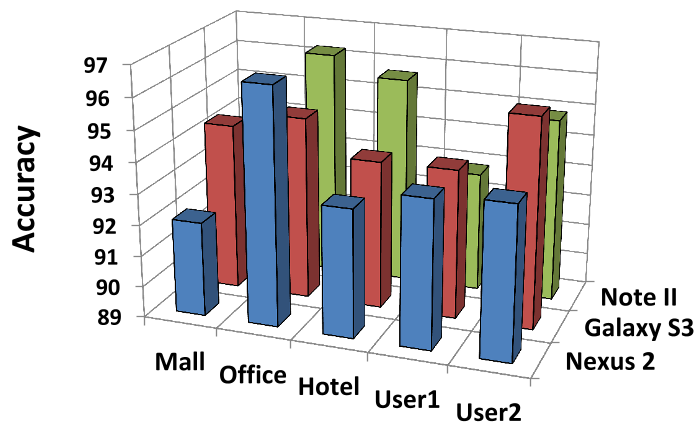
The system was tested using real-world data from malls, hotels, and offices.
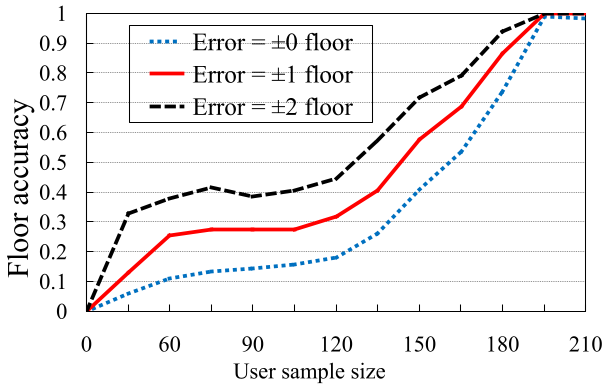
- Accuracy: Achieved 98.8% accuracy at the exact floor level (±0) in a 10-floor field study.
- Robustness: Even when Wi-Fi coverage was artificially reduced to only 2 access points per scan, accuracy remained above 85%.
- Scalability: In a 20-floor hotel simulation, the system reached 90% accuracy with 1500 crowd-sourced samples—a volume easily reached in busy commercial buildings within days.
Critical Insights
What makes F-Loc stand out is its Inductive Bias regarding human behavior. By focusing on a "choke point" (the elevator), it avoids the noise of general walking patterns. Unlike previous SOTA works like SkyLoc, which struggled with GSM variance, F-Loc’s use of clustering logic over raw signal matching makes it far more resilient to the "noisy" nature of smartphone sensors.
Limitations & Future Work
- Elevator Dependency: The current model relies heavily on elevator usage. Buildings relying solely on stairs or escalators would require different activity signatures.
- Crowd Density: The system requires a "warm-up" period to collect enough traces to build the initial DAG.
Conclusion
F-Loc represents a significant shift from "deterministic mapping" to "probabilistic crowdsourcing." It proves that by understanding local physical constraints (elevators) and combining them with opportunistic signal collection, we can build highly accurate localization systems that require zero manual labor.