
Unearthing the "Dark Age": An Ethnographic Journey into Japan's FLOSS History
The FLOSS history in Japan: an ethnographic approach
This paper introduces the "FLOSS Stories in Japan" project, an ethnographic study designed to document the growth of Free/Libre/Open-Source Software (FLOSS) in Japan through oral history. The project creates a comprehensive chronicle of the 1980s-2000s era, capturing the cultural and technical shifts led by key Japanese developers and organizations.
TL;DR
The "FLOSS Stories in Japan" project is a vital ethnographic mission to rescue the fading memories of Japan's open-source pioneers. By interviewing the architects of the 1980s and 90s tech scene, researchers have uncovered how community structures differed between Linux and BSD, and discovered that the "failed" government-led Sigma Project actually secretly fertilized the growth of major Japanese open-source tools.
Background: Rescuing a Fading Legacy
The year 2013 marked several milestones in Japan: the 30th anniversary of the Japan Unix Society and the 20th anniversary of the Ruby programming language. Yet, as the "founding fathers" of the Japanese Internet retire, a significant portion of their institutional memory—the "why" behind the code—is disappearing.
The authors argue that while code is archived on GitHub, the social context of the late 80s and 90s remains a "dark age." This project aims to turn oral testimonies into a compass for future generations.
Methodology: Mapping the Ecosystem
To capture the history systematically, the researchers used a hierarchical "Mind Map" approach to identify the interplay between technology, business, and individuals.
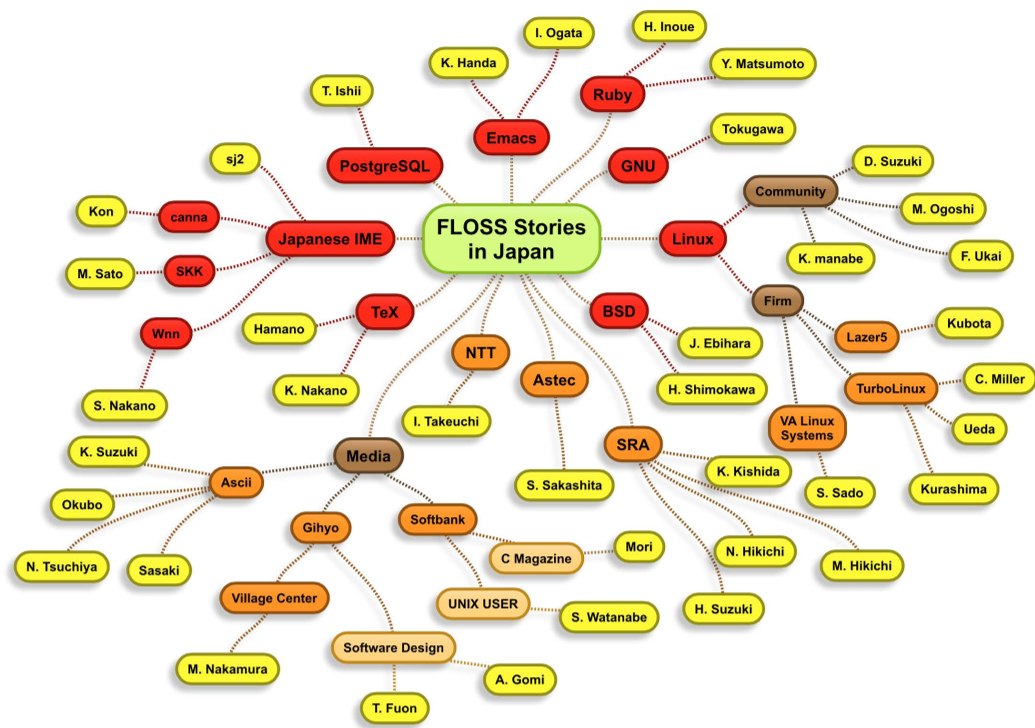
- Technologies (Red Nodes): Focus on localized essentials like Linux, BSD, Ruby, and Japanese Input Method Engines (IME) like Canna and Wnn.
- Stakeholders (Orange Nodes): Beyond tech giants like NTT, the authors emphasize the role of Publishers (e.g., SoftBank, Gijutsu Hyouronsha), who acted as the primary influencers before the age of social media.
Key Insights: Community DNA and Hidden Funding
1. Grass-roots vs. Academy
One of the project's most striking findings is the cultural divide in how operating systems gained traction in Japan:
- Linux: Characterized by "grass-roots" enthusiasm, driven by hobbyists and developers outside traditional power structures.
- BSD: Rooted in the "orthodox" academic community, flourishing within universities and research institutions.
2. The Sigma Project: A Productive Failure?
The Sigma Project (1985) is often cited in textbooks as a classic example of failed industrial policy—a government attempt to "industrialize" software that yielded no commercial fruit.
However, the ethnographic interviews tell a different story. While the project failed its primary goals, it acted as a massive talent incubator. Funding from Sigma-related sub-projects inadvertently supported the development of GWM and Wnn, providing the financial "oxygen" that allowed early Japanese FLOSS projects to breathe and evolve. This "hidden impact" suggests that even failed policies can have a profound positive legacy if they support the right people.
Critical Analysis & Conclusion
The value of this paper lies in its movement away from "code-as-history" toward "people-as-history." It reminds us that technologies like Ruby or localized Linux distros didn't emerge in a vacuum; they were products of specific social tensions and unexpected financial lifelines.
Limitations: As an interim report, the data is still narrow (7 interviews). The reliance on oral history also introduces "recall bias," where interviewees might romanticize or misremember the past.
Future Work: The team intends to expand their interview list to include more diverse contributors and eventually publish a comprehensive "Chronicle of Japanese FLOSS" that bridges the gap between the 20th-century pioneers and today’s global contributors.
Takeaway for Today
The success of open-source in Japan wasn't just about writing better code—it was about building communities (grass-roots vs. academic) and finding creative ways to leverage government resources, even when the official project goals were failing.