
The Flouted Naming Game: Why Societies Don't Always Agree
The flouted naming game: contentions and conventions in culture
This paper introduces the "Flouted Naming Game" (FNG), an extension of the canonical Naming Game framework that explores how cultural contentions—rather than just conventions—can be maintained in agent-based systems. By incorporating asymmetric cognitive rewards for cognate versus non-cognate traits, the model demonstrates a sharp phase transition between a state of diversity (contentions) and linguistic uniformity (conventions).
TL;DR
In the world of AI-driven linguistic modeling, the "Naming Game" has long been the gold standard for explaining how consensus (conventions) emerges. However, this paper by Harold P. de Vladar argues that consensus is only half the story. By introducing a "Flouted" version of the game, the research shows how asymmetric rewards—the tendency to prefer our "own" words over others even when we understand both—can lead to stable cultural contentions. This work identifies a critical phase transition where diversity suddenly collapses into uniformity, proving that larger populations are actually better at keeping disagreements alive.
Context: The Problem with Total Agreement
In a standard Naming Game (CNG), agents interact until everyone uses the same word for the same object. While this explains how "language" forms, it ignores "culture." In the real world, Americans say soccer and Britons say football. We understand each other, yet we refuse to converge. Prior models struggled to maintain this "polymorphism" without physical isolation. The author’s insight is that the human brain doesn't treat all information equally; we have a cognitive bias—or "identity"—that weights rewards differently.
Methodology: The Flouting Mechanism
The core of the "Flouted Naming Game" (FNG) lies in its update rule. Instead of a uniform learning rate, the author proposes:
- Cognate Reward (): High reinforcement for the agent's "native" term.
- Flouting Reward (): Lower reinforcement for the "alternative" term.
Mathematically, the update follows:
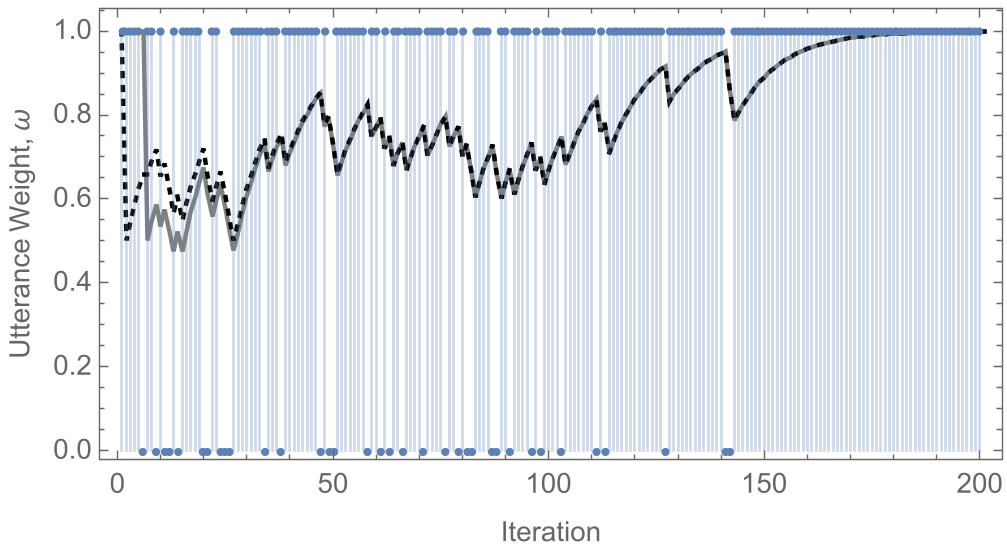 Figure 1: While the canonical game (above) leads to fixation, the FNG allows association weights to fluctuate without ever reaching 1.0.
The "Discovery" of the Cultural Phase Transition
The most striking finding is the existence of a Phase Transition. There is a specific threshold for the flouting reward (). If the reward for using the "other" word is too low, the population stays in a state of contention (diversity). If it crosses a critical point, the system suddenly "breaks" and collapses into a single convention.
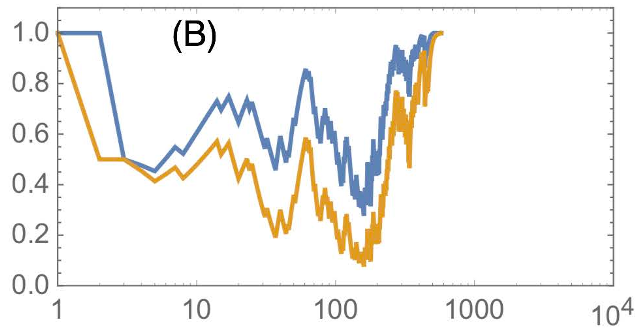 Figure 2: Evolution of weights over time. Note how in (A-D), weights fluctuate (contention), whereas in (E-F), one utterance eventually "wins" (convention).
Key Insights from Experiments:
- Population Size Matters: Counter-intuitively, larger populations (N=50+) are more stable at maintaining contentions. In a small group, a few random interactions can accidentally tip everyone toward one word. In large groups, the statistical "noise" is averaged out, preserving the cultural split.
- Statistical Mechanics of Culture: By plotting the variance of correlations between agent weights, the author found a "dip and spike" pattern—a classic hallmark of a phase transition in physical systems.
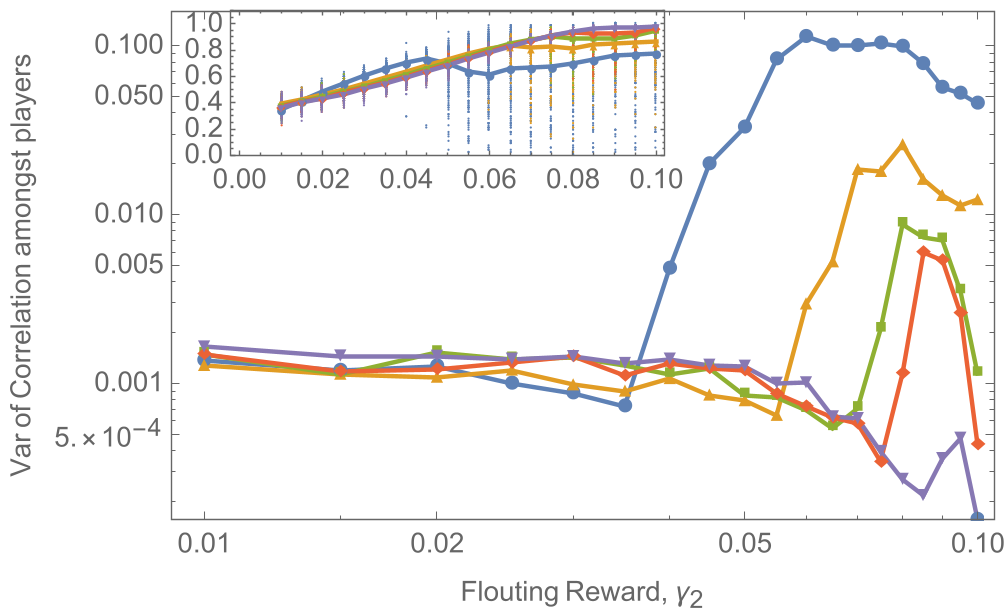 Figure 3: The variance (main plot) and mean correlation (inset) as a function of the flouting reward. The sharp change indicates a fundamental shift in the "phase" of the social system.
Critical Analysis & Conclusion
This paper elevates the Naming Game from a simple convergence algorithm to a tool for Evolutionary Sociology. It suggests that cultural diversity is not a "failure" of communication, but a stable biological/cognitive state.
Limitations: The model currently uses "well-mixed" populations (everyone can talk to everyone). In reality, social networks are hierarchical. How does "clique" behavior affect the flouting reward?
Future Outlook: By mapping these "games" to payoff matrices in Evolutionary Game Theory, we can begin to treat language change with the same mathematical rigor we use for genetic drift. This could lead to a better understanding of how digital "echo chambers" are formed not by lack of information, but by low "flouting rewards" in social algorithms.
Takeaway: Diversity is a feature, not a bug, of large-scale cognitive systems.