
Flow Map Language Models: Breaking the "Few-Step" Curse in Non-Autoregressive LMs
Flow Map Language Models: One-step Language Modeling via Continuous Denoising
The paper introduces Flow Map Language Models (FMLM), a continuous flow-based generative framework that achieves one-step language modeling. By utilizing continuous flows over one-hot token embeddings and a novel "two-time denoiser" reparameterization, the model matches state-of-the-art (SOTA) discrete diffusion performance and significantly outperforms existing distilled few-step models.
TL;DR
Researchers from KAIST and CMU have introduced Flow Map Language Models (FMLM), a framework that flips the script on the belief that discrete noising is necessary for language modeling. By treating tokens as continuous one-hot embeddings and distilling the "flow map" (the operator that jumps between timepoints), they achieved high-quality one-step text generation—a feat that previous discrete diffusion models failed to accomplish due to fundamental mathematical limitations.
The Problem: The "Independence" Trap
Traditional Autoregressive (AR) models are slow because they generate text token-by-token. To solve this, Discrete Diffusion Models (like MDLM) noise and de-noise full sequences in parallel. However, they rely on a factorized approximation: they assume tokens are independent during a step.
- The result? In many steps, they work well. In 1-2 steps, the model ignores the relationship between words, resulting in "word salad" or repetitive loops.
- The Mathematical "No": The authors prove (Proposition 3.5) that no sample-level deterministic map can generically replace the distributional flow map in discrete settings, making a true one-step discrete diffusion leap impossible.
The Methodology: Continuous Flow on a Simplex
The core innovation is migrating the problem to Continuous Euclidean Space. Instead of discrete jumps, the model follows a "velocity" field.
1. The Two-Time Denoiser ()
The breakthrough is the two-time denoiser. While a standard denoiser predicts the "clean" data from a noisy state, the two-time denoiser is a reparameterization that bridges two different timepoints ( and ).
- It ensures the prediction stays on the probability simplex (the math space where probabilities live).
- This allows the team to use Cross-Entropy loss, which is far more stable for language than the standard Mean Squared Error (MSE) used in image diffusion.
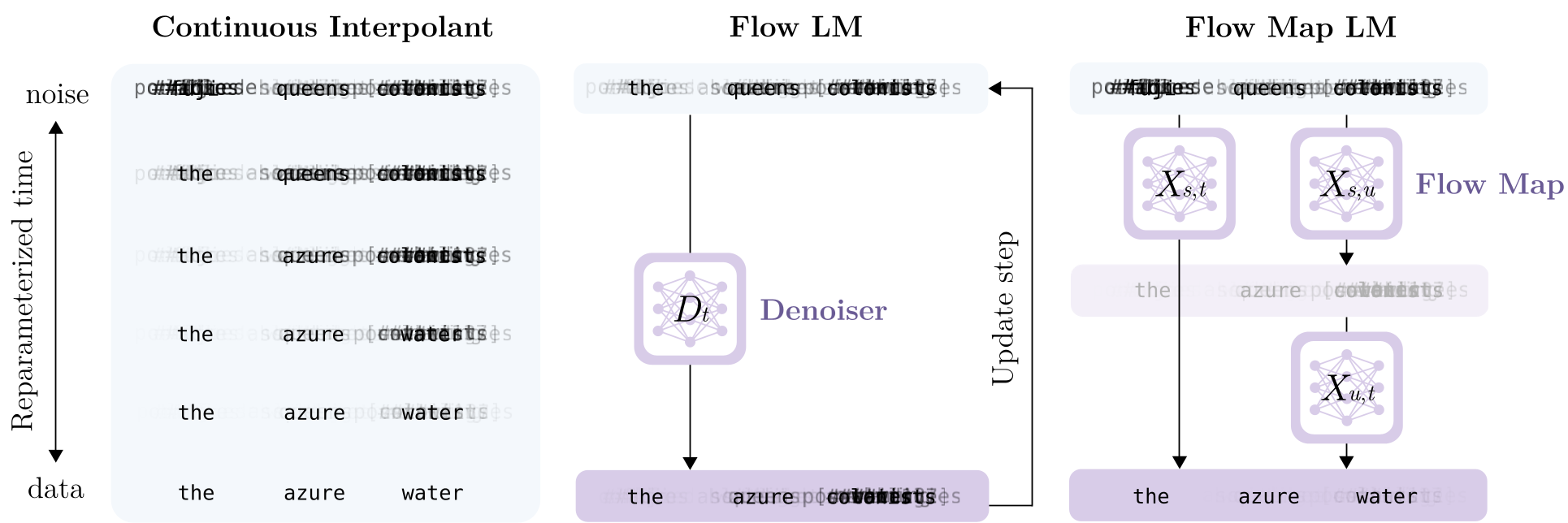 Figure: Overview of FLM/FMLM - bridging Gaussian noise to one-hot language data.
2. Time Reparameterization
Language models "decide" on tokens very late in the denoising process. The authors use a custom time schedule based on Decoding Error Rate to focus training where the most "deciding" happens, rather than wasting compute on pure noise.
Experimental Results: Speed Without Sacrifice
The experiments on LM1B and OpenWebText (OWT) show that FMLM is essentially the first model of its kind to handle one-step generation without "breaking" the text logic.
- Quality: FMLM's 1-step perplexity matches the 8-to-16-step performance of the best existing distilled discrete models.
- Logic: In a Sudoku generation task (a proxy for logical constraints), FMLM maintained 93.75% validity in 1024 steps and still managed to produce valid boards in just one step, whereas discrete baselines hit 0%.
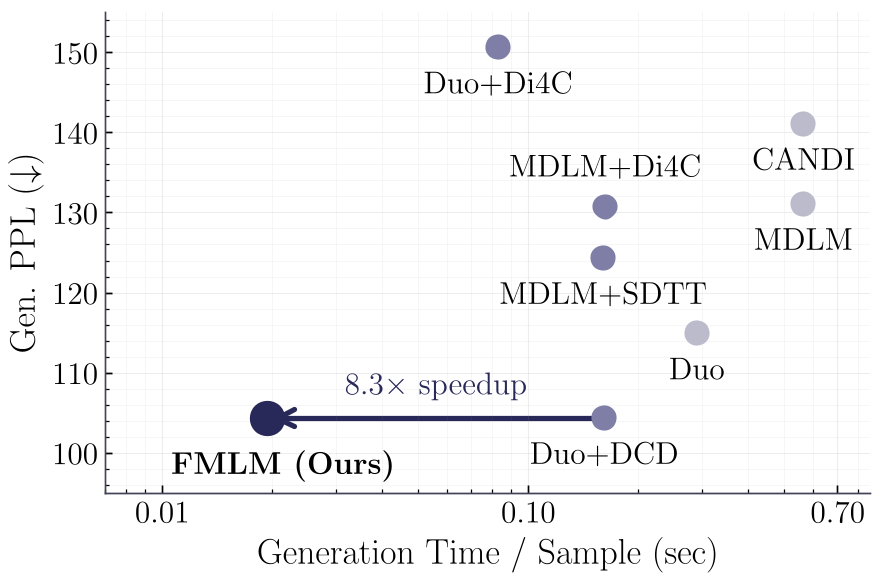 Figure: FMLM (Dark Purple) maintains high performance at 1-step while discrete models (Gray) collapse.
Advanced Steering: Autoguidance and FMTG
Because FMLM operates in continuous space, it inherits "guidance" tools from the image-generation world.
- Autoguidance: Using a weaker version of the model to push the stronger model's predictions towards higher quality.
- FMTG (Flow Map Trajectory Guidance): Since the flow map can "look ahead" to the finished sentence in one evaluation, it can use gradients from a classifier (e.g., "make this more positive") to steer the generation mid-flight.
Critical Insight & Conclusion
The success of FMLM challenges the industry's pivot toward discrete masking for parallel generation. It proves that Continuous Denoising is not only viable for language but superior when the goal is maximum inference speed (1-step).
Limitations: The current one-hot approach requires processing the full vocabulary matrix (), making it ~30% more memory-intensive during training than embedding-based methods. However, for inference—the ultimate bottleneck for LLMs—FMLM offers a profound speedup that could redefine real-time AI interactions.
Key Takeaway: The future of fast LLMs might not be discrete tokens, but a continuous flow that masters the probability simplex.