
FlowWM: Escaping the "Mean Future" with Flow Matching in Feature Space
Flow Matching in Feature Space for Stochastic World Modeling
FlowWM is a stochastic world model that performs flow matching directly in high-dimensional pretrained feature spaces (e.g., DINOv3). It achieves state-of-the-art results on the FuturePerception benchmark, significantly outperforming deterministic baselines and VAE-based models in downstream perception tasks like object detection and depth estimation.
TL;DR
For years, world models have been stuck between two worlds: the blurry low-resolution latents of VAEs and the deterministic "average" predictions of feature-space regressors. FlowWM breaks this deadlock by performing stochastic Flow Matching directly on high-dimensional DINOv3 features. By introducing a "one-step projection" for efficient training, it preserves semantic richness while capturing the inherent multimodality of the real world—achieving a 37% gain in downstream perception accuracy.
The "Average Future" Problem: Why Determinism Fails
In autonomous driving, the future is a fork in the road, not a single path. A pedestrian might cross or stop; a car might brake or accelerate. When we train deterministic models using standard or losses, we force the model to predict the conditional mean or median.
In feature space, this "mean" is often a nonsensical state that exists between valid modes. As the prediction horizon grows, these errors compound, leading to "blurry" features where semantic information (like object identity) evaporates.
Methodology: High-Dimensional Flow Matching
FlowWM shifts the generative process into the latent space of frozen encoders like DINOv3. However, standard Diffusion/DiT recipes often fail in these high-dimensional (D=384+) spaces.
1. Architectural Innovation
A critical insight from the paper is the Projection Head. While the backbone handles multimodal fusion, a shallow but "wide" projection head (dimension 1024) is required to accurately predict velocity fields in high-dimensional spaces.
2. The One-Step Projection Trick
One of the most elegant contributions is how FlowWM handles temporal consistency. Traditionally, optimizing for a "consistent" video requires backpropagating through the entire ODE solver (BPTT), which is a memory nightmare.
The authors propose One-Step Projection: By "peeking" at the predicted endpoint from any point in the flow, they can apply auxiliary losses (like temporal motion consistency or even a frozen object detector's loss) directly to the gradient.
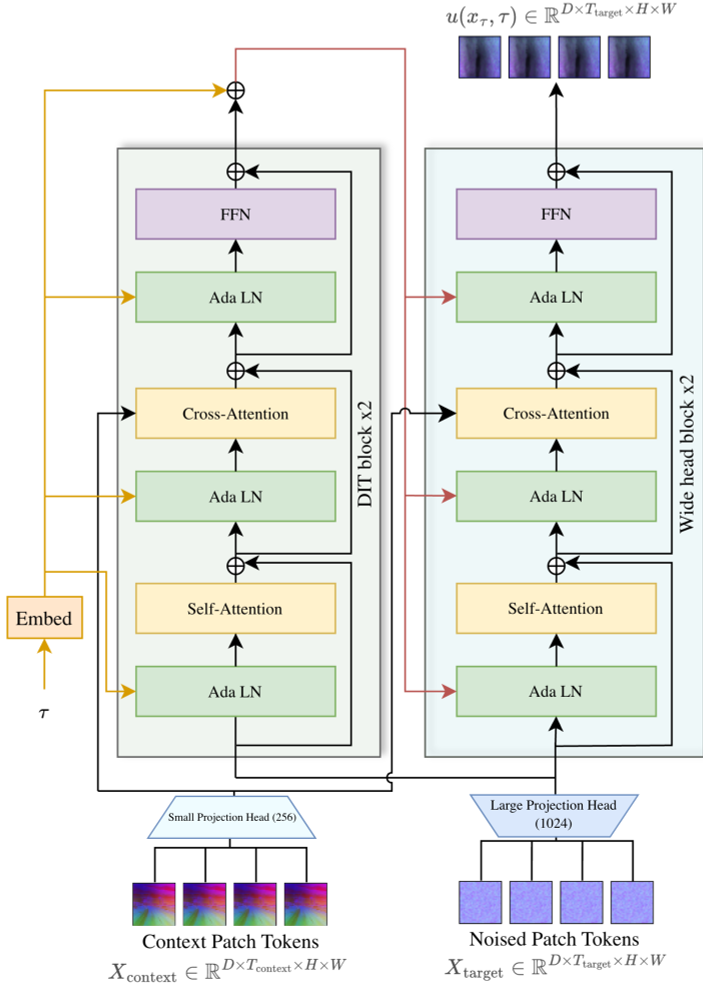 Figure: The FlowWM architecture using cross-attention for context and a wide head for velocity prediction.
Experiments: Superior Perception and Diversity
The authors validated FlowWM on FuturePerception, a benchmark based on the Waymo Open Dataset. Unlike VAE-based models, FlowWM maintains the "semantic fidelity" needed for high-level tasks.
- Object Detection: FlowWM reached 21.7 APL(6), trouncing deterministic baselines (15.2) and VAE-based stochastic models (18.2).
- Horizon Robustness: While deterministic models' errors explode over time, FlowWM's stochastic trajectories stay on the "data manifold," allowing it to sustain perception accuracy over much longer sequences.
 Table: FlowWM outperforms all baselines across detection and depth estimation.
Critical Analysis & Insights
The Shifted Schedule
A subtle but vital design choice was shifting the timestep schedule (-scaling). Because high-dimensional latents contain more "noise dimensions," the model needs a schedule that spends more time in the high-noise regime to learn stable trajectories.
Limitations
Currently, FlowWM relies on a frozen encoder. While this prevents "representation collapse," it also means the world model is only as good as the pre-trained features it uses. If the feature space misses a specific detail (like traffic light color), the world model will too.
Future Outlook
FlowWM proves that we don't need pixels to reason about the world. By operating in the "mind's eye" of a semantic encoder, world models can become faster, more diverse, and more useful for high-level planning. The next frontier? Action-conditioning. Integrating FlowWM into a policy loop could allow autonomous agents to "hallucinate" multiple scenarios and choose the safest one.
Takeaway: If you want a model that understands where a car is going 2 seconds from now, stop predicting pixels and start matching flows in feature space.