
Flow-OPD: Harmonizing Multi-Task Expertise in Flow Matching Models via On-Policy Distillation
Flow-OPD: On-Policy Distillation for Flow Matching Models
Flow-OPD is a novel post-training framework that introduces On-Policy Distillation (OPD) to Flow Matching (FM) text-to-image models. Built on Stable Diffusion 3.5 Medium, it consolidates multiple specialized expert models into a single generalist via dense, trajectory-level supervision, achieving state-of-the-art results across GenEval, OCR, and aesthetic benchmarks.
TL;DR
Post-training alignment for text-to-image models has long been a zero-sum game: focusing on OCR often ruins aesthetics, and chasing PickScore often breaks compositional logic. Flow-OPD changes this by importing On-Policy Distillation (OPD) from the LLM world into Flow Matching. By distilling dense trajectory-level knowledge from multiple specialized "experts" into one student, it reaches a GenEval score of 92 and OCR accuracy of 94, effectively ending the "seesaw effect" of competing metrics.
The Problem: The Sparse Reward Bottleneck
In the current generative landscape, we want "Generalist" models that can do it all: render perfect text, follow complex spatial instructions, and maintain top-tier aesthetics. Previous attempts used RL (like GRPO) with scalar rewards. However, scalar rewards are "information-poor."
As the authors point out, when you optimize for a single scalar (like PickScore), the model aggressively exploits unmonitored parameters, leading to Gradient Interference. This results in a frustrating "seesaw effect":
- Scenario A: You get great text rendering, but the images look like plastic (reward hacking).
- Scenario B: You get beautiful art, but the model forgets how to spell "Colony Mars."
Methodology: The Architecture of Expertise
Flow-OPD introduces a systematic two-stage pipeline to decouple expertise acquisition from model unification.
1. Expert Cultivation & Cold Start
First, specialized "Teacher" models are trained using single-reward GRPO to define the performance ceiling for specific domains (OCR, GenEval, etc.). To start the student model on the right foot, the framework uses a Flow-based Cold-Start, either through Supervised Fine-Tuning (SFT) on teacher trajectories or via Model Merging to blend initial priors.
2. Dense On-Policy Distillation
This is the core innovation. Instead of a single reward number, the student receives a velocity field reward. The student samples a trajectory (On-Policy), and a task-router assigns the relevant expert to provide a "target velocity."
The authors mathematically prove that in the continuous Flow Matching space, the Reverse KL Divergence collapses into a simple L2 distance between vector fields. This allows the student to follow the teacher's dense "thought process" throughout the entire denoising trajectory, rather than just getting a "good/bad" grade at the end.
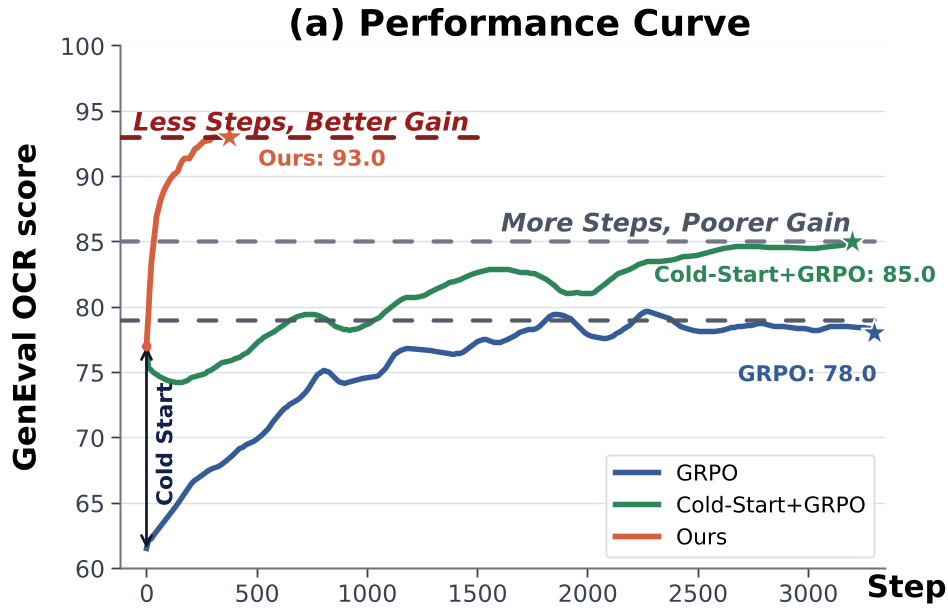 Figure 1: Comparison showing Flow-OPD achieving higher rewards and more stable convergence compared to vanilla GRPO.
3. Manifold Anchor Regularization (MAR)
To prevent the student from drifting into "ugly" regions of the latent space while chasing functional accuracy (like text), the authors introduce MAR. It uses a frozen aesthetic teacher to act as an "anchor," ensuring the student stays on a high-quality manifold.
Experiments: Surpassing the Teachers
Tested on Stable Diffusion 3.5 Medium, the results are striking. Flow-OPD doesn't just match the experts; it exhibits a "teacher-surpassing" effect.
| Model | GenEval | OCR Acc. | Avg |
|---|---|---|---|
| SD-3.5-M (Base) | 0.63 | 0.59 | 0.71 |
| GRPO-Mix (Joint Reward) | 0.73 | 0.83 | 0.81 |
| Ours (Flow-OPD Merge) | 0.93 | 0.93 | 0.90 |
The student model benefits from knowledge cross-pollination. Because it is guided by multiple experts simultaneously, it learns a more holistic, smoothed representation that can handle edge cases where individual teachers might fail.
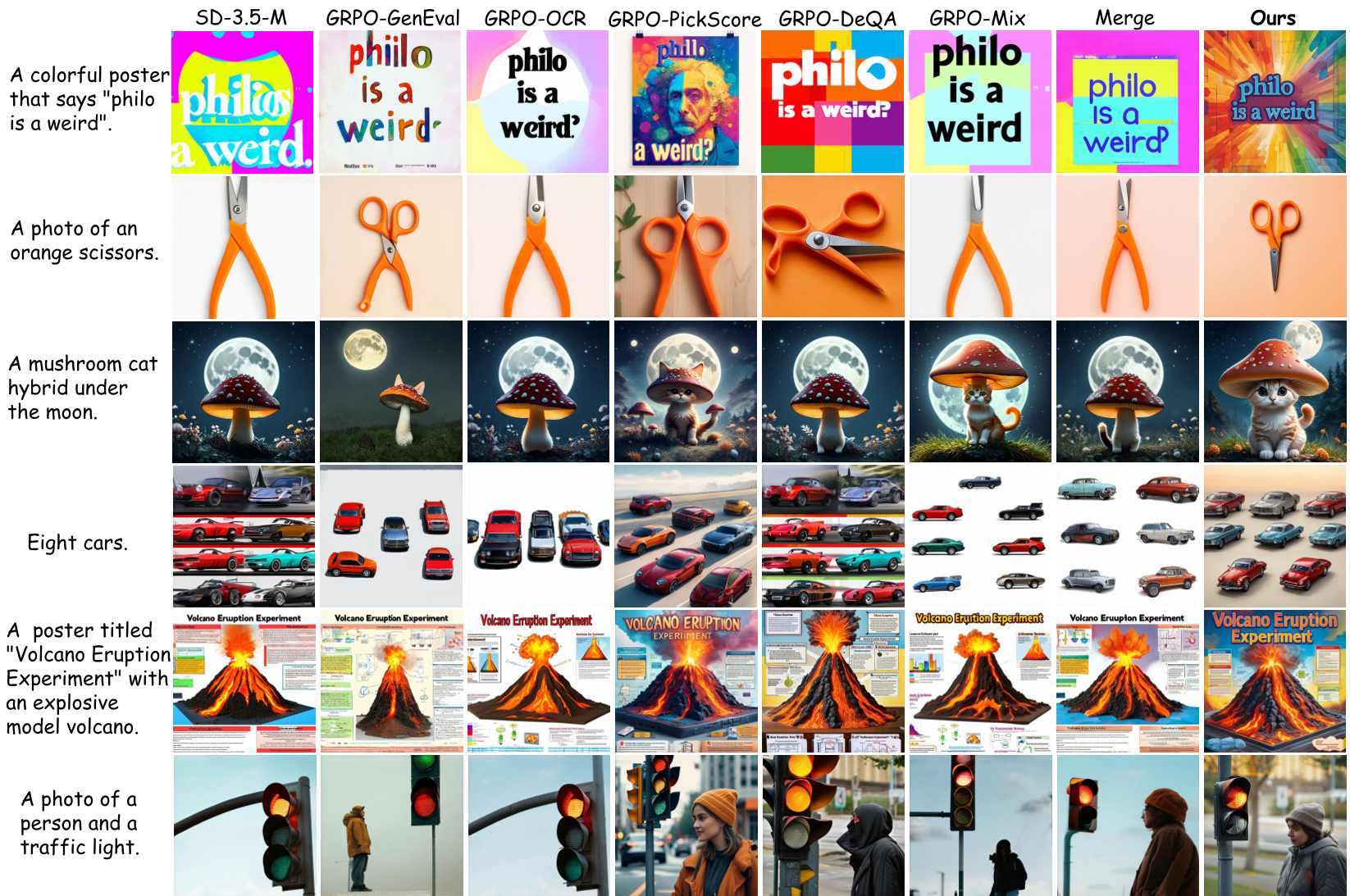 Figure 2: Qualitative samples showing superior text rendering, composition, and aesthetic quality.
Conclusion & Insights
Flow-OPD demonstrates that the future of aligning foundation models lies in dense supervision. Moving from "scalar rewards" to "trajectory distillation" solves the fundamental conflict between diverse tasks.
Key Takeaways for Engineers:
- Stop simply mixing rewards: Combined scalar rewards often lead to gradient collapse.
- Use Experts as Guides: Distilling the how (the velocity field) is far more efficient than distilling the what (the final image).
- The Manifold Matters: Always use a task-agnostic aesthetic anchor to prevent RL-induced visual degradation.
While limited by the need for architectural homogeneity between teacher and student, Flow-OPD sets a new SOTA for controllable, generalist text-to-image synthesis.