
SVF: Breaking the "Hairball" Barrier with High-Dimensional Fluid Interaction
Fluid UI for HIGH-dimensional Analysis of Social Networks
This paper introduces Social Viewpoint Finder (SVF), a visual analytics tool that enables fluid exploration of complex social networks by mapping them into high-dimensional (500-3,000D) Euclidean space. By utilizing modern OpenGL compute shaders, SVF achieves real-time, high-dimensional rotation and clustering triggered by simple user dragging operations.
TL;DR
Social Viewpoint Finder (SVF) is a performance-driven visual analytics tool that solves the problem of "hairball" graph visualizations. By treating a social network as a cloud of points in a 500+ dimensional space and using OpenGL Compute Shaders to handle the heavy math, it allows users to reveal hidden community structures through smooth, real-time dragging and rotation.
Background: Beyond the 2D Layout
Traditional graph visualization (like Force-Directed layouts) often fails as networks grow, resulting in a cluttered mess. SVF takes a different approach: it places vertices in a High-Dimensional Euclidean Space. While this sounds counter-intuitive for a 2D screen, the "Active Graph Interface" (AGI) allows users to manipulate these high-dimensional coordinates, effectively "shaking" the network into clusters that are visually distinct.
The "Fluidity" Problem: Why CPUs Failed
The math behind high-dimensional rotation is essentially massive matrix multiplication. For a network with 30,000 nodes in 500 dimensions, recalculating a projection at every mouse move is computationally expensive.
- The 100ms Rule: For a UI to feel "fluid," the system must respond in under 100ms.
- The Reality: Previous CPU-based versions of SVF dropped to ~2 FPS (500ms latency) on datasets like the Enron email network, making interaction feel "shaky" and unusable.
Methodology: Bringing Shaders to the Rescue
The authors re-engineered the SVF pipeline to live almost entirely on the GPU.
1. Massively Parallel High-Dimensional Rotation
The core innovation is moving the high-dimensional projection matrix multiplication to a Compute Shader. This gives the system CUDA-like power within a standard graphics pipeline.
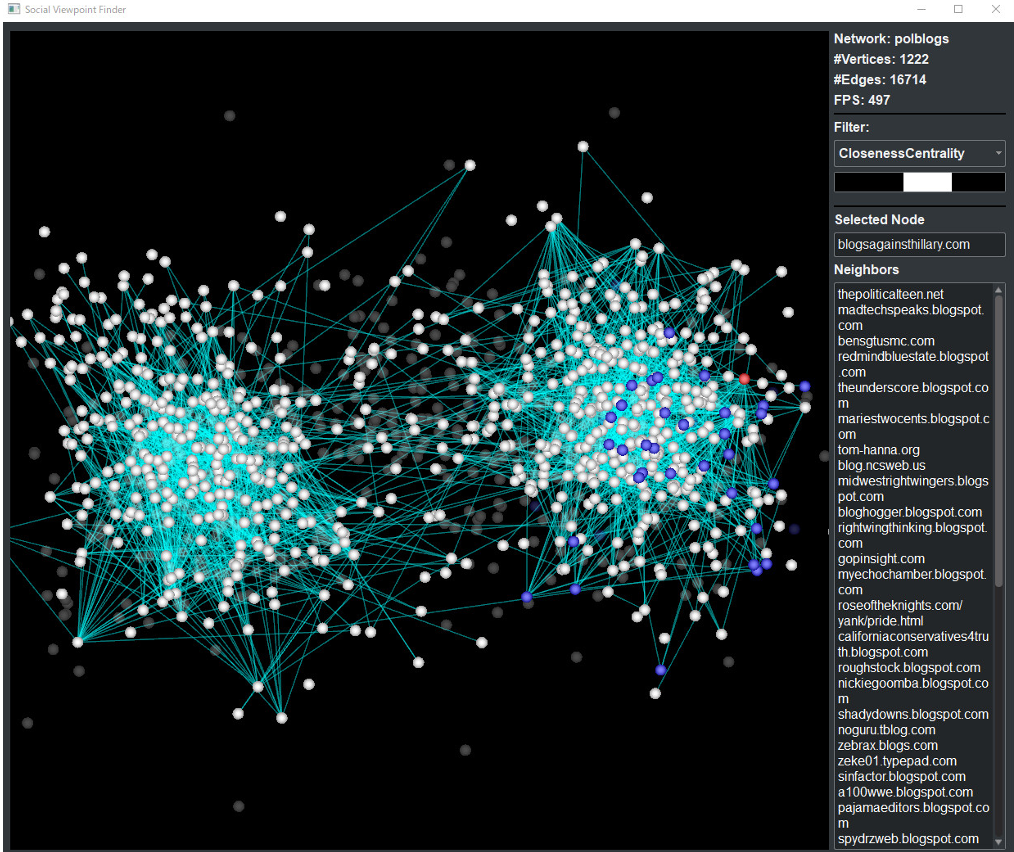 Figure 1: SVF revealing political blog clusters that were previously hidden in a "hairball" state.
2. Fast Vertex Identification
Usually, finding which node a user clicked requires a CPU-side search. SVF uses a fragment shader-based identification method. During a non-drawing pass, it checks the pixel under the mouse and stores the corresponding Vertex ID directly in a Shader Storage Buffer (SSB).
Experiments: Performance Breakthrough
The results show orders of magnitude improvement. On the Internet dataset (22k nodes), the proposal reached 228.8 FPS, compared to the CPU version's measly 3.8 FPS.
| Dataset | Vertices | Edges | CPU-based (FPS) | SVF Proposal (FPS) |
|---|---|---|---|---|
| USPol | 1,222 | 16,714 | 57 | 331.1 |
| Internet | 22,463 | 48,436 | 3.8 | 228.8 |
| Enron | 33,696 | 180,811 | 1.9 | 162.6 |
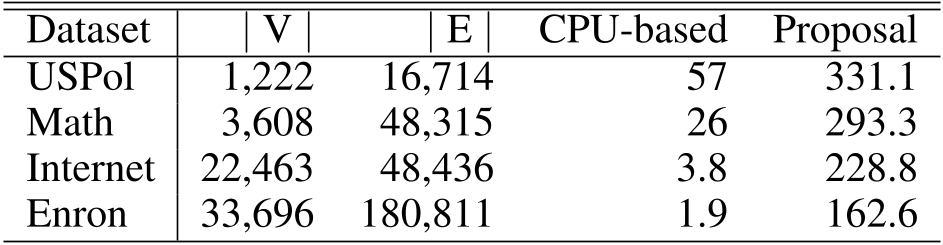 Figure 2: Performance comparison highlighting the exponential gain in frame rates.
Critical Insight: The "Why" behind the "How"
Why does dragging a node in 500D space help clustering? The intuition is that dragging a node acts as a manual optimization constraint. By moving one node, the high-dimensional rotation matrix adjusts to minimize a cost function, naturally pulling "related" nodes together and pushing "unrelated" groups apart. The GPU doesn't just make it faster; it makes this Human-AI collaboration possible by providing the instantaneous feedback needed for human intuition to work.
Conclusion & Limitations
SVF proves that modern graphics APIs are not just for games—they are vital for complex data analysis. However, there are limitations:
- Hardware Dependency: While it runs on a "moderate" desktop, it requires specific OpenGL 4.3+ support for compute shaders.
- Scalability: While 33k nodes is a great start, modern social networks reach millions of nodes, which might eventually saturate even high-end GPU buffers.
In summary, SVF is a masterclass in using GPGPU techniques to reclaim the "fluidity" of interactive data exploration.