
FANETs: The Next Frontier in Autonomous Aerial Networking and Social Impact
9952_Flying Ad-Hoc Networks Technological and Social Implications.
This paper introduces Flying Ad-Hoc Networks (FANETs), a specialized sub-field of ad-hoc networking governed by autonomous Unmanned Aerial Vehicles (UAVs). It explores the transition from single-UAV systems to multi-UAV swarms that establish dynamic communication links to provide reliable, delay-tolerant data delivery for surveillance and disaster recovery.
TL;DR
Flying Ad-Hoc Networks (FANETs) move beyond single-drone operations to coordinated swarms. By establishing peer-to-peer communication among UAVs, these networks provide a resilient, infrastructure-independent solution for disaster management and surveillance. However, their high mobility creates significant technical challenges in routing, paired with profound social concerns regarding privacy and safety.
Background: From Drones to Swarms
The evolution of wireless technology has moved from static infrastructure to mobile nodes. While Mobile Ad-Hoc Networks (MANETs) and Vehicular Ad-Hoc Networks (VANETs) paved the way, FANETs introduce a third dimension of complexity: high-speed flight. In a FANET, multiple UAVs connect to each other, meaning only a subset needs to link to a ground station. This "swarming" behavior ensures that even if one drone loses its link, the overall network remains intact.
The Core Challenge: High Mobility and Rapid Topology Changes
The primary hurdle for FANETs is the sheer speed of the nodes (up to 460 km/hr). This leads to:
- Unstable Links: Traditional routing protocols cannot update fast enough to keep track of nodes moving at hundreds of kilometers per hour.
- Latency Requirements: In "search and destroy" or disaster monitoring, data must be near-instantaneous.
- Line-of-Sight (LoS): While flight offers better LoS than ground networks, maneuvers and weather can cause sudden signal drops.
Methodology: Designing the Aerial Mesh
The authors suggest that the solution lies in a robust Cross-Layer Architecture.
1. MAC and Network Layer Innovations
Instead of relying solely on high-bandwidth protocols like IEEE 802.11, the paper proposes IEEE 802.15.4 for control data to save power and ensure the delivery of time-sensitive location updates.
2. Mobility Models
The paper categorizes mobility models based on the mission type:
- Manhattan Grid: For urban surveillance.
- Gauss-Markov: Ideal for relaying networks where movement depends on historical speed and direction.
- Random Waypoint: Best for patrol systems with flexible trajectories.
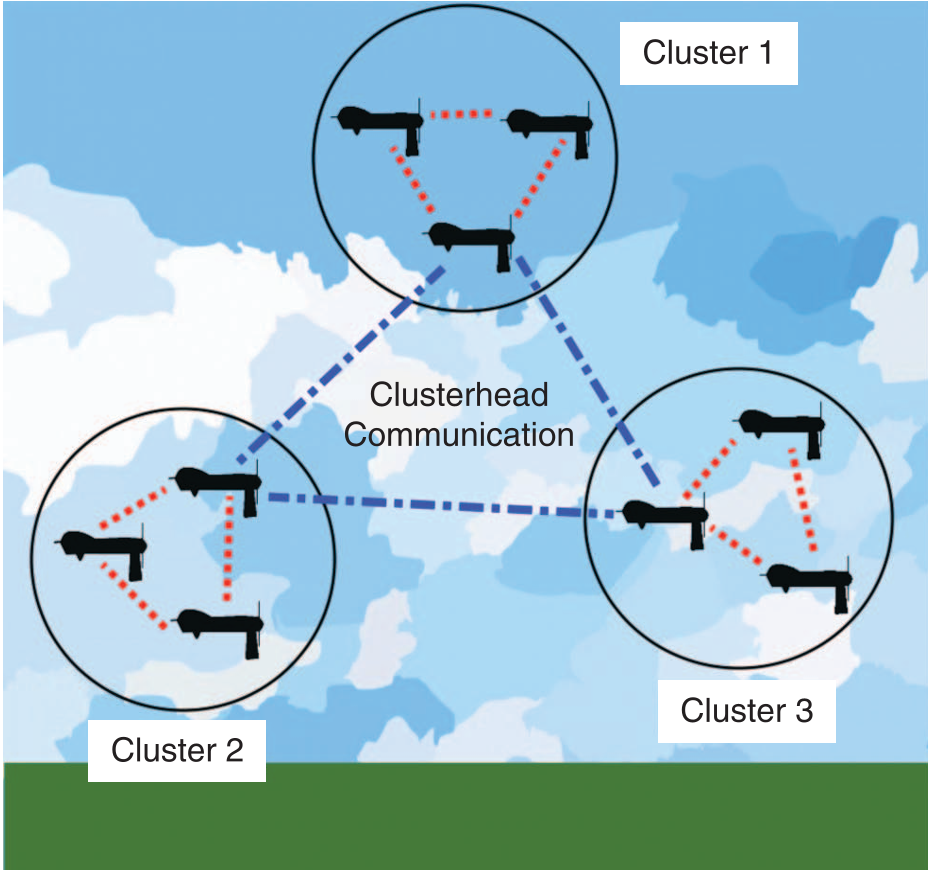 Figure 1: Multicluster formations enhance scalability, allowing UAVs to cover vast terrains by delegating communication through cluster heads.
Social Significance and Ethical Dilemmas
FANETs serve as the "First Line of Defense." The paper cites the 2011 Fukushima disaster and the 2015 Nepal earthquake as pivotal moments where aerial networks saved lives. By obtaining high-resolution imagery in areas too dangerous for humans, FANETs revolutionize disaster management.
However, the "Social Ramifications" section provides a sobering counter-perspective:
- Psychological Impact: Constant aerial monitoring in conflict zones creates "mentally paralyzed" societies.
- Privacy: The risk of surveillance at the cost of civil liberties is a major hurdle for urban deployment.
- Security: Vulnerability to signal jamming and spoofing by non-state actors could turn these networks into "tools of war."
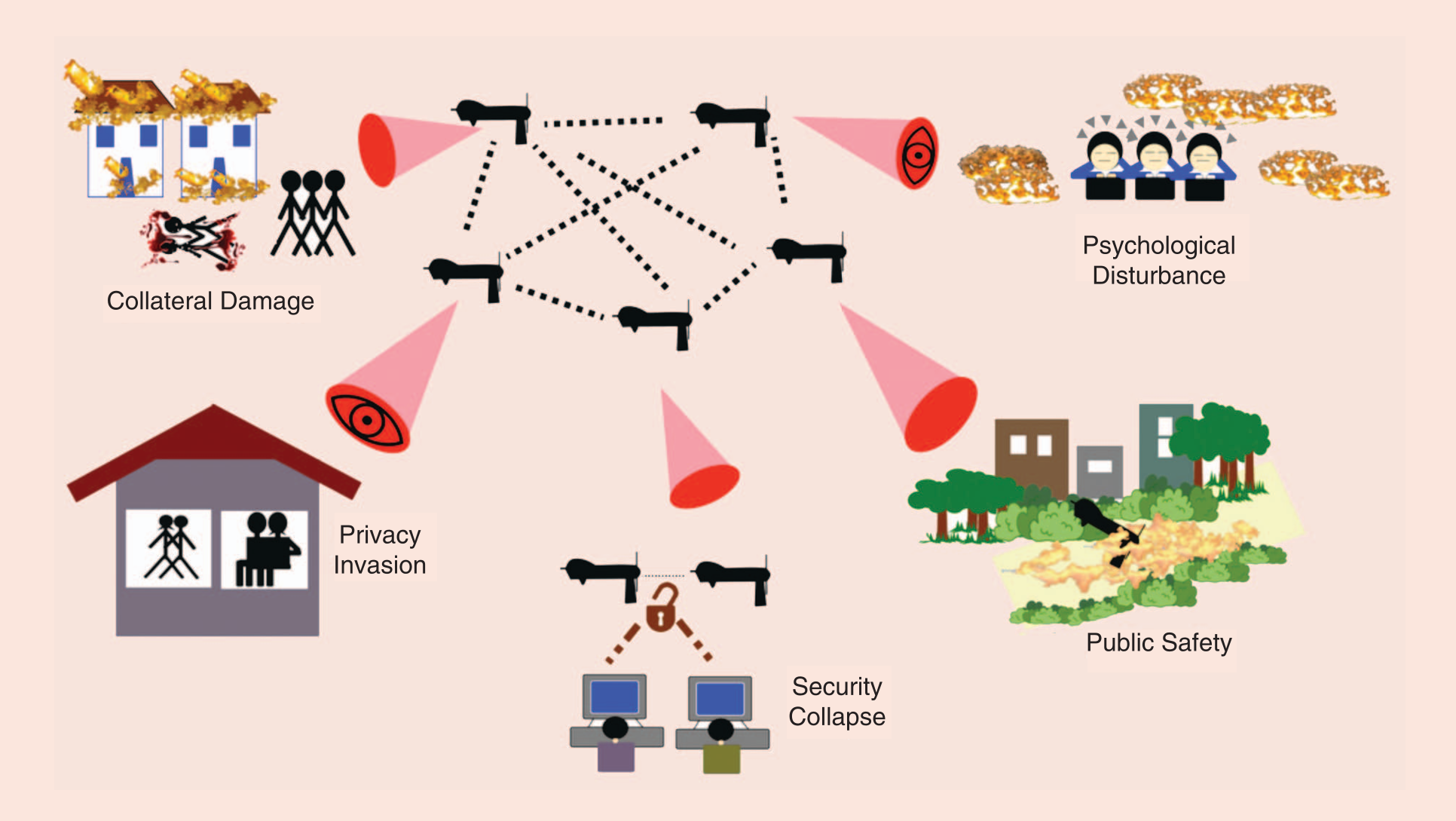 Figure 2: A taxonomy of the threats posed by FANETs, ranging from military misuse to mid-air collisions.
Critical Analysis & Conclusion
The technical feasibility of FANETs is rapidly outpacing the legal and social frameworks required to manage them. While the proposed cross-layer architecture addresses the "How," the industry must still answer the "Should."
Takeaway: Future research must pivot toward Social Sustainability. This means not just making the routing faster (e.g., via location prediction) but also making the networks secure against hijacking and aligned with international humanitarian laws. FANETs are a powerful tool, but without global standards, their potential for harm in urban and war-torn areas remains a significant risk.