
FOAF-Academic: Bridging the Semantic Gap in Scholarly Social Networks
FOAF-Academic Ontology: A Vocabulary for the Academic Community
The paper introduces FOAF-Academic, an OWL-DL based ontology designed specifically for the academic community. It extends the standard Friend of a Friend (FOAF) vocabulary to include university-specific entities, professional achievements, and research relationships, achieving automated knowledge discovery through SWRL rules.
TL;DR
FOAF-Academic is a specialized extension of the FOAF vocabulary tailored for the academic world. By leveraging OWL-DL and SWRL rules, it moves beyond simple personal profiles to model complex relationships like co-authorship, departmental affiliations, and research interest clusters, enabling machines to "understand" and infer academic hierarchies.
Background & Motivation
The Semantic Web envisions a web of data that machines can process. While the FOAF (Friend of a Friend) vocabulary successfully pioneered the description of people and their social circles, it remains too generic for specialized professional use.
In an academic context, knowing someone's "IM chat ID" is less important than knowing their "co-authors," "research fields," or "departmental colleagues." Existing prior work in FOAF lacked the inductive bias necessary to represent the specific constraints of universities. The author's insight was to restrict personal data and extend professional attributes to create a focused academic knowledge base.
Methodology: The Architecture of Academic Knowledge
The FOAF-Academic ontology is built using a two-layered approach:
1. The Class Hierarchy
The ontology defines a rigorous hierarchy (using the afoaf namespace) that captures the essence of a university. It includes classes like University, Faculty, Department, and different roles such as Professor, Researcher, and PhD_Student.
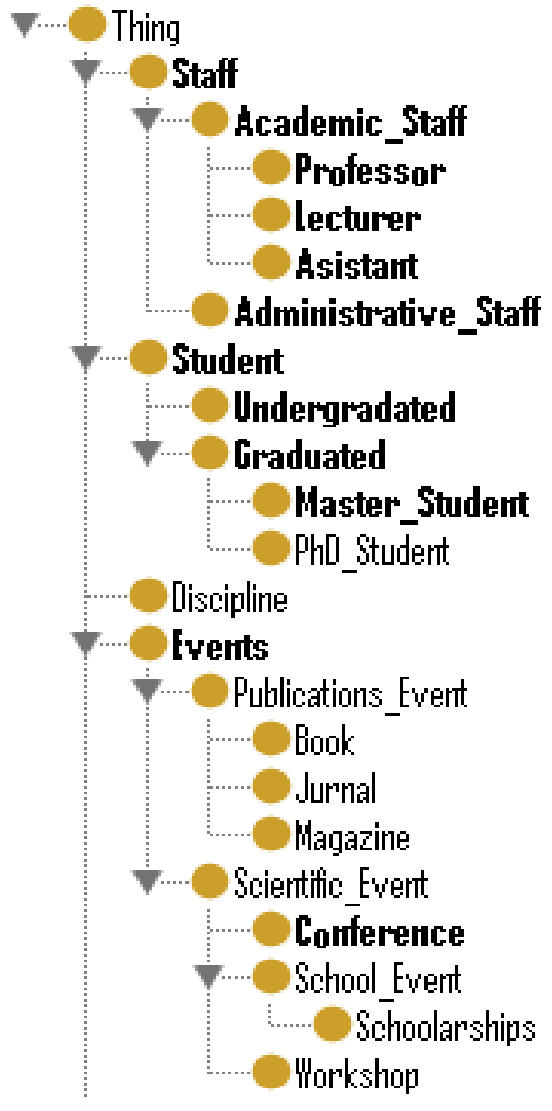 Figure: The hierarchical view of FOAF-Academic classes, showcasing the inheritance from general 'Person' to specific academic roles.
2. Properties and Reasoning with SWRL
The real power of FOAF-Academic lies in its Properties. While OWL-DL is excellent for classification, it struggles with complex property chains. The authors solve this by introducing Semantic Web Rule Language (SWRL).
For example, consider the Co-author problem. In standard OWL, linking two authors of a single book is difficult. FOAF-Academic uses Rule 4:
Book(?x), authorof(?D, ?x), authorof(?P, ?x) -> co-author(?P, ?D)
This allows the reasoner to automatically discover links that aren't explicitly stated in the database.
Experimental Inference & Results
The authors validated the ontology by populating it with instances (e.g., an individual named "Ejona"). By applying a Description Logic (DL) Reasoner, the system was able to perform:
- Inferred Membership: Automatically moving a Person to the "Student" class if they have a
studies-atrelationship. - Relationship Discovery: Automatically generating a
colleaguelink between two people working at the sameUniversity.
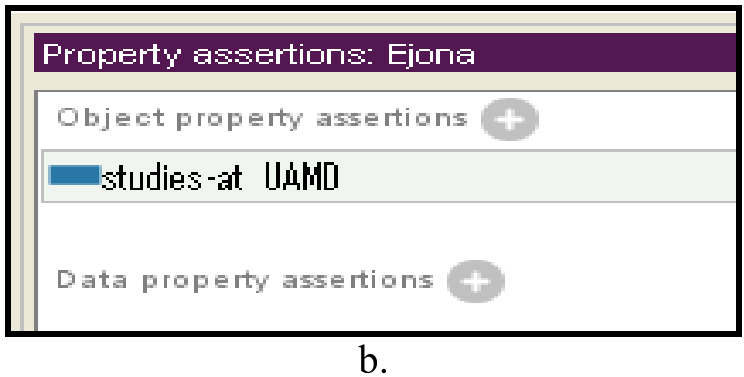 Figure: A visual representation of the reasoner in action, highlighting (in yellow) properties that were automatically inferred from existing rules.
Critical Insight & Conclusion
The significance of FOAF-Academic is its ability to turn a flat social network into a Knowledge-Based System. Instead of manually updating a researcher's list of colleagues, the ontology manages these links dynamically as institutional data changes.
Limitations & Future Work
- Ontology Alignment: As noted by the author, a major challenge remains the alignment of FOAF-Academic with other burgeoning academic ontologies (like VIVO or BIBO).
- Scalability: The use of SWRL and OWL-DL reasoners provides high precision but can encounter performance bottlenecks when dealing with millions of academic publications.
In conclusion, FOAF-Academic provides the necessary vocabulary to transform the "Academic Social Web" into a machine-readable, inferential engine, laying the groundwork for better research discovery and automated scholarly statistics.