
SHICARO: Transforming Social Networks into Business Intelligence via Ranked Ontology Clustering
FOAF-based clustering of handicraft women using ranked features
The paper introduces <b>SHICARO</b> (Semi-supervised HIerarchical Clustering based on RAnking features using Ontology), a framework designed to cluster social network data from handicraft women in Tunisia and Algeria. By integrating the <b>FOAF</b> ontology with domain-specific handicraft knowledge, it achieves a structured hierarchy of clusters to facilitate data warehouse schema expansion.
TL;DR
In the push to digitize and support the handicraft industry in emerging economies, researchers have developed SHICARO. This semi-supervised hierarchical clustering algorithm leverages the FOAF ontology and expert-led feature ranking to group handicraft women based on their production patterns and social interactions, providing a structured foundation for evolving Data Warehouse (DW) schemas.
Background: The Socio-Economic Mission
Handicraft women in rural Tunisia and Algeria face significant hurdles in market access and raw material procurement. The BWEC (Business for Women in Women of Emerging Country) project aims to solve this by analyzing social network (SN) interactions. However, social data is notoriously messy. To turn "likes" and "connections" into business insights, we need a way to group these individuals into meaningful clusters—clusters that an expert can actually use to build a Data Warehouse.
The Problem: The Failure of "One-Size-Fits-All" Clustering
Current clustering techniques suffer from three primary weaknesses in this context:
- Unsupervised Irrelevance: Most algorithms treat all features (age, location, product type) as equally important. In reality, a business analyst might care more about "Production Type" than "Age."
- The Mixed-Data Gap: Real-world data is a mix of numbers (age: 35) and categories (product: "Kilim"). Simply converting categories to numbers often destroys the semantic meaning.
- Semantic Blindness: Traditional distances (like Euclidean) ignore the rich relationships in an ontology, such as "is-a" or "part-of."
Methodology: Semantic Intelligence through SHICARO
The authors' solution, SHICARO, introduces a two-pronged innovation: Feature Ranking and Compounded Similarity Measures.
1. Expert-Guided Feature Ranking
Instead of clustering everything at once, SHICARO follows the expert's priorities. If "Production" is ranked #1, the algorithm first splits the data based on what the women produce. Subsequent levels of the hierarchy refine these groups using lower-ranked features like "Resources."
2. A Unified Global Similarity Measure
To handle the complexity of the FOAF-enriched Handicraft Ontology, authors defined a global measure:
- Instance-based Similarity (IS): Handles direct values using Jaccard (categorical) or Euclidean (numerical) logic.
- Attribute-based Similarity (AS): Compares instances based on their "Data Properties" (e.g., comparing two people by their intellectual level).
- Relationship-based Similarity (RS): The most "semantic" level, comparing instances based on how they relate to other concepts (e.g., two resources are similar if they utilize the same tools).
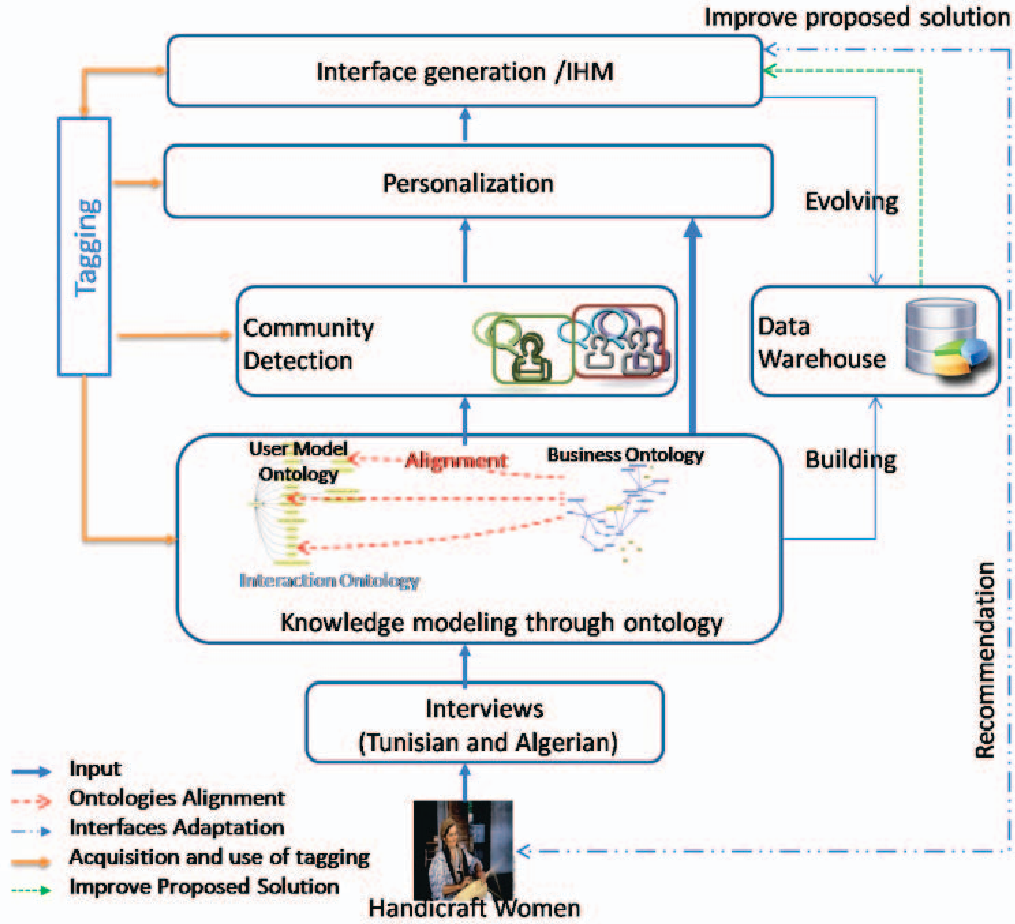 Figure: The integration of FOAF with domain-specific handicraft concepts.
Evaluation and Results: Proven Effectiveness
The researchers implemented SHICARO using Java and the Weka platform. By comparing it to the SOIM (Similarity measures on Ontology Instances based on Mixed features) baseline, they found that SHICARO consistently provided higher quality clusters.
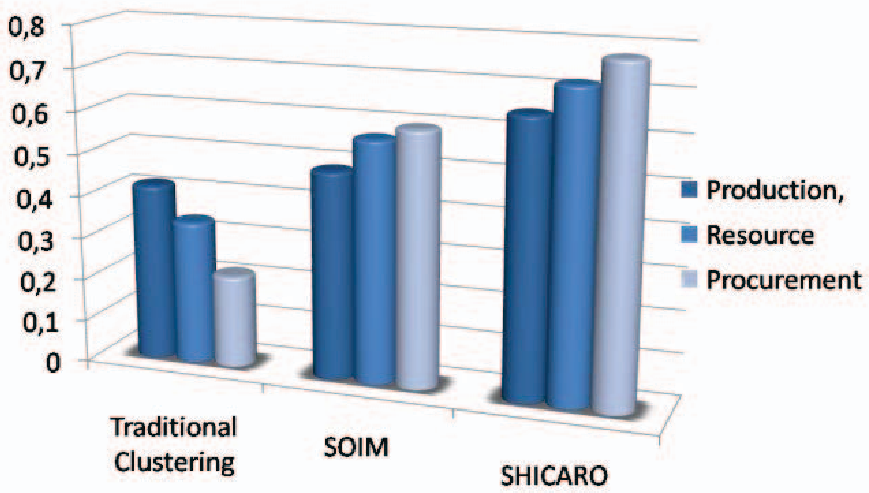 Figure: SHICARO shows a steady increase in F-Score as more ranked features are processed, peaking at 78% for Procurement tasks.
The experiment demonstrates that by supervising the process through ranking, the "noise" from irrelevant features is minimized, leading to clusters that align with the actual business logic of the handicraft sector.
Critical Analysis & Future Outlook
The strength of SHICARO is its human-in-the-loop philosophy. It acknowledges that AI should serve the expert's intent. However, the reliance on a predefined ontology means that if the social network data contains concepts not covered by FOAF or the Craft ontology, the system may struggle.
The Bigger Picture: This work is a vital step toward Automated Data Warehousing. By successfully clustering social data into "multidimensional concepts," SHICARO allows for the semi-automatic modeling of warehouse schemas that can track the socio-economic progress of these women over time. Future work investigating the dynamic evolution of these clusters as new technologies are adopted will be crucial.
Final Takeaway: Don't just cluster data; rank your features according to business value. In semantic domains, the relationship between data points is often more informative than the data points themselves.