
Focal Patterns: Why the Group, Not the Individual, Rules Social Networks
Identifying focal patterns in social networks
This paper introduces "focal patterns," a novel methodology for identifying small, densely connected influential structures in social networks rather than isolated authoritative nodes. By utilizing a recursive application of the Louvain modularity method, the authors extract the functional "backbone" of a network, achieving superior performance in event-related information retrieval compared to traditional HITS and PageRank algorithms.
TL;DR
In the era of digital-native movements like the Arab Spring, influence is no longer a solo performance. This paper moves beyond the "Influncer" obsession to identify Focal Patterns—the small, densely connected structural backbones of social networks. By recursively applying modularity-based partitioning, the authors demonstrate that these clusters provide higher contextual relevance and faster information discovery than traditional node-ranking algorithms like PageRank or HITS.
Problem & Motivation: The "Individual" Fallacy
For decades, Social Network Analysis (SNA) has been preoccupied with finding the "Kingpin"—the most central node (PageRank) or the most connected hub (HITS). However, the authors argue that individuals are often context-poor. A single activist cannot organize a revolution; a single physician cannot manage a pandemic response.
The pain points are two-fold:
- Context Gap: A single authoritative node doesn't represent the interaction context necessary for large-scale coordination.
- Resolution Limit: Traditional community detection (clustering) identifies large groups but often ignores the "hidden" small-scale structures that actually drive the network's behavior.
Methodology: Mining the Structural Backbone
The researchers propose a methodology dubbed f-patterns, which treats network analysis through a recursive, multi-level lens.
From Unweighted to Weighted Graphs
The basic intuition is simple yet powerful: Modularity (Q) measures the strength of a network's division into modules. When Q = 0, a graph cannot be partitioned further without losing its essential connectivity.
- Recursive Partitioning: The algorithm applies the Louvain Method to the whole graph.
- Base Case Recognition: If a sub-graph reaches , it is labeled a "Focal Pattern."
- Recursive Descent: If , the sub-graph is treated as a new "whole graph" and partitioned again.
For weighted graphs, the authors add a Thresholding Layer, using cumulative distribution of edge weights to filter "noise" and identify overlapping focal structures.
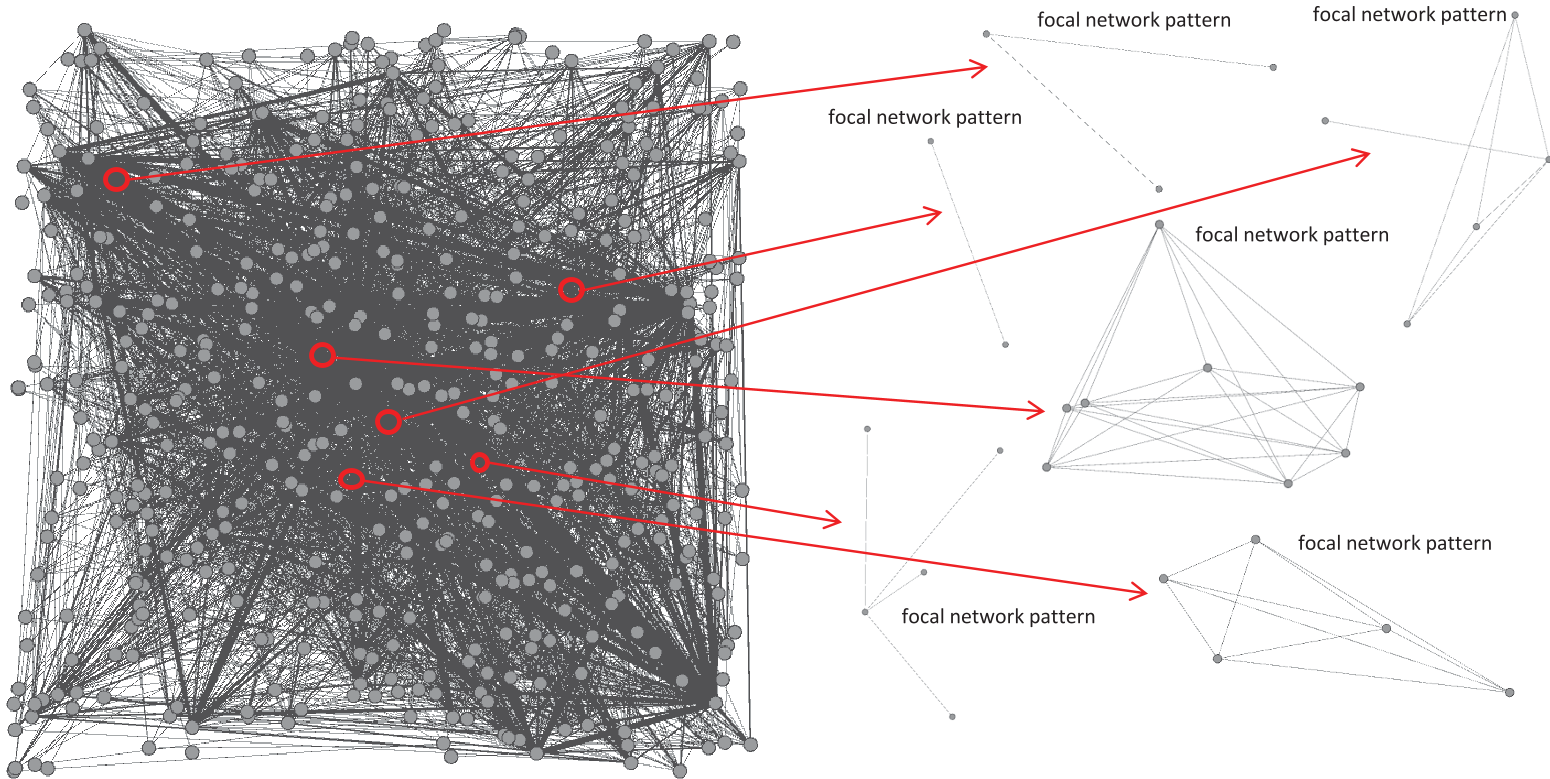 Fig 1: Identification of focal patterns in a social graph. Note how these structures (size 2-8) differ from large, loose communities.
Experiments: The Egyptian Revolution Case Study
To prove the superiority of structures over individuals, the authors used the TREC Tweets2011 corpus, focusing on 12,000 tweets related to the Egyptian Revolution.
They compared three groups:
- Focal Patterns: Identified via their recursive method.
- Influential Nodes: Identified via the HITS algorithm.
- Random Baseline: Random sets of nodes of equal size.
Performance Results
Using AlchemyAPI to extract Named Entities (like "Tahrir Square" or "Mubarak") and calculating their Relevance Scores (TF-IDF), the authors measured how much "knowledge" each method provided.
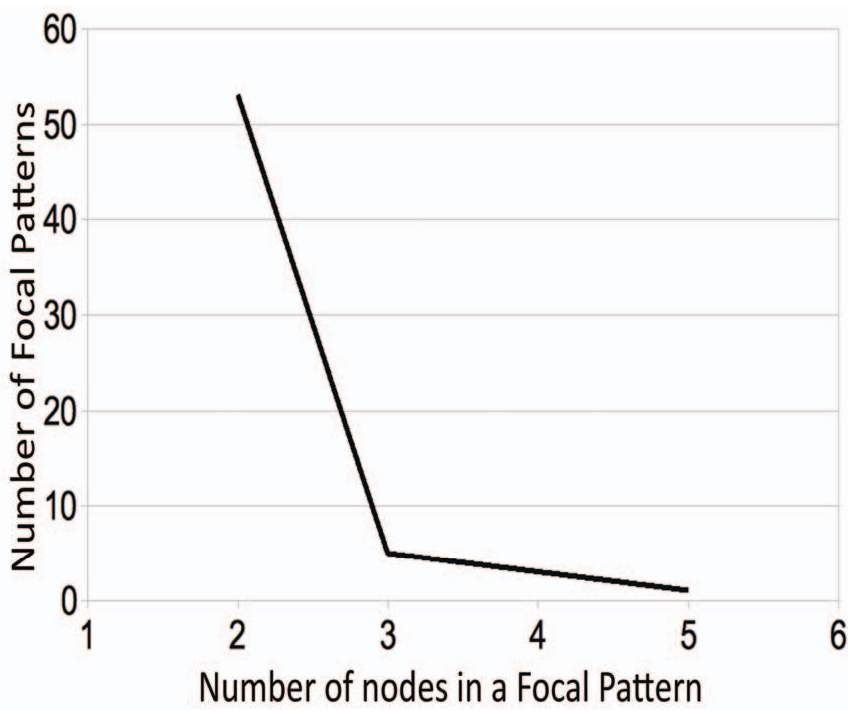 Fig 2: Cumulative Relevance Scores. The steeper curve of Focal Patterns proves they provide event-specific information much faster than HITS-ranked individuals.
The experiment revealed that focal patterns are essentially information hubs. While an influential individual might tweet about many things, a focal pattern—by virtue of its internal interactions—is locked into a specific context (event analysis).
Critical Analysis & Conclusion
The value of this work lies in its Inductive Bias: it assumes that influence is a collective property of "dense interactions" rather than "centrality."
Takeaways
- Scale Invariance: Focal patterns are typically small (avg. 2.13 nodes), suggesting that the "backbone" of a revolution is composed of many tiny atoms rather than one giant heart.
- Actionable Knowledge: If you want to understand an event quickly, look at the clusters, not the celebrities.
Limitations & Future Work
While effective, the recursive Louvain method can be computationally expensive on web-scale graphs (billions of edges). Future research should focus on Scalability and the Temporal Dynamics of these patterns—how do these focal structures form and dissolve as an event unfolds?
In conclusion, this paper successfully shifts the focus from "Who is important?" to "What structure is driving the movement?"—a vital distinction for anyone analyzing modern social media dynamics.