OoT: Reimagining Marine Monitoring with Fog-Based Intelligence
Fog-Based Marine Environmental Information Monitoring Toward Ocean of Things
2019-10-10
Summary
Problem
Method
Results
Takeaways
Abstract
This paper proposes a layered "Ocean of Things" (OoT) framework that integrates fog computing into marine environmental monitoring. By deploying an improved D-S evidence theory for multi-sensor fusion at the fog layer, the system achieves real-time data cleaning and volume reduction before cloud-based predictive modeling.
## TL;DR
The "Ocean of Things" (OoT) is moving away from purely cloud-based architectures. This paper presents a layered framework that utilizes **Fog Computing** to process marine sensor data locally on ships and buoys. By implementing an improved **D-S Fusion algorithm** and **gradient-based cleaning**, the system reduces data redundancy, slashes transmission latency, and achieves highly accurate environmental predictions using cloud-side neural networks.
## The Latency Crisis in Deep-Sea Monitoring
Monitoring the ocean is a massive data challenge. With vast areas to cover and heterogeneous sensors (CTD, ADCP, WPR) generating constant streams of hydrological and meteorological data, traditional cloud computing models are hitting a wall. The cost of transmitting raw, noisy data via satellite from remote survey vessels to shore-based clouds is prohibitive, and the resulting latency prevents real-time decision-making.
The authors argue that the "Ocean of Things" requires an intermediate layer—**the Fog Layer**—to act as the "local brain" for survey vessels.
## Methodology: Distributed Multi-Sensor Fusion
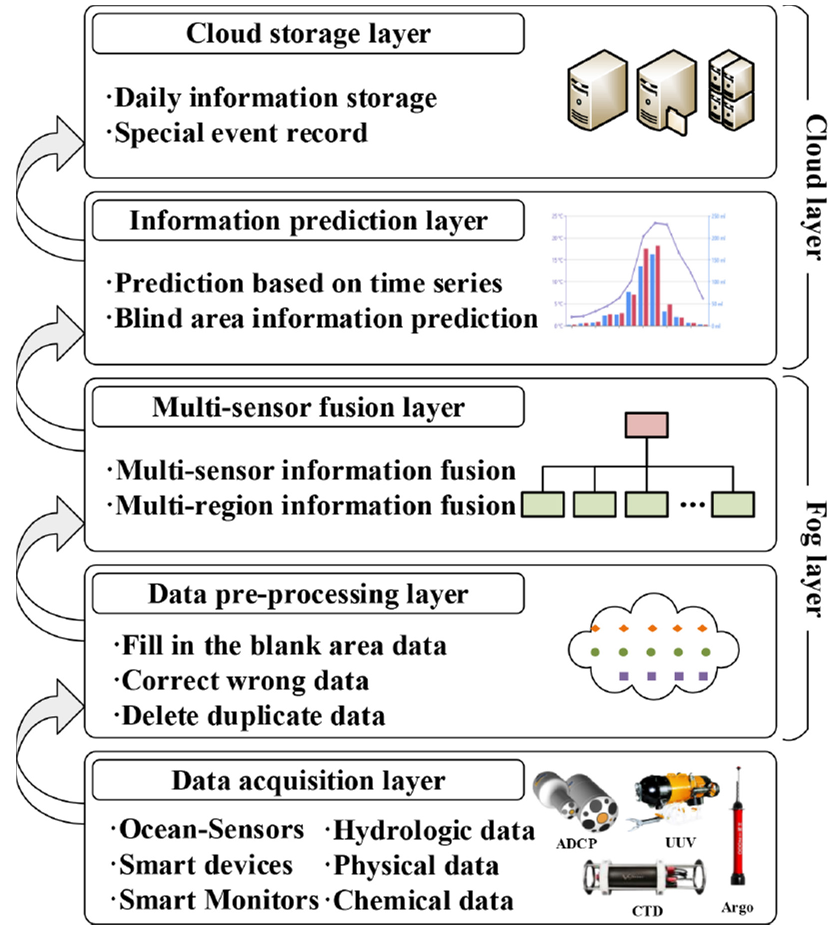
The proposed OoT framework is divided into five layers, but the magic happens in the **Fog Layer**.
### 1. Data Cleaning at the Edge
Sensors at sea are prone to errors due to underwater noise and equipment drift. The authors use a numerical gradient-based method to identify null values, wrong values, and duplicates directly on the onboard computing platform.
### 2. Improved D-S Evidence Theory
Instead of simple averaging, the paper uses an improved **Dempster-Shafer (D-S)** algorithm. The innovation lies in the weighting of time ($\Delta t$) and position ($\Delta \beta$). By minimizing the Root-Mean-Squared Error (RMSE), the fog node calculates the "credibility" of each sensor's data, ensuring that only high-quality, fused information is sent to the cloud.
## Experiments: Efficiency Meets Accuracy
The system was tested using real-world data from the Western Pacific.
### Fog Performance
Compared to traditional Bayes or standard D-S methods, the proposed approach achieved a significantly lower **Data Loss Rate (DLR) of 0.062** and a faster processing time of **0.9 seconds**. This proves that pre-processing data at the edge does not just save bandwidth—it improves the integrity of the data itself.
### Cloud Prediction
Once the distilled data reaches the cloud, a BP Neural Network (BPNN) takes over for long-term modeling. The results for Sea Surface Temperature (Tem) were particularly impressive, with a fitness (R) of **0.969**, indicating that the fog-layer's cleaning process provides a superior foundation for machine learning.
## Deep Insight: Why This Matters
This work highlights a critical shift in IoT: **Data Utilization (DUR)**. In traditional systems, redundant data is often simply ignored because it's too expensive to transmit. By using fog nodes, the system "uses" the redundancy to increase confidence in its measurements through fusion, rather than discarding it.
**Limitations**: While effective, the system still relies on BP Neural Networks, which may struggle with the extreme temporal dependencies found in multi-year climate cycles. Future iterations might benefit from integrating Transformer architectures or Gated Recurrent Units (GRUs) for even more robust forecasting.
## Conclusion
The "Ocean of Things" is no longer a distant concept. By bringing intelligence to the edge of the network, this fog-based framework provides a blueprint for high-efficiency, low-latency marine environmental monitoring that can scale to global proportions.