
Fog-Driven Healthcare: Revolutionizing ECG Monitoring with Edge Intelligence
Fog Computing in Healthcare Internet of Things: A Case Study on ECG Feature Extraction
This paper introduces a Fog Computing-based architecture for Healthcare IoT, specifically focusing on real-time ECG monitoring. By deploying a "Smart Gateway" at the network edge, the system performs decentralized ECG feature extraction (P-wave, T-wave, and heart rate) using a lightweight wavelet transform mechanism.
TL;DR
This paper tackles the critical latency and bandwidth bottlenecks in Healthcare IoT by introducing a Fog Computing architecture. Instead of dumping raw ECG data into the cloud, the authors propose a Smart Gateway capable of local feature extraction—specifically heart rate, P-waves, and T-waves. The result? A massive 90%+ reduction in bandwidth and significantly faster emergency response times.
Background: The Cloud Latency Trap
In the era of Wireless Body Area Networks (WBAN), we are drowning in bio-signal data. Traditionally, these sensors (ECG, EMG, EEG) act as "dumb" pipes, streaming data to the cloud. However, the "Cloud-only" model fails in three critical areas:
- Latency: In cardiac emergencies, every millisecond counts.
- Bandwidth: Continuous streaming of high-frequency ECG data is expensive and congests networks.
- Reliability: If the internet drops, monitoring stops.
The authors position Fog Computing as the savior—a middle layer that brings cloud-like capabilities (processing, storage) to the edge of the network.
Methodology: The Smart Gateway & Wavelet Transformation
The core innovation lies in the Smart Gateway operational structure. Unlike a standard router, this gateway runs a layered service architecture:
1. Heterogeneous Interoperability
The gateway supports multiple protocols (ZigBee, BLE, 6LoWPAN, Wi-Fi) through a modular physical design (Pandaboard + Sink Nodes), allowing it to talk to any sensor regardless of the manufacturer.
2. Lightweight ECG Feature Extraction
To process data locally without specialized high-power hardware, the authors designed a flexible template using Discrete Wavelet Decomposition (DWT).
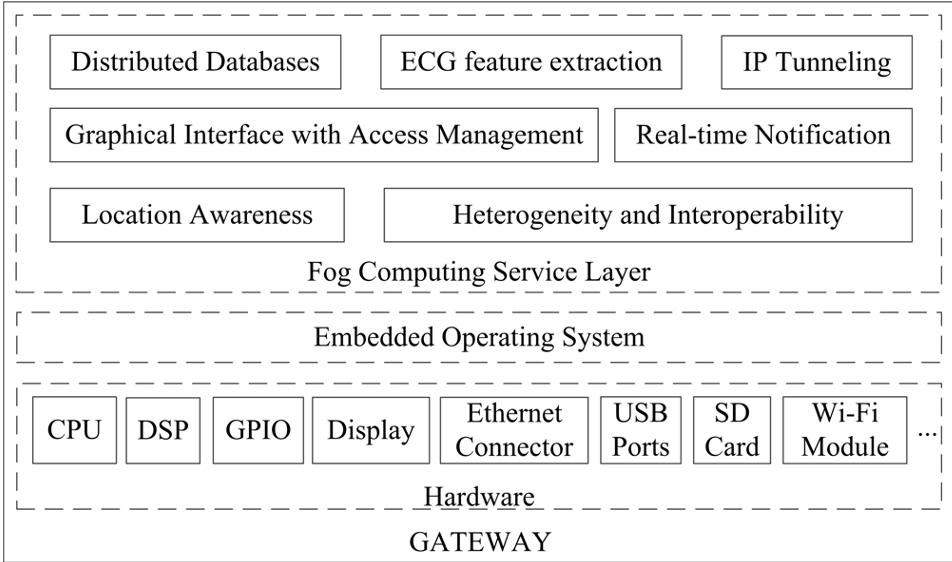 Fig: Operational structure of the Smart Gateway showing the Fog Computing service layer.
The 4-level DWT allows the gateway to filter noise (like movement artifacts) and isolate specific frequency components of the ECG signal to identify the R-R interval, P-wave, and T-wave. This reduces the data from a high-resolution waveform to a few key numerical features.
Experimental Results: Efficiency Gains
Using the MIT-BIH Arrhythmia Database, the authors compared raw data transmission against their Fog-processed approach.
| Data Rate (Mb/s) | Raw Latency (ms) | Fog Latency (ms) | Latency Reduction (%) |
|---|---|---|---|
| 12 (Busy) | 152.2 | 9.5 (trans) + 96.3 (proc) | ~30.5% |
| 9 (Busiest) | 213.3 | 13.5 (trans) + 96.3 (proc) | ~48.5% |
Beyond latency, the data size reduction exceeded 93%. By transmitting only the extracted features (heart rate and wave indices) instead of the full raw signal, the system remains functional even on congested or low-bandwidth networks.
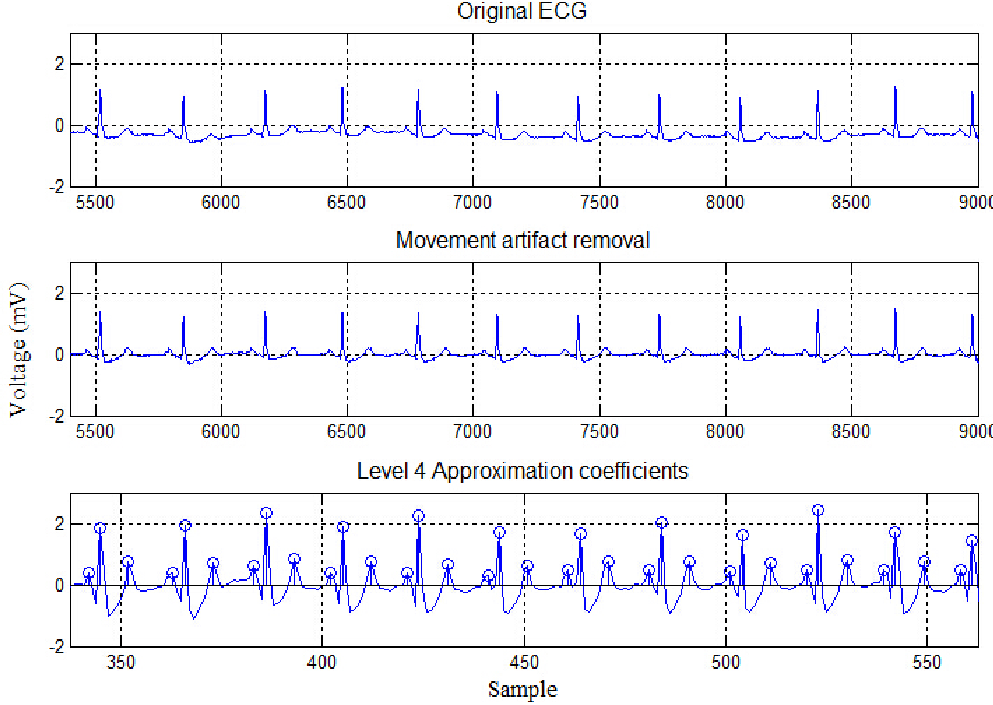 Fig: Real-time ECG waveforms visualized through the gateway's local GUI.
Critical Insights & Conclusion
The value of this work isn't just in the "speed"; it's in the Location Awareness and Distributed Storage. The gateway provides a local GUI for doctors, meaning diagnostics can continue even if the global cloud server is unreachable.
Limitations: While the wavelet transform is lightweight, the paper does not deeply explore how the gateway handles complex arrhythmias that might require more sophisticated Deep Learning models (like CNNs or LSTMs), which are traditionally harder to run on edge hardware like the Pandaboard.
Final Takeaway: This research marks a transition from "Internet of Things" to "Intelligence of Things." By empowering the gateway to "understand" the data it routes, we create a healthcare infrastructure that is both more resilient and significantly more efficient.