
Follow Me: The Digital Rebirth of the Spiral of Silence and Bandwagon Effect
Follow Me: The Impact of Opinion Majorities in Social Networks and the Role of Digital Maturity
This study investigates the interplay between the "Spiral of Silence" and "Bandwagon Effect" on Facebook, examining how simulated opinion majorities in user comments influence individual perspectives. The researchers found that 86% of participants shifted their stance at least once when confronted with opposing majorities, confirming the persistence of these psychological phenomena in digital environments.
TL;DR
Think you're immune to the opinions of strangers on the internet? Think again. A new study from RWTH Aachen University reveals that an overwhelming 86% of social media users changed their minds when confronted with a manufactured majority of comments, regardless of their age or technical expertise. The study explores the alarming ease with which online consensus can be simulated and its subsequent power to silence the minority.
Problem & Motivation: The Digital Echo Chamber
In the offline world, the "Spiral of Silence" theory suggests we hide our opinions if we feel they are in the minority, fearing social isolation. Conversely, the "Bandwagon Effect" describes our tendency to "follow the crowd."
While the internet was once thought to be a leveling ground where anyone could speak freely, the authors argue it has become a breeding ground for these effects. With the rise of social bots and disinformation, the "perceived" public opinion on platforms like Facebook can be easily manipulated. The researchers set out to discover: does being "digitally savvy" actually protect us from falling for these psychological traps?
Methodology: Simulating the Facebook Echo Chamber
The researchers utilized a controlled online experiment involving 163 participants. The core methodology was divided into two phases:
- Baseline Opinion: Participants were asked their stance on four topics ranging from neutral to polarized (e.g., paying for public toilets vs. support for Cristiano Ronaldo).
- The Intervention: Participants saw the same topics again, but this time formatted as Facebook posts with five comments. By design, four out of five comments contradicted the participant's original opinion.
 Figure 1: The experimental setup simulating a Facebook post environment to measure opinion volatility.
Experiments & Results: The Illusion of Consensus
The findings were striking. Even for participants who identified as active social media users, the "crowd" had a massive impact.
- Universal Vulnerability: Only 14% of participants stood their ground across all topics.
- Topic Sensitivity: Neutral topics like "usage fees for public toilets" saw the highest shifts, while deeply held beliefs like the necessity of "smoke detectors" (88% initial agreement) were more resistant, though not immune.
- The Expertise Paradox: Surprisingly, neither age nor social media expertise (usage frequency) served as significant predictors for opinion stability. Even "power users" fell for the bandwagon.
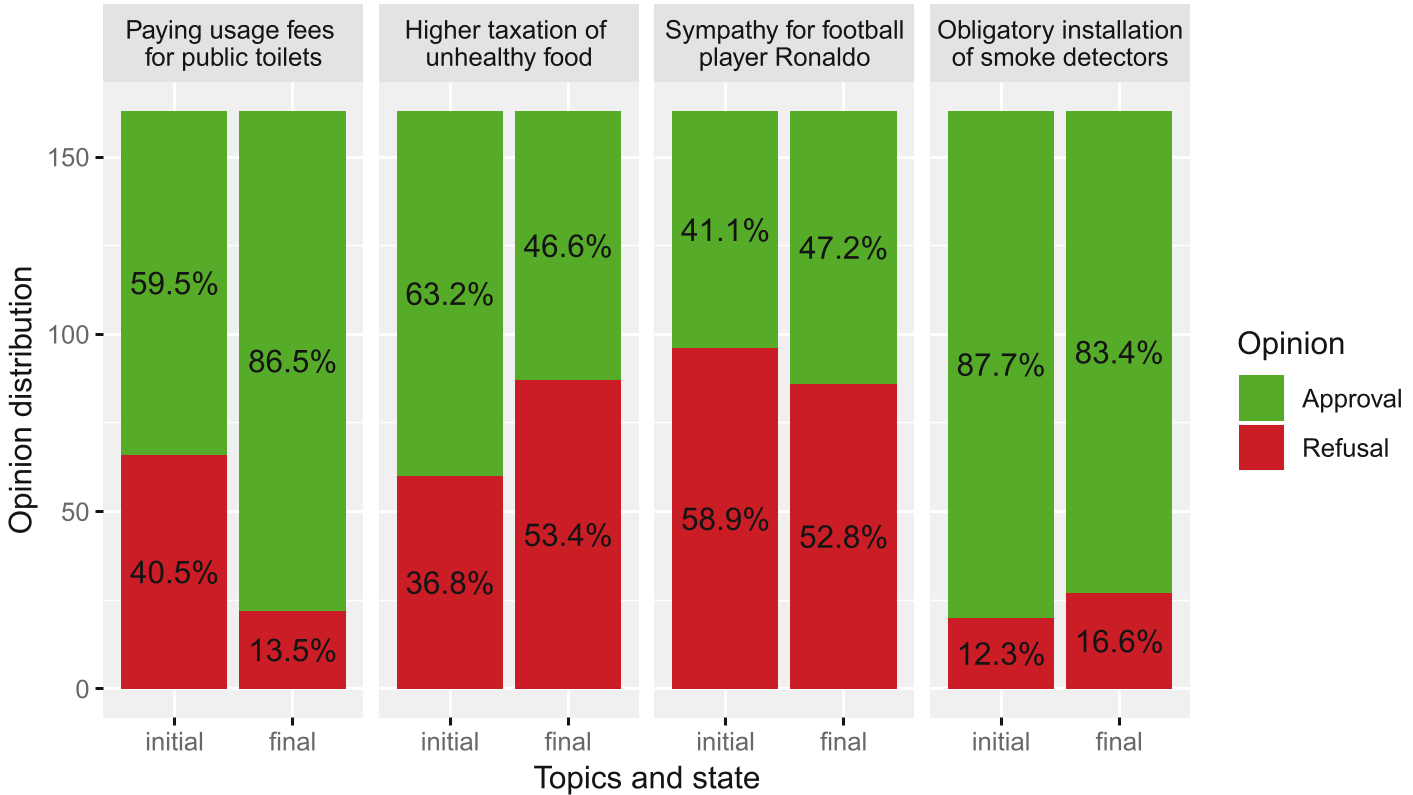 Figure 2: Distribution of opinion changes across the four test scenarios.
Critical Analysis & Conclusion: The Search for Digital Maturity
The most profound takeaway is the concept of Digital Maturity. The study proves that technical proficiency (knowing how to use a platform) is not the same as psychological resilience (knowing when you're being influenced).
Key Insights:
- Comments > Likes: Participants relied more on the textual arguments in comments to gauge public opinion than on numerical "like" counts.
- Strategic Manipulation: If 86% of people can be swayed by just four fake comments in a survey, the potential for political actors to use bot farms to shift real-world democratic discourse is a clear and present danger.
Limitations & Future Work
The study’s sample was relatively young (mean age 27.8), and the "comments" were anonymized. Future research needs to examine if these effects hold when the dissenting comments come from known social circles (friends/family) vs. strangers, as the fear of isolation (the heart of the Spiral of Silence) is likely much stronger in personal networks.
In conclusion, the study serves as a wake-up call. As we move deeper into an era of AI-generated content, developing "Digital Maturity"—the ability to recognize and resist the psychological gravity of the online crowd—is no longer optional; it is a requirement for a functioning democracy.