
Following the Leader: How Discursive Power Shapes Every Word in the Boardroom
Following the Leader: An Analysis of Leadership and Conformity in Business Meetings
This study investigates the link between discursive leadership and linguistic conformity in business meetings. Using a combination of Social Network Analysis (SNA) and Information Retrieval algorithms, the authors demonstrate that participants are significantly more likely to mimic the vocabulary of individuals who occupy central positions in the conversation network.
TL;DR
In any business meeting, there is an invisible "language game" happening beneath the surface. This study reveals that we aren't just agreeing with leaders; we are subconsciously mimicking them. By analyzing 3.5 hours of high-level management meetings using social network analysis and TF-IDF scores, the researchers found that the more "central" a speaker is in a conversation network, the more likely the next person is to copy their specific vocabulary—a phenomenon known as linguistic conformity.
Academic Positioning: This work bridges the gap between Social Constructionism (leadership as a shared process) and Computational Social Science, providing a quantitative toolkit to measure the ripple effects of influence.
Problem & Motivation: The Dark Side of Charisma
Meetings are often criticized as "time sinks," yet they are the primary stage where leadership is "enacted." Previous research on Discursive Leadership focused on how leaders manage meaning through talk. However, these studies were largely qualitative and failed to address a critical risk: Conformity.
The authors argue that strong leadership can create an implicit social pressure. When a central figure speaks, they set the "interpretive schemata" for the rest of the group. The motivation for this study was to prove that this influence is so strong it manifests in the very words followers choose to use, potentially leading to Groupthink and the silencing of divergent ideas.
Methodology: Mapping Influence via Matrix Algebra
To turn 32,000 words into hard data, the authors employed a sophisticated two-pronged approach:
1. The Conversation Network (Bonacich Centrality)
Leadership wasn't defined by job titles but by interaction patterns. They built an adjacency matrix where an edge exists if Person B speaks immediately after Person A.
- Bonacich Centrality: This specific metric was used because it is recursive. You are central not just if many people talk to you, but if other central people talk to you.
2. Linguistic Similarity (TF-IDF & Cosine Similarity)
How do you measure a "copycat"? The researchers treated each spoken turn as a "document":
- TF-IDF: Weighted the importance of words (ignoring common words like "the" or "is").
- Cosine Similarity: Measured the "distance" between the word vectors of the leader and the follower.
 Fig 1. The conversation network reveals that interactions are not random; they gravitate toward a core "triumvirate" of participants (A, C, and E).
Experiments & Results: The "Primacy Effect" in Action
The researchers tested whether a speaker's centrality (Independent Variable) predicted the next speaker's linguistic similarity (Dependent Variable) across 9 different business topics.
Key Findings:
- The Power of Centrality: The regression models showed a massive jump in accuracy when Bonacich Centrality was included ( jumped from 0.21 to 0.40).
- Language Proficiency as Power: Participants with CEFR B2-level English (higher proficiency) were more likely to be treated as discursive leaders, showing that language fluency is a prerequisite for influence in international business settings.
- The "Primacy Effect": The person who framed the problem early in the meeting dictates the vocabulary for the remainder of the session.
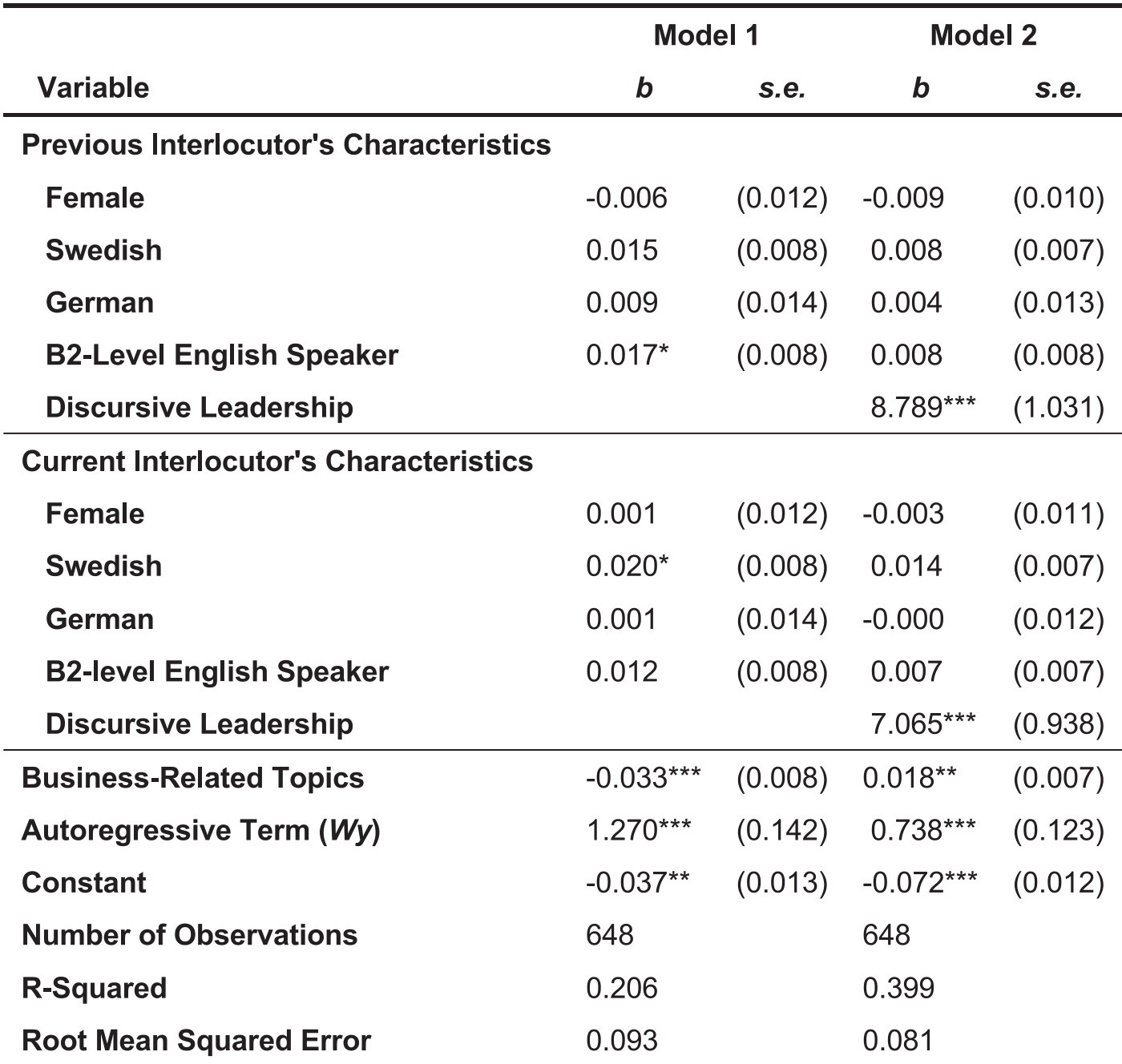 Table 1. Model 2 shows that Discursive Leadership of both the previous and current interlocutor significantly predicts similarity, dominating other demographic factors.
Critical Analysis & Conclusion
The "Chicken or the Egg" of Leadership
The most intriguing finding is that even leaders mimic followers—but to a lesser degree. This suggests two possibilities:
- Strategic Inclusion: Leaders use followers' words to build rapport and demonstrate "active listening."
- Social Compromise: The words being used are already "socially compromised" products of the leader's earlier influence.
Limitations
The study’s primary weakness is its sample size (). While the 32,000-word corpus is robust for a single meeting, the lack of gender diversity (only 1 woman) prevents generalizable conclusions about gendered leadership styles.
Final Takeaway
For practitioners, this research is a warning: Leadership is a double-edged sword. While it provides direction, it also creates a "conformity trap." To foster innovation, leaders must intentionally disrupt these networks—by using techniques like the Six Thinking Hats or ensuring a randomized speaking order to prevent the "Primacy Effect" from locking the group into a single perspective.