
EmoTree: Leveraging Wearable Sensing to Break the Cycle of Emotional Eating
Food and Mood: Just-in-Time Support for Emotional Eating
This paper introduces EmoTree, a mobile just-in-time adaptive intervention (JITAI) system designed to mitigate emotional eating through physiological sensing and personalized support. By integrating wearable sensors into a brassiere form factor and utilizing Gaussian Process Regression, the researchers achieved significant SOTA-level accuracy in mobile emotion detection (75% for arousal, 72.6% for valence).
TL;DR
Emotional eating—consuming food in response to feelings rather than hunger—is a primary driver of obesity. Researchers from the University of Rochester and Microsoft Research have developed EmoTree, a proactive system that senses emotional stress via wearable sensors (hidden in everyday clothing) and provides "Just-in-Time" interventions to prevent maladaptive eating before it starts.
The Motivation: Why Fixed Alarms Fail
Traditional health apps focus on "post-mortem" logging: you eat a donut, you feel guilty, you log it. This does nothing to break the habitual loop of emotional eating. The authors argue that for real behavioral change, we need to intervene proactively.
The core insight here is that emotional eating is often a "non-homeostatic" response to stress, boredom, or anxiety. If technology can detect these "pre-eating" emotional states, it can introduce a cognitive speed bump—like a deep breathing exercise—to shift the user from a reactive state to a deliberate one.
Methodology: Sensing Stress Through the Fabric of Life
The researchers took a three-pronged approach to tackle this ambitious goal:
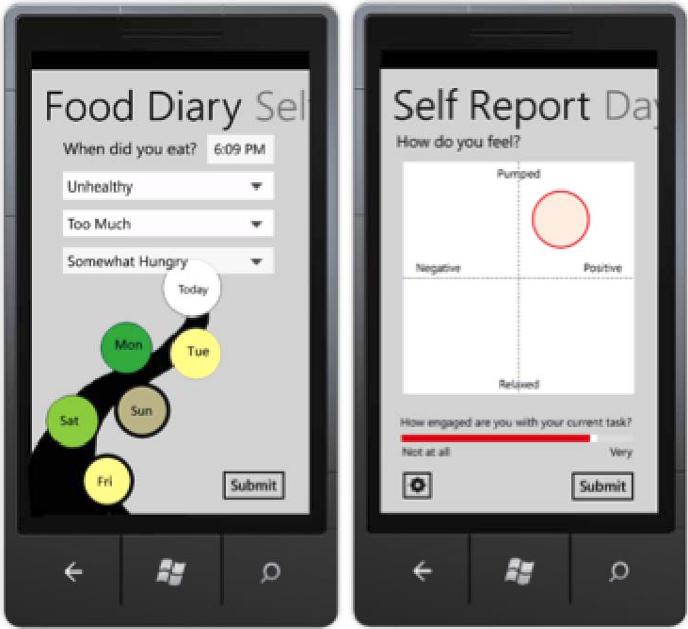
1. The EmoTree Interface
The application uses the Russell Circumplex Model, mapping emotions onto two axes: Valence (Negative to Positive) and Arousal (Relaxed to Pumped). Instead of just tracking calories, users track their "internal weather."
2. The Wearable Architecture
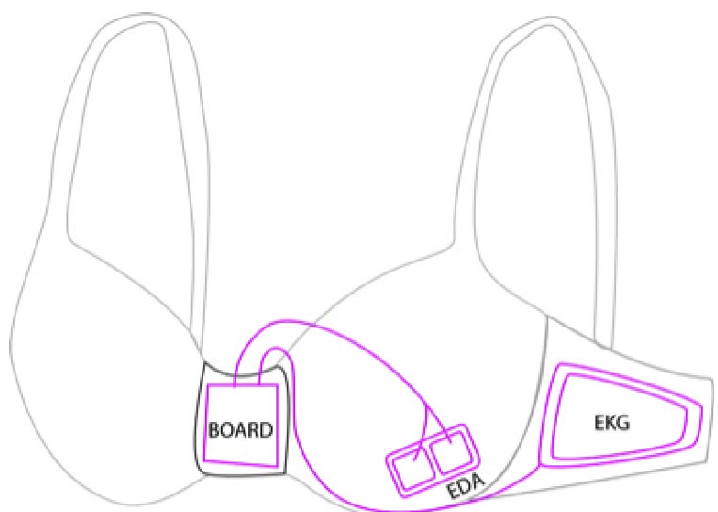
To move beyond lab-tethered sensors (like Kinects or desktop EDA sensors), the team designed a novel "Bra-Sensing" system.
- Form Factor: Conductive silver ripstop fabric pads and neoprene were inserted into brassieres to capture EKG (heart rate) and EDA (skin conductance).
- Hardware: The GRASP (Generic Remote Access Sensing Platform) board, mounted at the sternum, transmitted data via Bluetooth to the phone.
3. The Machine Learning Pipeline
The system doesn't just look for a high heart rate; it uses Gaussian Process Regression (GPR). This framework is particularly effective for multimodal data because it models the similarity between observations to predict a continuous affective state (Valence/Arousal).
Experiments: Does it Actually Work?
The study was conducted across three phases (Gathering Patterns, Testing Interventions, and Sensing Feasibility).
Key Findings:
- Individual Differences: While 50% of participants were "stress eaters" (High Arousal, Negative Valence), others ate when bored or even happy. This highlighted the need for Personalization.
- Sensing Accuracy: The system achieved 75% accuracy for Arousal and 72.6% for Valence. In the world of mobile sensing—where movement and shirt-rubbing create massive signal noise—these are impressive SOTA-level results.
Critical Insights & The Future of JITAI
The paper honesty admits a significant hurdle: Intervention Fatigue. While deep breathing helped reduce stress for some, others found it ineffective for stopping the urge to eat. Participants requested a "menu" of interventions—ranging from brain teasers to calling a friend.
The Academic Takeaway: The success of this work isn't just in the 75% accuracy; it’s in the validation of the Wearable-Mobile-Cloud loop. By showing that "non-standard" body locations (like the bra cup) can provide valid EDA signals, they open the door for truly invisible, integrated health monitoring.
Future Outlook
The authors are already moving toward consumer-grade wearables like the Affectiva Q sensor to include men in future studies and are refining the "Real-Time" aspect of the intervention trigger. The ultimate goal? A system that knows you're stressed before you even reach for the fridge.