
FooDNet: Revolutionizing Food Delivery via Urban Taxi Crowdsourcing
Poster: FooDNet: Optimized On Demand Take-out Food Delivery using Spatial Crowdsourcing
This paper introduces FooDNet, a novel food delivery framework that leverages urban taxis through Spatial Crowdsourcing to fulfill on-demand takeout orders. By integrating food delivery into existing taxi passenger trips (O-OTOD problem), the system optimizes urban logistics and achieves a sustainable delivery network.
TL;DR
FooDNet is a breakthrough framework that solves the "rush hour" food delivery crisis by turning city taxis into an opportunistic delivery fleet. By piggybacking food packages on existing passenger trips (O-OTOD), the researchers have developed a two-stage algorithm that minimizes costs for restaurants while providing extra income for drivers.
Executive Summary
In the era of "everything-on-demand," the traditional courier model is reaching its breaking point. Bicycles are too slow for long distances, and hiring a dedicated fleet for only lunch and dinner peaks is economically inefficient. FooDNet enters the scene as a Spatial Crowdsourcing (SC) powerhouse. It doesn't just add more drivers to the road; it optimizes the ones already there. By treating food delivery as an incidental task for taxis carrying passengers, FooDNet lowers the barrier for long-distance delivery and optimizes urban resource utilization.
Problem & Motivation: The Efficiency Gap
Existing OTOD (Online Takeout Ordering & Delivery) services like Ele.me or Meituan face a "fixed-resource vs. burst-demand" paradox.
- Inefficiency: Bicycles/scooters are limited by speed and range.
- Resource Waste: Professional delivery staff are overwhelmed at noon but idle at 3:00 PM.
- Complexity: Unlike standard package delivery, food is perishable and highly time-sensitive, requiring strict arrival windows.
The authors' insight is simple yet profound: Thousands of taxis are already moving between commercial hubs (restaurants) and residential areas (users). Why not use that "latent capacity"?
Methodology: Two-Stage Optimization
The core of the paper is solving the Opportunistic OTOD (O-OTOD) problem, which is categorized as NP-hard. The workflow is divided into a strategic pipeline:
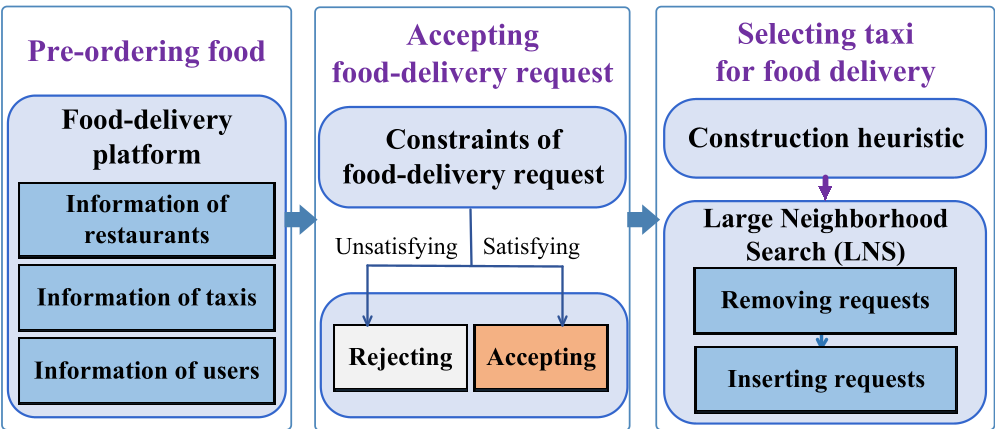
1. System Architecture
The system coordinates three stakeholders: restaurants, taxi drivers, and users. It matches "frequent-interaction areas"—spatial corridors where taxis are already carrying passengers—with food delivery needs.
2. The Algorithm: Construct and Refine
To minimize the number of taxis (thus maximizing incentives for participating drivers), the authors use a two-pronged algorithmic attack:
- The Construction Stage: Uses greedy heuristics like Best Delivery (BD) to quickly slot food orders into taxi routes without violating the passenger’s 10-minute maximum delay tolerance.
- The LNS Stage: The Large Neighborhood Search is the "brain." It uses Shaw Removal to pluck out suboptimal assignments and Best Insertion to re-organize the route globally, effectively jumping out of local optima.
Experiments & Results: Real-World Validation
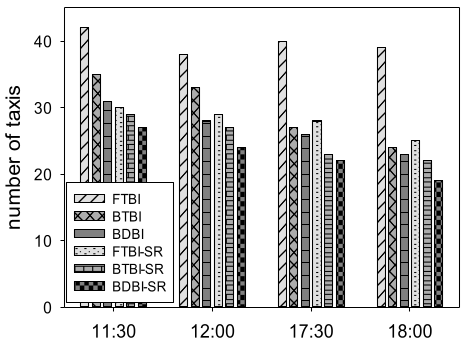
Using real taxi trajectory data from Xi'an, China, the researchers proved that "opportunistic" delivery is not just a theory.
Key Findings:
- Optimization Edge: LNS-based methods (FTBI-SR, BDBI-SR) consistently required fewer taxis than baseline greedy methods to handle the same volume of orders.
- Peak Harmony: Interestingly, at 12:00 PM and 18:00 PM, the number of taxis needed dropped compared to pre-peak hours (11:30 AM). Why? Because the volume of passengers traveling at those exact times increases the probability of an "opportunistic" match.
Deep Insight & Conclusion
FooDNet proves that the future of the "Sharing Economy" isn't just about sharing a car with a person, but sharing a move with a service.
Takeaway for Professionals:
- Inductive Bias: The system smartly prioritizes the passenger ("pick-up food before passenger, deliver after passenger"), ensuring that crowdsourcing doesn't degrade the primary service quality.
- Future Impact: While this work focused on taxis, the logic is easily extensible to autonomous vehicle fleets or even public transit networks.
Limitations:
The current model relies on "frequent interaction." In areas with low taxi traffic, the authors admit that a dedicated "special delivery" mode would be required—a challenge they plan to tackle in future iterations using predictive movement modeling.
Final Verdict: FooDNet is a classic example of using sophisticated optimization algorithms (LNS) to solve a very "ground-level" physical world problem, bridging the gap between theoretical CS and urban logistics.