
From Footprint to Friendship: How Neighborhood Density Shapes Our Mobile Social World
From Footprint to Friendship: Modeling User Followership in Mobile Social Networks from Check-in Data
The paper introduces the Neighborhood-Cardinality-Based Model (NCBM), a novel framework for modeling user followership in Mobile Social Networks (MSNs) using check-in data. By integrating multi-center spatial mobility with Zipf’s law for degree distribution, NCBM achieves superior accuracy in simulating social tie formation compared to traditional distance or rank-based approaches.
TL;DR
Researchers from Tongji University have developed a new model called NCBM (Neighborhood-Cardinality-Based Model) that predicts who you follow based on where you hang out. Unlike older models that just look at distance, NCBM accounts for the fact that we have multiple "hotspots" (home, work, and favorite cafes) and that social networks naturally follow a "power-law" where a few people have many followers and most have few.
The Problem: Why Old Models Fail
For years, we've relied on two main ideas to explain how geography affects our online social circles:
- Distance-based models: You are more likely to follow someone if they are physically close to you.
- Rank-based models: You follow people based on how many people are closer to you than they are.
The issue? These models assume we are static. In the real world, we move. We have multiple "centers" of activity. Traditional models fail to capture the long-tailed Zipf's distribution—they often result in a "normal" (Gaussian) distribution of followers, which doesn't match the reality of social media where "super-users" exist.
The Insight: Defining "Neighborhood Cardinality"
The authors propose that the secret sauce isn't just distance, but Neighborhood Cardinality. This represents how many other users visit your "nearby" area and how often.
The NCBM Methodology
The model works through a two-step logic:
- Modeling Mobility: Instead of a single home point, the model uses a Multi-center Gaussian Model to identify several "hotspots" for each user based on their check-ins.
- Modeling Social Linkage: The probability of user following user is determined by a power law of the neighborhood cardinality of user 's centers.
 The equation above shows the probability density function for choosing social "anchor points" based on the expected number of nodes in a neighborhood.
Experimental Results: Closing the Gap
The researchers tested NCBM against two massive datasets: Brightkite and Gowalla.
1. Degree Distribution
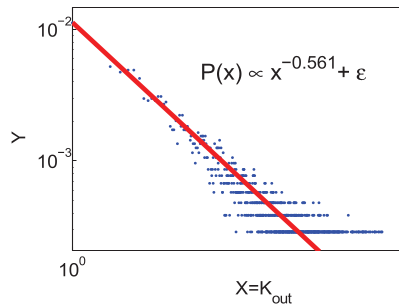
As shown in the charts below, NCBM's generated network (Top) closely mirrors the real-world Zipf distribution, while distance-based models (Bottom) create an inaccurate bell curve.
2. Accuracy Metrics
When measuring the error (RMSE) in predicting the geographical distribution of followers:
- Distance-Based: 5.73e-6 (Highest Error)
- Rank-Based: 7.20e-8
- NCBM: 1.29e-8 (Lowest Error)
NCBM provided a significantly better fit, proving that considering multiple mobility centers is vital for understanding MSN dynamics.
Critical Analysis & Conclusion
The NCBM model is a major step forward for Mobile Social Networks. By bridging the gap between "footprints" (GPS/Check-in data) and "friendship" (Social graphs), it provides a mathematical foundation for better location-based recommendations.
Limitations: The paper primarily uses check-in data, which can be sparse or biased (people only check in at "cool" places, not necessarily where they spend the most time). Future work could integrate continuous GPS trajectories or semantic location data (e.g., distinguishing between a "Work" hotspot and a "Gym" hotspot).
Future Outlook: This approach could revolutionize how we think about "digital footprints" in urban planning and targeted advertising, moving beyond where someone is to who they are likely to know.