
Social Gravity & Scaling: Aligning Network Importance with Visual Centrality
Force-Directed Graph Drawing Using Social Gravity and Scaling
2013-01-01
Summary
Problem
Method
Results
Takeaways
Abstract
This paper introduces a novel force-directed graph drawing framework that incorporates "Social Gravity" based on network centrality measures. By assigning mass to vertices proportional to their centrality (degree, closeness, or betweenness), the algorithm naturally places critical nodes at the center of the visualization. The method achieves SOTA aesthetics in social network visualization by combining this gravity with a dynamic scaling technique that significantly reduces edge crossings.
## TL;DR
Graph visualization often struggles to represent the "importance" of nodes without cluttering the screen. This paper presents a refined force-directed algorithm that uses **Social Gravity**—assigning physical mass to nodes based on their **centrality**—to pull key players to the center. By using a **Scaling** technique that gradually introduces gravity, the authors solve the major problem of edge crossings, creating aesthetically pleasing "Lombardi-style" social networks.
## The Core Intuition: Why Gravity Isn't Enough
In a standard Fruchterman-Reingold layout, nodes act like charged particles: they repel each other, while edges act like springs pulling them together. However, this often leads to "straggly" graphs where peripheral components drift away, and important nodes are indistinguishable from the noise.
Researchers have tried adding **gravity** to pull everything toward a center point. The problem? If gravity is too strong from the start, nodes collapse into a tangled mess of local minima—basically, the graph "freezes" before it can untangle itself.
## The Innovation: Social Gravity + Dynamic Scaling
The authors propose two major shifts in thinking:
1. **Mass as Centrality**: Instead of uniform mass, a node's mass $M[v]$ is determined by its **Degree**, **Closeness**, or **Betweenness** centrality. This makes the "center" of the drawing a reflection of the "core" of the social structure.
2. **The Scaling Schedule**: gravity is initially set to zero ($\gamma_t = 0$). This allows repulsive forces to push nodes apart and resolve crossings. As the simulation progresses, $\gamma_t$ is ramped up (e.g., in steps of 0.2 up to 2.5), slowly guiding the most central nodes to the center of the disk.

*The modified force equation where $f_g(v)$ is the gravitational pull modulated by mass and the scaling parameter.*
## Experiments: Trees, Forests, and Conspiracies
The algorithm was tested on various structures:
* **Trees and Forests**: Traditional layouts produce elongated "spinaches." Social gravity results in a uniform disk distribution. In forests, it keeps disconnected components from drifting to infinity, placing larger components at the heart of the visualization.
* **Scaling Impact**: The paper demonstrates that without scaling (constant high gravity), large forests become a bird's nest of crossings. With scaling, the layout remains clean.
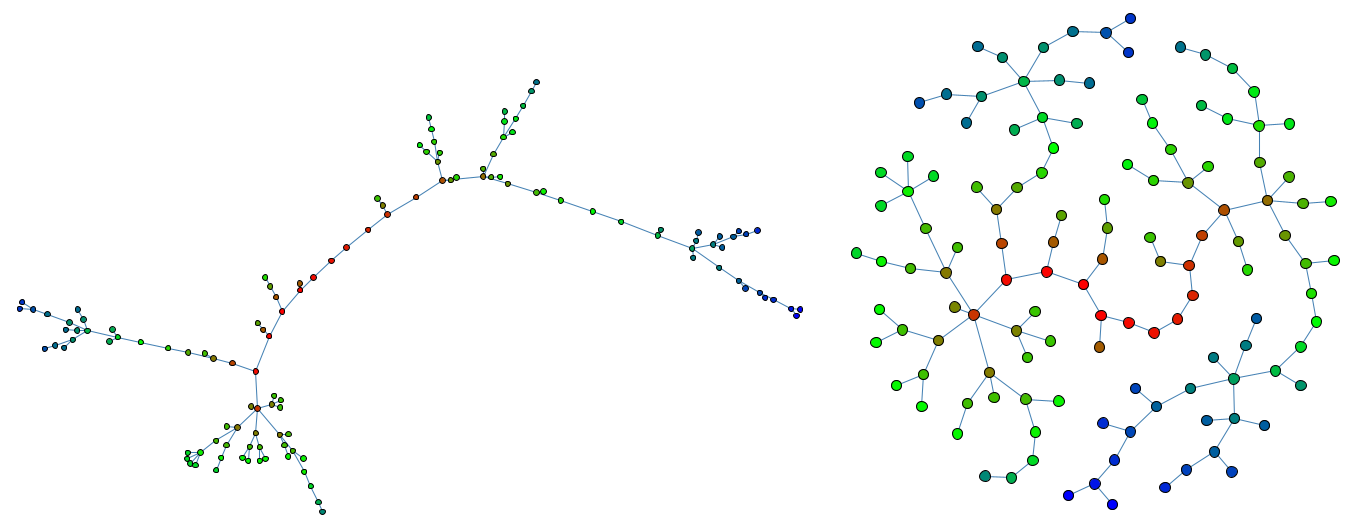
*Fig 2: A tree with 126 vertices. Left: Classical force-based. Right: Scaled Social Gravity.*
## Deep Dive: Lombardi-Style Social Networks
The authors applied their method to the art of **Mark Lombardi**, who hand-drew intricate political conspiracy networks. By combining social gravity with circular-arc edges, the algorithm automates the aesthetic of drawing critical power players at the center of complex webs of influence.
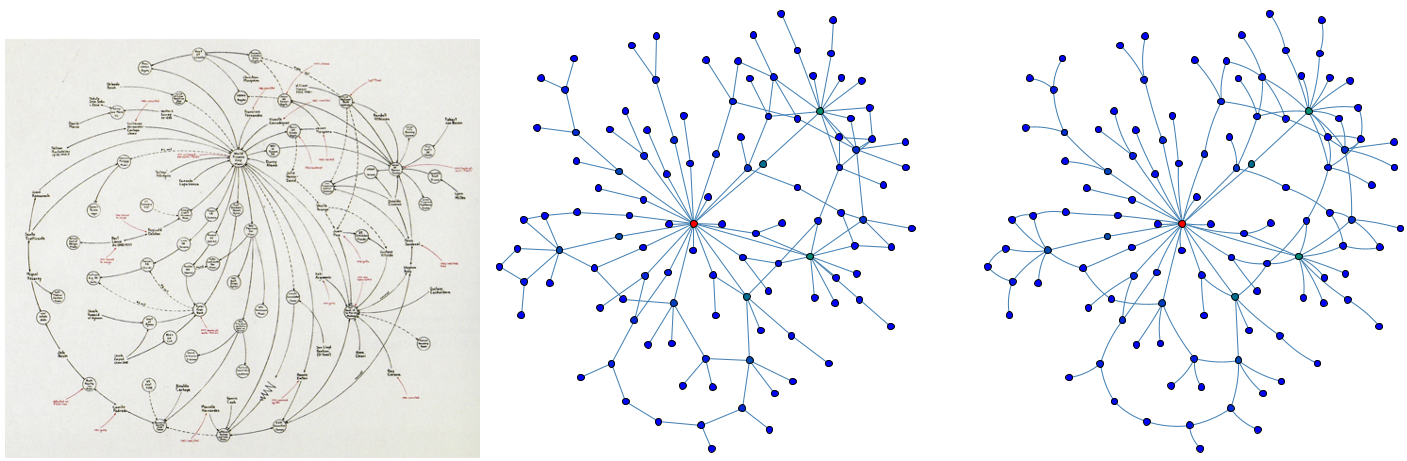
*Fig 8: Lombardi’s "World Finance Corporation." Note how the betweenness centrality gravity (center) pulls the primary entity to the focal point.*
## Critical Analysis & Conclusion
**Takeaway**: This work demonstrates that physical simulations in graph drawing are most effective when they map graph-theoretic properties (centrality) to physical properties (mass). The **Scaling** mechanism is the "secret sauce" that allows these forces to interact without causing topological disasters (crossings).
**Limitations**: The algorithm currently scales at $O(n^2)$, making it potentially slow for massive networks. Future optimizations using N-body simulation methods (like Barnes-Hut) would be necessary to bring "Social Gravity" to the era of Big Data.
**Future Work**: The interaction between Lombardi-style circular arcs and varying edge lengths remains an open research question, as does the optimal tuning of the gravity step function for different graph topologies.