
TrajCast: Revolutionizing Molecular Dynamics with Force-Free Autoregressive Equivariant Networks
Force-free molecular dynamics through autoregressive equivariant networks
TrajCast is a transferable, force-free molecular dynamics (MD) framework based on autoregressive equivariant message passing neural networks (MPNNs). It directly predicts atomic positions and velocities at time-steps 10–30x larger than traditional MD, achieving state-of-the-art efficiency in generating long-range trajectories for molecules, crystals, and liquids.
TL;DR
TrajCast is a breakthrough framework that liberates Molecular Dynamics (MD) from the "time-step prison." By training an equivariant message passing neural network (MPNN) to directly predict the next state (positions and velocities) of a system, it achieves stable simulation steps 30 times larger than traditional methods. Whether it’s a small paracetamol molecule or a massive quartz crystal, TrajCast maintains physical accuracy without ever calculating a single interatomic force.
Background: The Time-Step Bottleneck
In the world of computational chemistry, we are often stuck in a trade-off between accuracy and timescale. To simulate a protein folding or a crystal phase transition, we typically use Machine Learning Interatomic Potentials (MLIPs) to get ab-initio quality forces. However, even with fast forces, we must integrate the equations of motion using tiny steps (often 0.5 femtoseconds) to prevent the simulation from "exploding."
TrajCast's core insight is simple yet radical: Why calculate forces at all? If we can learn the mapping from to directly, we can skip the integration bottleneck entirely.
Methodology: Equivariance and Momentum Conservation
TrajCast isn't just a black-box regressor; it is built on the rigorous principles of E(3)-equivariance.
1. Velocity-Conditioned Message Passing
Unlike standard MLIPs that only look at positions , TrajCast treats velocity as a first-class citizen. It uses Spherical Harmonics to embed velocity vectors, ensuring that if you rotate the molecule, the predicted trajectory rotates accordingly.
2. The Architecture
The model uses a series of equivariant convolutions where pairwise messages (topology) are combined with node-based velocity information via Clebsch-Gordan tensor products.
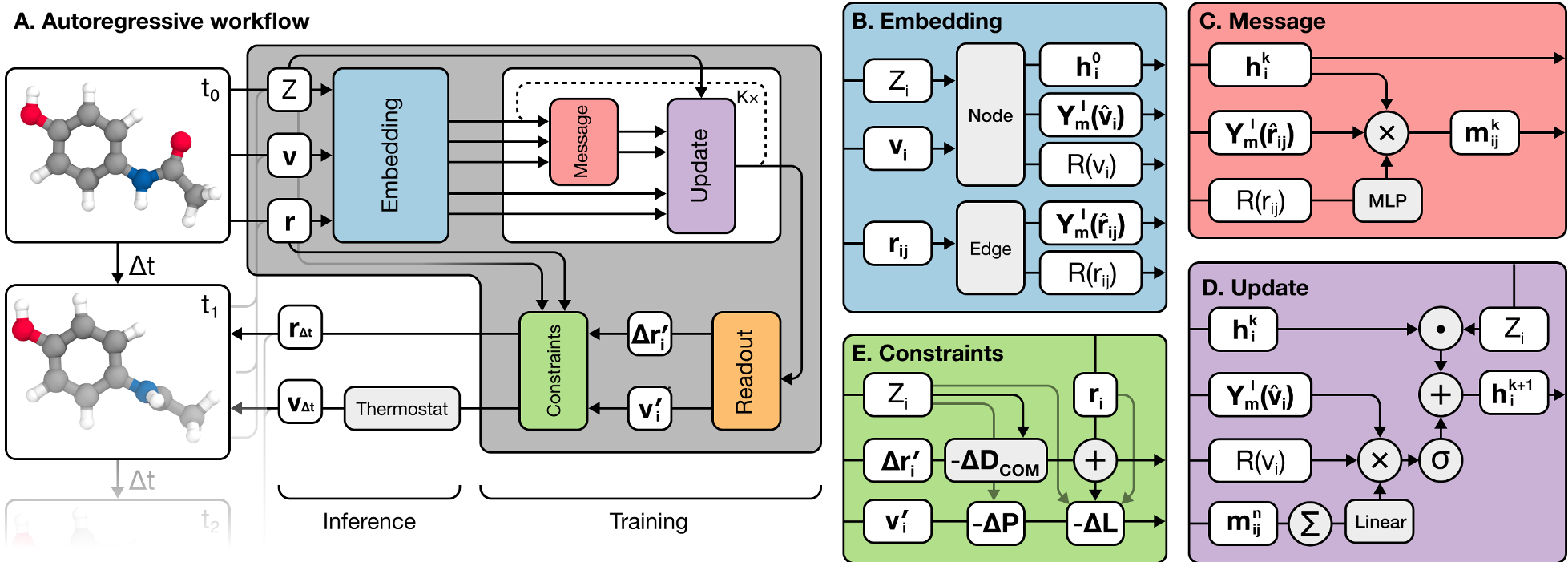 Figure 1: The TrajCast workflow. Note the grey box where the MPNN predicts displacements and updated velocities.
3. Stability via Thermostats
Autoregressive models are prone to error accumulation (drifting). TrajCast solves this by:
- Momentum Refinement: Explicitly removing excess linear and angular momentum.
- CSVR Thermostat: Injecting a slight amount of "noise" via velocity rescaling to keep the system in the Canonical (NVT) ensemble, which also serves to stabilize the roll-out.
Experimental Results: From Molecules to Bulk Matter
The authors validated TrajCast across three distinct regimes:
Paracetamol (Small Molecule)
With a of 7 fs (14x larger than MD), TrajCast reproduced the Vibrational Density of States (VDOS) and the Free Energy Surface (FES) of paracetamol rotations with near-perfect overlap.
α-Quartz (Crystalline Solid)
Crystals have highly correlated atomic motions, allowing TrajCast to push the limits to a 30 fs time-step. This enabled the simulation of 4,300+ atoms at a rate of 15 ns per day—roughly 15x faster than state-of-the-art MLIPs like MACE.
Bulk Water (Liquid)
Water is notoriously difficult due to hydrogen bonding. Even here, TrajCast (at 5 fs steps) captured the Mean Squared Displacement (MSD) and Radial Distribution Function (RDF), though it predicted a slightly more mobile liquid than the MD reference.
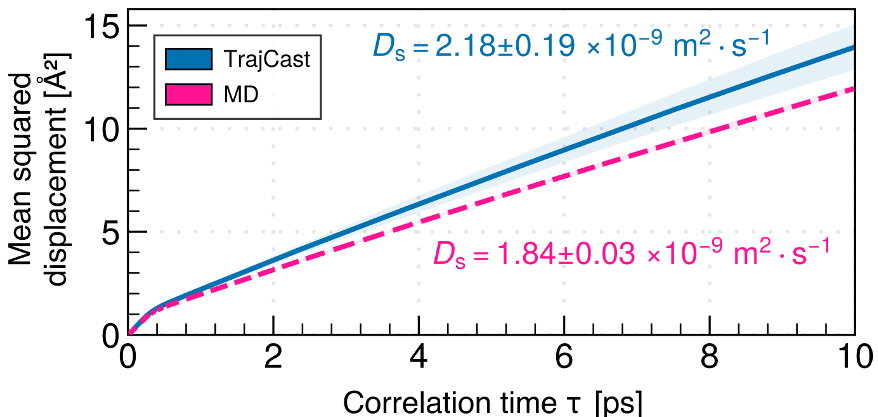 Figure 2: Performance on Bulk Water. The overlap in VDOS (Panel B) and RDF (Panel D) demonstrates that the structural and dynamical "soul" of the liquid is preserved.
Why TrajCast Wins: Data Efficiency
Most generative MD models require hundreds of nanoseconds of training data. TrajCast is remarkably data-efficient, requiring less than 1 ns of reference trajectory. This is because the equivariant MPNN extracts significantly more physical insight from each configuration by incorporating velocity and symmetry constraints.
Critical Insight & Future Outlook
While TrajCast is a leap forward, it has limits:
- Force-related properties: Since it's "force-free," it cannot currently calculate virial stress or pressure (restricting it to NVT/NVE ensembles).
- Extrapolation: The model is trained on a fixed . Future iterations utilizing multi-scale training could allow for variable-speed forecasting.
The Takeaway: TrajCast marks the beginning of the "Generative Physics" era in materials science. By shifting from calculating forces to predicting futures, we can finally bridge the gap between atomic vibrations and macro-scale phenomena.
For those interested in technical implementation, the open-source code is available at IBM's GitHub.