
Ensemble of Classifiers: A Precision Shield Against Corporate Bankruptcy
Forecasting Corporate Bankruptcy with an Ensemble of Classifiers
The paper introduces a specialized ensemble learning framework for corporate bankruptcy prediction, combining the RIPPER rule-induction algorithm with Naive Bayes (NB). By utilizing a cost-sensitive approach on a Greek dataset of 150 firms, the method achieves superior precision in identifying bankrupt entities up to three years before failure.
TL;DR
Predicting financial collapse is a high-stakes game where missing a "bankrupt" signal is far costlier than a false alarm. This paper proposes a unique ensemble of RIPPER (Rule-based) and Naive Bayes (Probabilistic) classifiers. By applying a cost-sensitive logic that penalizes missed bankruptcies, the model provides early warning signals up to three years in advance with significantly higher precision than traditional MetaCost or Voting methods.
The Problem: The High Cost of Silence
In financial lending, not all errors are equal. If a bank identifies a healthy firm as "risky," it loses a small profit. If it identifies a failing firm as "healthy," it loses the entire principal.
The authors identify two major gaps in prior work:
- Data Skewness: Bankruptcies are rare events, leading to imbalanced datasets where standard algorithms favor the majority (healthy) class.
- Rigidity: Individual models like SVM or C4.5 often have a "blind spot"—they are either too aggressive or too conservative.
Methodology: The "RIPPER-NB" Hybrid
The core innovation lies in how the researchers orchestrated their ensemble. Instead of a simple majority vote, they created a specialized logic based on the inherent strengths of different ML families:
1. Feature Engineering & Weighting
The study analyzed 21 financial ratios. Using the ReliefF Score, they discovered that the most critical indicators for the Greek market were:
- WC/TA: Working Capital / Total Assets (Liquidity)
- EQ/CE: Equity / Capital Employed (Capital Structure)
- GRNI: Growth Rate of Net Income (Profitability)
2. The Ensemble Architecture
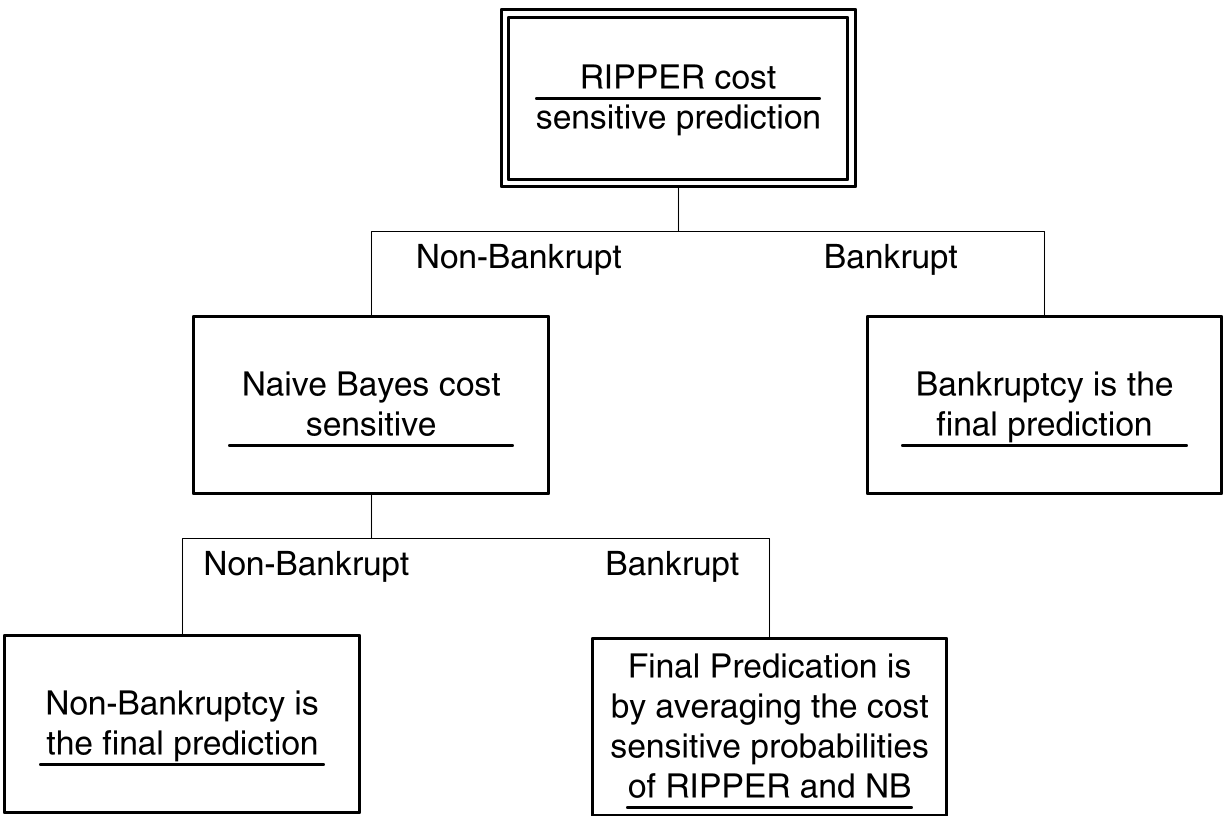
The workflow follows a "Bankrupt-First" logic:
- Step 1: Use RIPPER, which was found to be the most "sensitive" to positive bankrupt cases.
- Step 2: If the case is flagged as healthy, use Naive Bayes to provide a second opinion, as it excels at identifying healthy firms.
- Step 3 (The Tie-Breaker): If conflict remains, the model calculates the Cost-Sensitive Probabilities, applying a 2:1 penalty ratio against missing a bankruptcy.
Experimental Battleground
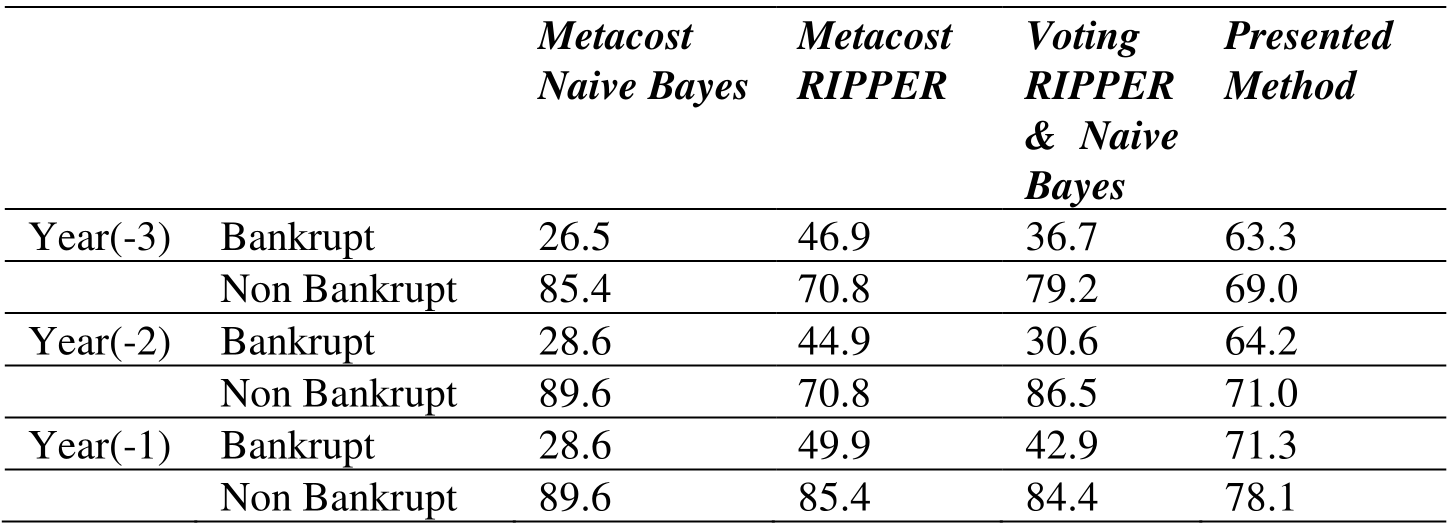
The researchers tested their method against 150 Greek firms over a 3-year lead-up to bankruptcy.
| Method | Year -3 (Bankrupt Pref.) | Year -1 (Bankrupt Prec.) |
|---|---|---|
| Naive Bayes | 26.5% | 28.6% |
| MetaCost RIPPER | 46.9% | 49.9% |
| Presented Ensemble | 63.3% | 71.3% |
Key Findings:
- Stability: While individual models' performance fluctuated wildly across the three-year window, the ensemble remained consistently high.
- Early Warning: Even three years before the actual filing (Year -3), the ensemble maintained a 63.3% precision, providing a substantial lead time for creditors to take action.
Critical Insight & Conclusion
The study proves that in financial forecasting, the "How" of combining models is more important than the "Which." By understanding that RIPPER is an aggressive "hunter" of failure and Naive Bayes is a cautious "guardian" of health, the authors created a system that balances the two.
Limitations & Future Work
- Sample Size: With only 150 firms, the model might require further validation on larger, international datasets.
- Qualitative Data: The current model relies purely on hard financial ratios. The authors admit that incorporating "soft" data like management reputation or market sentiment could further sharpen the predictions.
Final Takeaway: For fintech developers and risk officers, this paper serves as a blueprint for building "Safe-by-Design" AI that respects the asymmetrical costs of financial failure.