
Forecasting the Frontier: When Will AI Agents Outperform Human Engineers?
Forecasting frontier language model agent capabilities
This paper presents a rigorous framework for forecasting the "frontier" capabilities of LLM agents in specialized domains like software engineering and cybersecurity. By evaluating six different forecasting pathways, the authors identify that a two-step approach (Release Date → Elo → Benchmark) provides high predictive accuracy, projecting that SOTA agents could reach an 87% success rate on SWE-Bench Verified by early 2026.
Executive Summary
TL;DR: How quickly are AI agents evolving from chatbots into autonomous engineers? This paper formalizes the art of "forecasting the frontier," moving beyond average model stats to predict the capabilities of the world's most powerful AI systems. By utilizing public data like release dates and Chatbot Arena Elo ratings, the authors project that SOTA AI agents will reach a staggering 87% success rate on the SWE-Bench Verified software engineering benchmark by early 2026.
Strategic Positioning: This work bridges the gap between theoretical scaling laws and practical societal preparedness. It moves the conversation from "how big can models get" to "when will models be able to autonomously execute a developer's job?"
The Problem: Why Accurate Prediction is Getting Harder
Traditional forecasting relies on knowing the "ingredients" of a model—specifically FLOPs (compute) and parameter counts. However, as the industry becomes more proprietary, these numbers are becoming "dark matter." Furthermore, current scaling laws often fail to account for:
- Frontier vs. Average: We care about what the best model can do, not what the average open-source model does.
- Agentic Interaction: Agents operate in loops, making standard "one-shot" benchmarks like MMLU insufficient for measuring real-world utility.
- Elicitation Gap: A model's raw capability (intelligence) is often bottlenecked by its "scaffold" (how it's prompted and what tools it has).
Methodology: The Power of Two-Step Forecasting
The authors compared "One-Step" approaches (Directly predicting performance from Date/FLOPs) against "Two-Step" approaches. The Two-Step method is inspired by the physics of intelligence: there is a latent "general capability" factor that grows linearly, which then translates into benchmark performance via a sigmoid (S-curve) function as tasks saturate.
The Winning Recipe: Release Date → Elo → Benchmark
While PC-1 (the first principal component of benchmarks) was theoretically the strongest, Chatbot Arena Elo emerged as the most practical intermediate metric. Why? Because Elo reflects human-perceived "smartness" and is available for almost every frontier model.
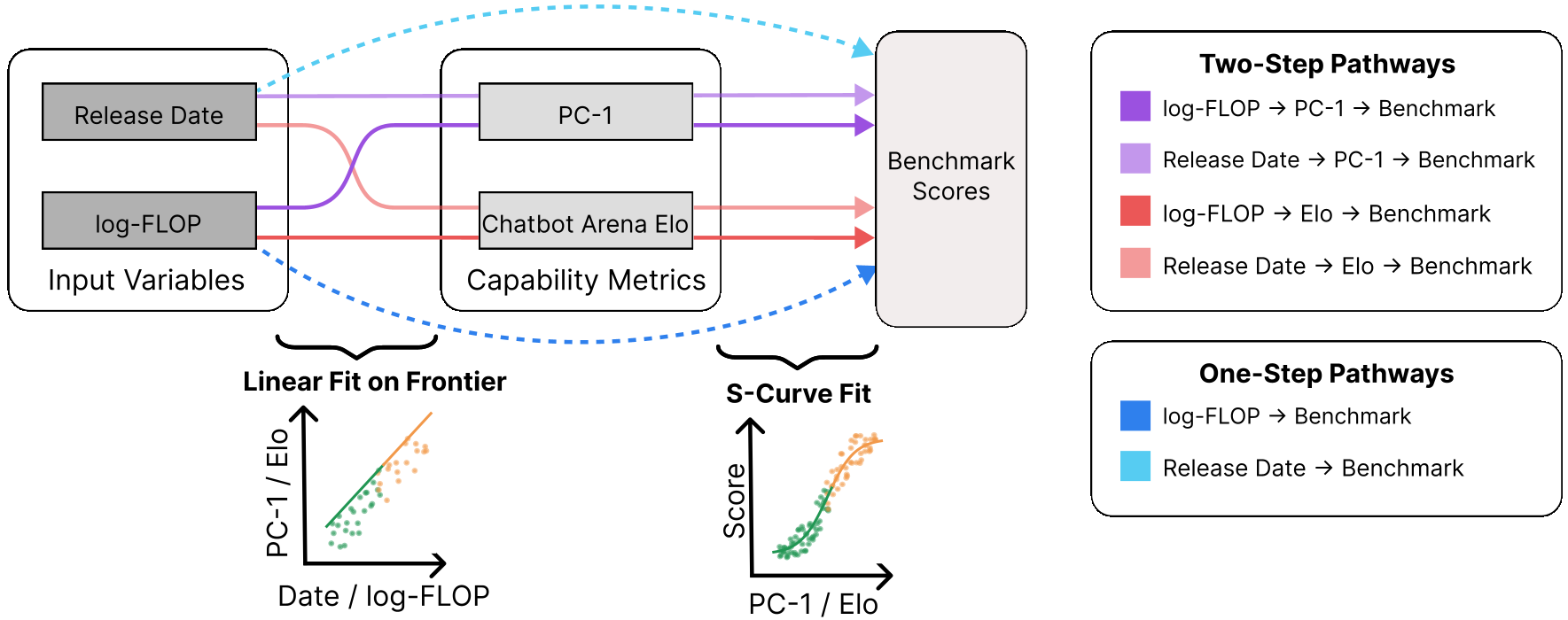 Figure 1: The six evaluated pathways. The red/purple two-step paths provide a "regularization" effect that makes data-scarce frontier forecasting more stable.
Experimental Results: The 2026 Milestone
The authors backtested these methods on 38 models from the OpenLLM Leaderboard v2. They found that Release Date is a surprisingly potent predictor—not because dates create intelligence, but because they serve as an aggregate for algorithmic progress and hardware expansion.
Agent Capability Projections
The study applied the validated model to three major "agentic" benchmarks:
- SWE-Bench Verified: Real-world GitHub issue resolution.
- Cybench: Cybersecurity Capture-The-Flag (CTF) tasks.
- RE-Bench: ML Research & Development tasks.
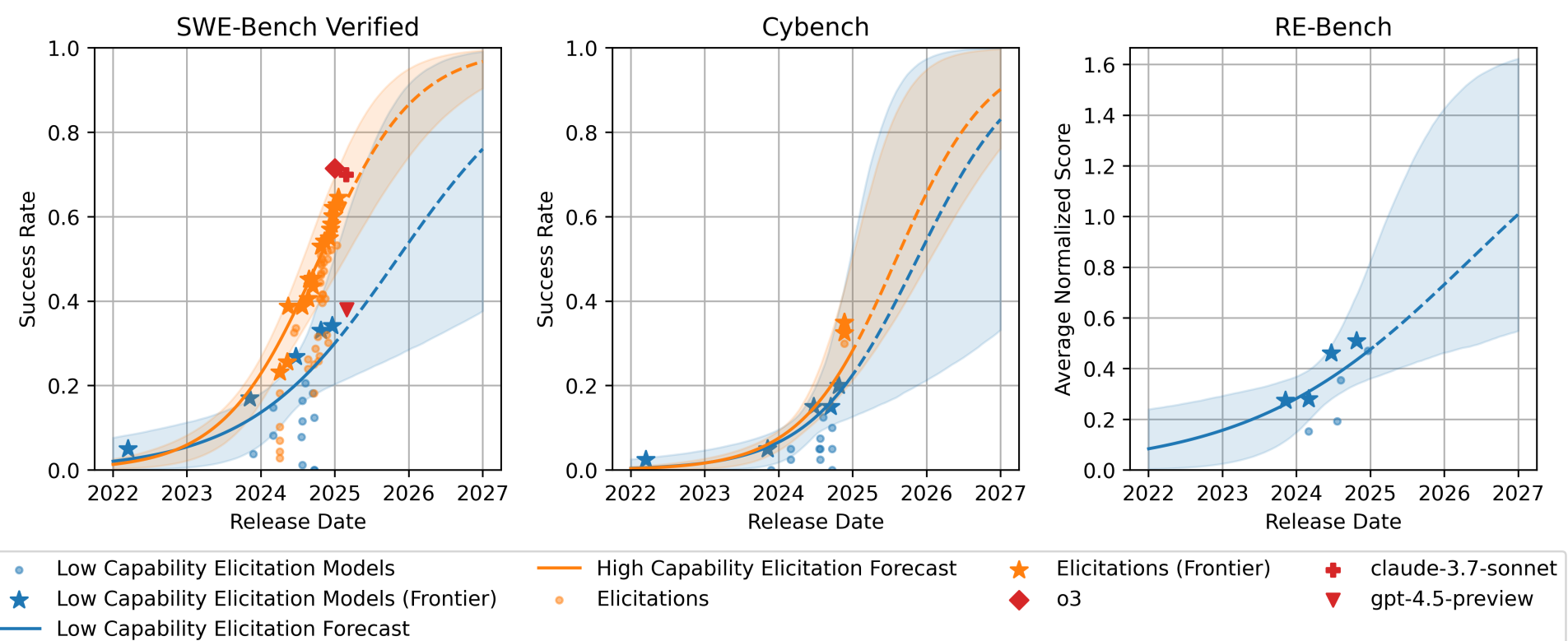 Figure 2: Forecasts for SWE-Bench and Cybench. Note the gap between "Low-Elicitation" (basic scaffolds) and "High-Elicitation" (optimized SOTA scaffolds).
Key Findings:
- SWE-Bench: Current SOTA agents (with high elicitation) are already on a trajectory to solve ~87% of verified software bugs by early 2026.
- The Scaled Compute Mystery: In Figure 3 (below), we see that Elo and PC-1 grow linearly with log-FLOPs (), confirming that "throwing compute at the problem" remains a highly predictable way to gain general intelligence.
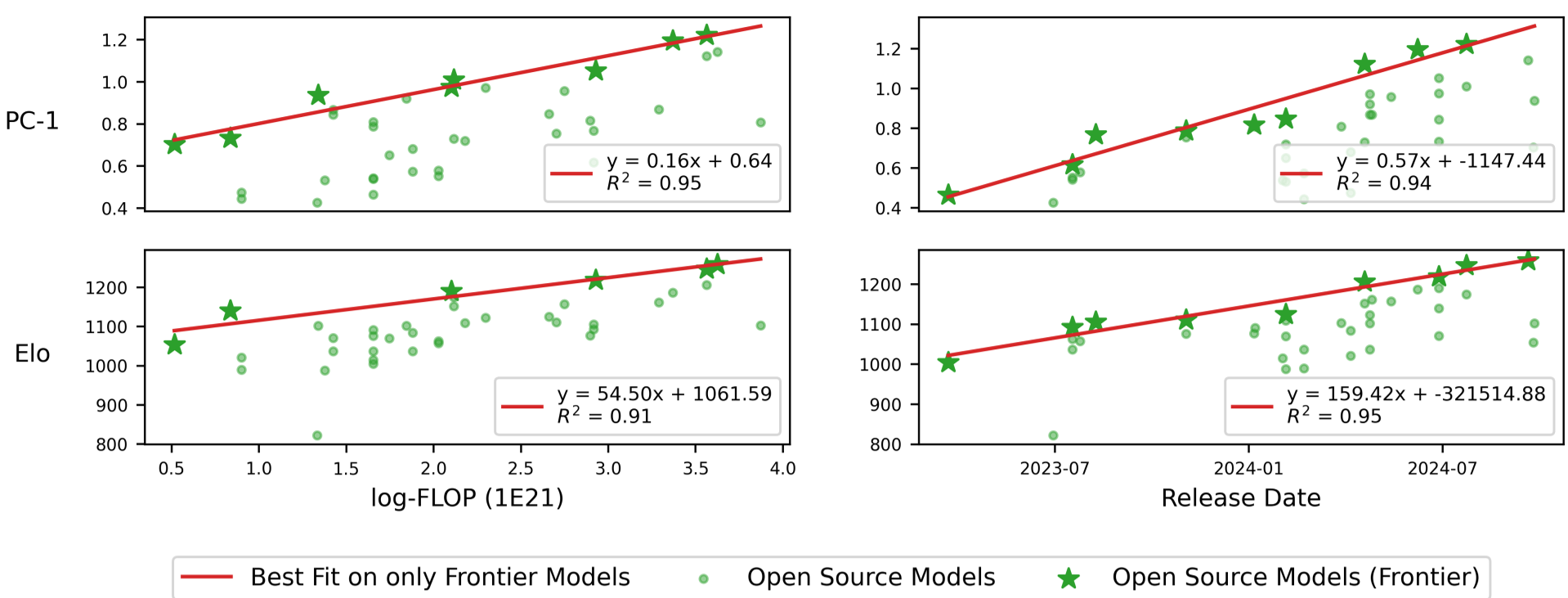 Figure 3: Mapping input variables (FLOPs/Date) to latent capabilities (Elo/PC-1). The linear fit is remarkably consistent.
Deep Insight: The "Elicitation" Variable
One of the paper's most critical insights is the distinction between Raw Intelligence and Elicited Performance. An agent's success isn't just about the LLM; it's about the "scaffold" (the Bash shell, the file editor, the retry logic). The "High-Elicitation" forecast suggests that as our scaffolding techniques catch up with our models, we will see jumps in performance that look "emergent" but are actually just the result of better tool usage.
Critical Analysis & Limitations
While the data is compelling, the authors acknowledge a major "Black Swan": Inference-Time Scaling.
- The o1 Paradigm: Models that "think" longer at inference time (like OpenAI's o1) may break these release-date-based scaling laws.
- Conservatism: Because the study fits its models primarily on "pre-training" era data, its 2026/2027 predictions might actually be too slow. We might hit these thresholds much sooner if "thinking" compute scales as effectively as "training" compute.
Conclusion: A Ready-for-Agent World?
This paper serves as a technical signal for industries to prepare. If AI can solve nearly 90% of verified software issues within 18 months, the bottleneck for software development will shift from "coding" to "system design and verification." The predictability of these "frontier" capabilities suggests that the era of autonomous AI employees is not a distant possibility, but a scheduled arrival.